

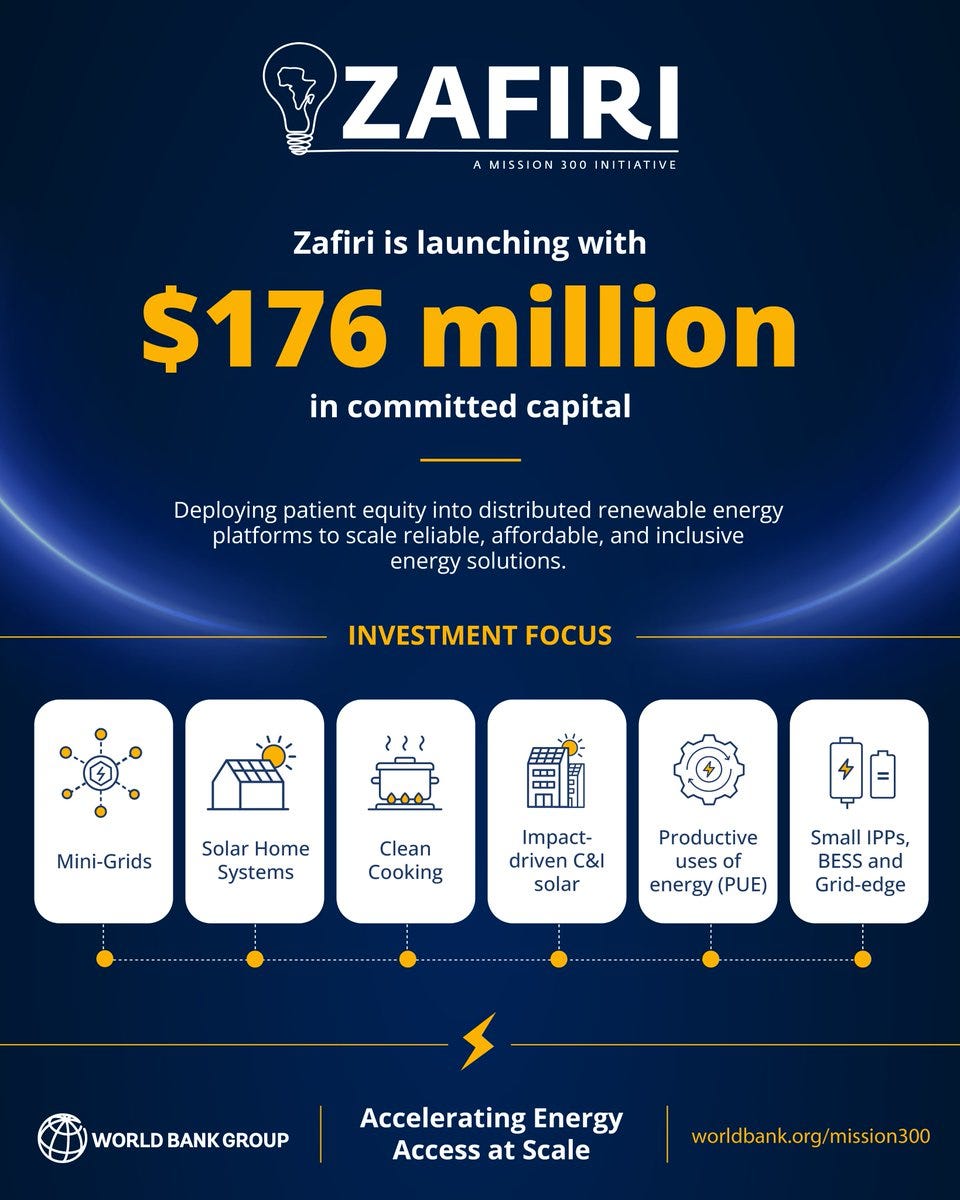
On 16 June 2026, Inspired Evolution announced the $176 million commercial launch of Zafiri, a blended permanent-capital vehicle backed by IFC, the African Development Bank Group, The Rockefeller Foundation, and FirstRand, designed to channel long-term equity into distributed renewable energy across sub-Saharan Africa. It aims to reach $300 million at final close and $1 billion over its lifetime. The AfDB, which helped structure it, describes it as the largest long-term equity commitment made to Africa’s distributed renewable energy sector, or DRE sector to date.
It is also, if you read it carefully, a $176 million institutional admission that the existing financing architecture is broken.
Not because the money is unimportant. The money matters enormously.
But because the shape of the money tells you what the market has been missing: patient capital, platform capital, and structures built for distributed assets that do not fit neatly inside traditional project finance.
I need to correct something.
In Part 1 and Part 2 of this series, I made the argument that African renewable energy companies keep dying because the market structure is wrong, and that history, from semiconductors to oil and gas to telecoms, tells us exactly what the structural fix looks like. The argument was right. The scope was wrong.
I analysed one-third of the market and presented it as the whole picture. The entire analysis was about C&I solar: developers chasing 500 kW to 20 MW projects for industrial offtakers, navigating project finance structures, dying in the gap between origination and financial close.
But the market is wider than that.
While I was writing about the missing middle in C&I finance, Nigerian households were adding 803 MW of solar capacity in a single year. A 141 percent year-on-year increase. Africa’s second-largest solar market behind South Africa. Almost entirely self-financed. Almost entirely invisible to the institutional energy conversation.
And the mini-grid sector, the most DFI-discussed segment in all of African energy, had already quietly built the prototype of the structural solution I said was missing.
This piece is about the other two-thirds. Then it is about what would actually fix all of it. Then it is the survival playbook for developers who need to know what Monday morning looks like.
The Residential Boom
Let me start with this incredible number.
Nigeria’s cumulative solar capacity rose from roughly 385 MW in 2024 to nearly 1.19 GW in 2025. Of that, approximately 96 percent is off-grid: solar home systems, private rooftop installations, commercial systems, mini-grids. The utility-scale share is a rounding error.
And here is the data point that should be projected onto the wall of every DFI conference room in Washington and London: formal capital importation into Nigeria’s electricity sector has been declining even as solar panel imports climb significantly. The boom is being financed by Nigerian households and small businesses making individual economic decisions. Not by institutional investors. Not by blended finance facilities.
The market cleared without us.
Two triggers arrived simultaneously in May 2023. Fuel subsidy removal caused petrol prices to rise nearly 500 percent. The national grid collapsed at least ten times in 2024 alone. For Nigerians, a solar panel now pays for itself within six months against diesel costs. Six months is not an investment thesis. It is an emergency decision.
The 6-month payback period is doing more for Nigerian residential solar adoption than twenty years of DFI technical assistance ever did for grid-connected IPPs.
Think about what this means through the Carlota Perez framework from Part 2. The residential solar market has entered the deployment phase without passing through an institutional installation phase. There was no government-sponsored foundry. No IREDA. No SECI auction. No MASEN procurement intermediary. Individual Nigerian households did the installation phase with their own capital, one rooftop at a time, driven by the simple economics of diesel avoidance. This is simultaneously the most impressive and the most fragile form of energy transition imaginable.
Three Markets Pretending to Be One
The residential boom is not one market. Collapsing it into a single category obscures the dynamics that matter.
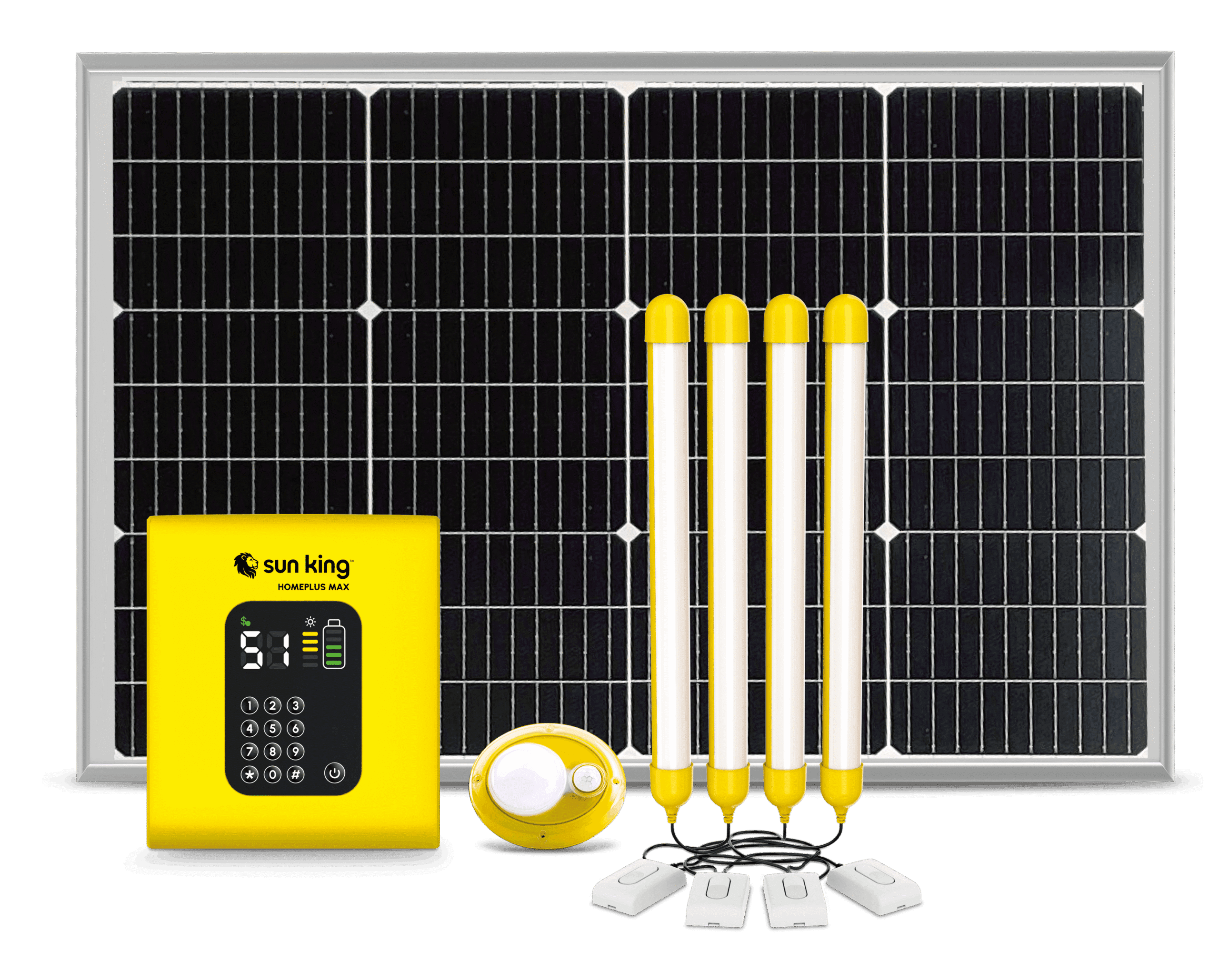
Solar home systems and PAYG. Sun King has sold over 2 million kits in Nigeria, growing from 3,000 kits per month in 2020 to 75,000 per month today. Nigeria is Sun King’s fastest-growing market and shows its lowest rates of non-payment globally. The company operates through more than 45,000 agents across Africa and had extended $1.2 billion in total loans to customers as of May 2025. In May 2025, Sun King closed an $80 million naira-denominated facility with IFC and Stanbic IBTC Bank, explicitly designed to mitigate foreign exchange risk. The World Bank’s NEP programme has delivered over 1.08 million verified standalone solar connections.
These are small systems, 50 to 200 watts, serving households with no or minimal grid connection. But at 75,000 kits per month, Sun King alone is connecting nearly a million Nigerian households per year. That is more connections per year than many African utilities manage.
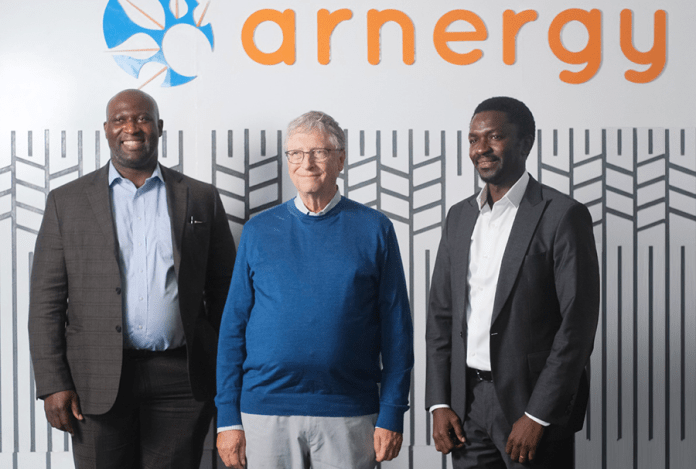
Urban rooftop solar. Arnergy scaled its lease customer base rapidly between 2023 and 2024, deploying over 1,800 systems across 35 Nigerian states, totalling 9 MWp of solar and 23 MWh of battery storage. These are larger systems, 3 to 20 kWp with meaningful battery storage, serving grid-connected households experiencing chronic reliability failure. Battery storage is not optional in this segment. Without it, you have daytime-only power.
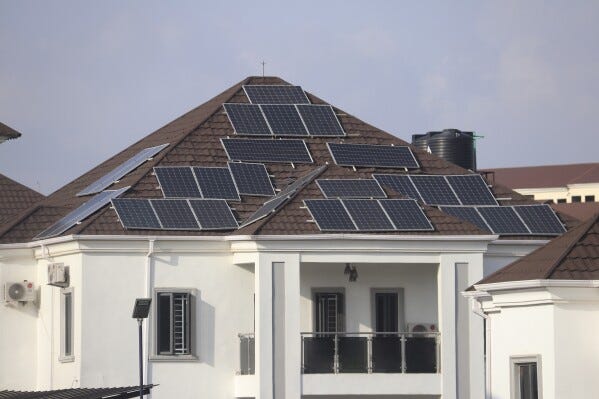
Estate-embedded solar. This is the sub-market I missed entirely, and it is the most structurally interesting. Property developers are now installing large-scale solar as a primary selling point. Solar-powered estates now house approximately 200,000 people across Nigeria, up from fewer than 50,000 in 2020. These developments embed solar at the estate level, typically 200 kWp to 3 MW, with costs recovered through service charges.
Read that again. Property developers have quietly become de facto electricity utilities. They own generation assets. They distribute power within a private boundary. They bill residents through service charges. They are doing everything a DisCo does, but better, within a gated perimeter, without a licence, and funded through real estate economics rather than energy finance.
This is the Samsung-as-IDM problem from Part 2, but in reverse. The estate developer vertically integrates because the specialist electricity market literally does not serve them. Williamson’s transaction cost economics again: when the external market is too unreliable, firms internalise the function. Every estate developer who installs solar is making the same calculation that every African RE developer makes when they try to be an IDM. The difference is the estate developer has a captive offtaker and a real estate margin to absorb the cost.
The Quality Crisis Underneath the Boom
The Nigerian Energy Support Programme reports that up to 40 percent of solar components in the market fail to meet international standards. REAN estimates that nearly 50 percent of installed systems suffer from design flaws: incorrect panel orientation, undersized inverters, insufficient battery capacity. There are over 350 solar installers listed on ENF in Nigeria alone. The vast majority are tiny, uncertified, with no formal training.
A homeowner who spent ₦500,000 on a solar system that stopped working after six months tells twenty people. Those twenty people do not buy solar. The substandard installer has already moved to the next customer. The reputational damage is absorbed by the entire industry.
This is the residential equivalent of the bankability problem in C&I. In C&I, financiers do not trust the project data. In residential, consumers do not trust the product and the installer. Both are information and trust failures. Both kill the market’s ability to scale. But they manifest differently: in C&I, the trust failure slows down deals. In residential, the trust failure actively destroys demand.
The Cleantech 1.0 parallel from Part 2 is instructive here. The MIT study found that 90% of cleantech companies funded after 2007 failed because they were hardware companies trying to compete in a commoditised market. The Nigerian residential solar market has the same commodity problem. Panels are panels. The differentiation is in installation quality, system design, and after-sales service. But there is no market infrastructure to signal quality. No installer certification that consumers trust. No system passport that a secondary buyer could evaluate. No warranty enforcement mechanism. The quality crisis is the residential version of the missing foundry.
The Mini-Grid Frontier: The Foundry That Already Exists
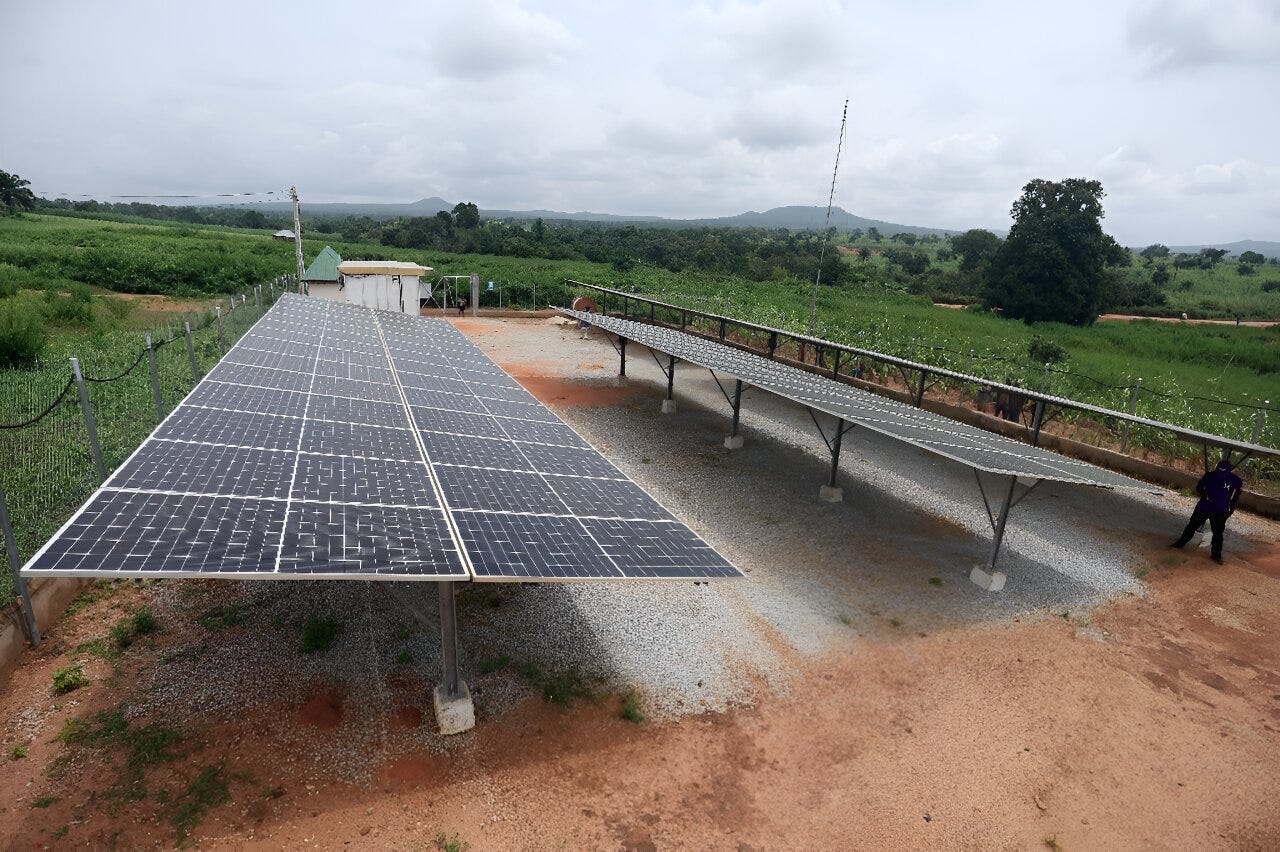
The World Bank estimates Sub-Saharan Africa needs 160,000 new mini-grids to achieve universal access by 2030. As of 2024, AMDA members had deployed roughly 600. That is 0.4 percent of the stated target with fewer than five years remaining.
That is not a miss. It is a structural failure that has been building for a decade.
CAPEX for mini-grids in Africa has declined about 20 percent since 2020, to a four-year average of $6,824 per kWp. That is more than double the global benchmark of $3,000 per kWp. Average consumption per customer is only 6.1 kWh per month across the continent. At $0.30/kWh, a household is paying roughly $1.80 per month. The only way the maths works is productive use: commercial anchor loads like grain mills, cold storage, water pumping, and small manufacturing that generate 10 to 50 times the revenue of a pure residential connection.
But here is what changed my understanding of the whole thesis.
The mini-grid sector has already built the structural solution I said was missing in C&I. It just built it quietly, without anyone using the semiconductor analogy to describe it.
CrossBoundary Energy Access is Africa’s first project finance facility dedicated to mini-grids. Their model: CBEA finances construction and owns the assets. The developer focuses on origination, community engagement, and operations. The developer retains a minority equity stake and the O&M contract. In January 2026, CBEA completed the first acquisition of an operational mini-grid platform, ANKA in Madagascar, with the developer retained as minority shareholder and operator.
Map it to the semiconductor analogy. CBEA is the foundry. It provides the capital-intensive manufacturing capacity, asset ownership and balance sheet, that individual developers cannot afford. The developer is the fabless designer. They bring the knowledge-intensive, relationship-intensive, local capabilities. CBEA owns the assets. The developer retains the IP equivalent: local knowledge and operational expertise, and a carried interest in the asset they originated.
This is the TSMC model for distributed energy. Beyond conceptual. Beyond just a proposal. Operating.
Husk Power operationalised the other half: the productive use anchor load thesis. Their deal with Olam Agri, a 1.3 MW solar system with 860 kWh BESS under a 10-year PPA for a rice farm in Nasarawa State, is a C&I solar project sitting inside a mini-grid portfolio. The anchor industrial load subsidises the community residential tariff while generating higher-margin C&I revenue.
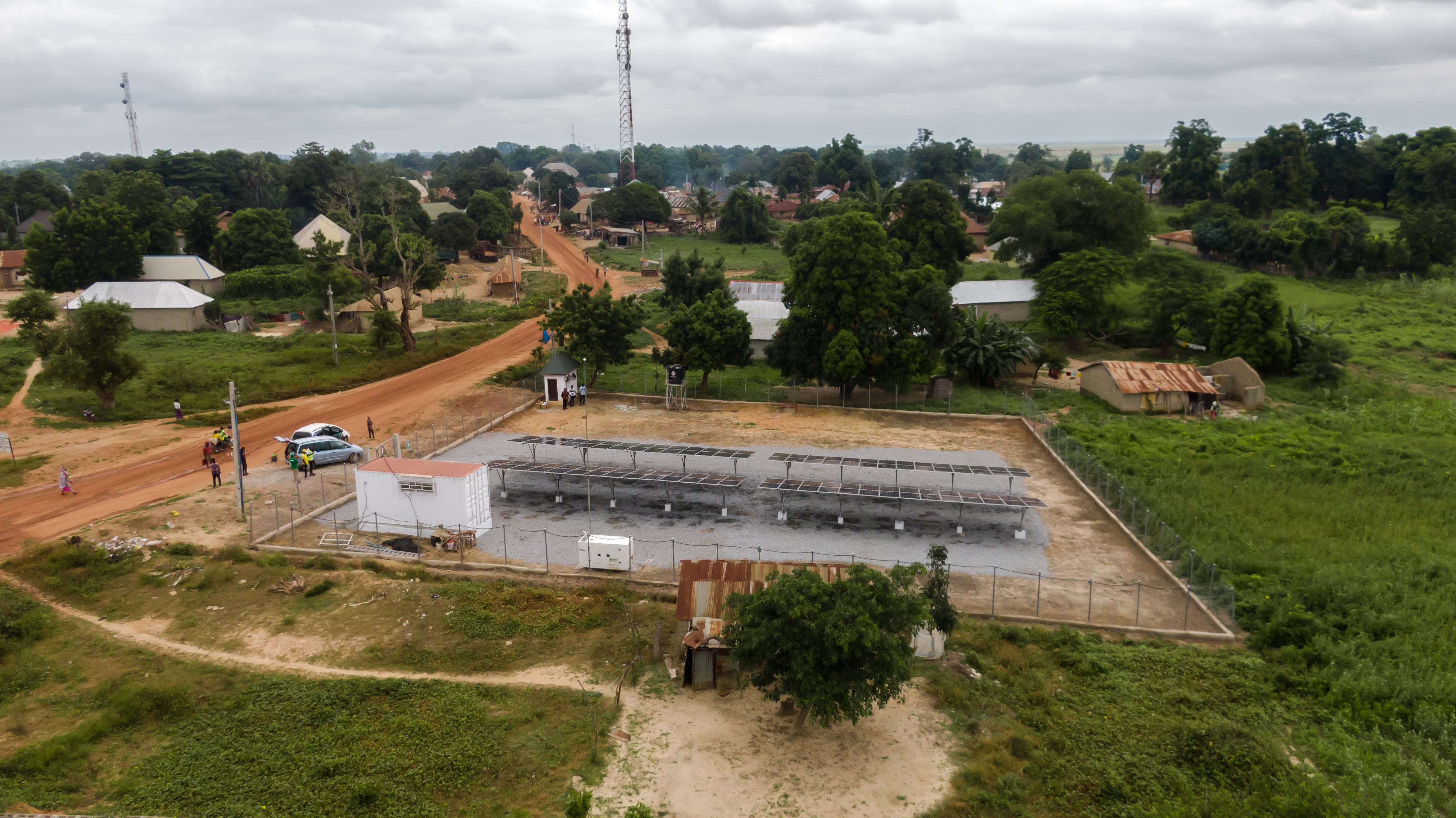
And the regulatory infrastructure is catching up. Nigeria now has more than 1,000 deployed mini-grids, with more than half financed through the REA. The December 2025 commercial framework for interconnected mini-grids establishes, for the first time, a clear commercial relationship between mini-grid operators and distribution companies. NERC’s 2026 regulations expand allowable interconnected mini-grid capacity to 10 MW. The $750 million DARES programme targets 1,350 solar mini-grids, including 250 interconnected systems. A developer who has been hesitating on interconnected sites because the commercial terms with the local DisCo were undefined now has a regulatory basis for those negotiations. That window is open now.
Three Markets, One Root Cause
Step back and look at all three segments together.
C&I’s problem: financiers do not trust the project data, so deals do not close.
Residential’s problem: consumers do not trust the product and installer, so bad installations proliferate and demand is poisoned.
Mini-grids’ problem: developers cannot predict demand accurately, investors cannot assess risk without historical comparables, so capital stays on the sidelines.
All three are data and trust failures. Different manifestations. Same root cause. The absence of standardised, verified, Africa-specific energy data infrastructure.
Khanna and Palepu’s institutional voids framework from Part 2 explains this precisely. In emerging markets, the absence of credit bureaus, contract enforcement, quality certification, and professional intermediaries forces every firm to fill those voids individually. In the Nigerian energy market, every C&I developer builds their own financial model from scratch. Every residential installer self-certifies. Every mini-grid developer conducts their own demand assessment. Each is independently solving the same information problem at enormous individual cost.
A C&I project needs a verified asset record. A residential installation needs a system passport. A mini-grid needs a community energy profile. All three data products share common underlying infrastructure: grid reliability data, solar irradiance data, equipment performance benchmarks, regulatory frameworks, fuel pricing.
And here is the network effect that makes this genuinely interesting. A platform serving only C&I has maybe 500 data points. One that serves C&I plus residential has 50,000. One that serves all three segments has 100,000 data points spanning urban industrial zones, suburban residential areas, and rural communities. The intelligence gets more accurate. The benchmarks get more meaningful. The carbon portfolio gets commercially viable.
The residential market is where the data volume lives. Mini-grids are where the data diversity lives. C&I is where the data value per record is highest. Together, they create a dataset that no single segment could produce alone.
The data infrastructure IS the bankability infrastructure. They are the same thing.
What Would Actually Fix This
Enough structural analysis. Not more accelerators. Not more pitch competitions. Not more capacity building workshops. Actual structural interventions that change the economics of being a small developer.
A development finance facility at the right ticket size. The single biggest killer of small developers is the development phase: $20,000 to $50,000 per project for feasibility, site assessment, legal documentation, and financial modelling. If the project does not close, that money is gone. What would work: a revolving development finance facility, capitalised by DFIs or philanthropic capital, providing $20,000 to $100,000 in recoverable grants. If the project reaches financial close, the facility gets its money back. If it fails, the loss is absorbed. For mini-grids, the window needs to be larger, $50,000 to $150,000. For residential installers, the equivalent is a revolving inventory credit line secured against PAYGO receivables. ETAFA Nigeria’s $50 million local currency fund, where $10 million in GEAPP concessional capital catalyses $40 million in commercial finance, demonstrates the leverage ratio works. The missing piece is ticket size: ETAFA is still structured for medium-scale projects, not the $20,000-$50,000 development phase.
Zafiri is important here because it shows the capital stack is beginning to move in the right direction: patient, blended, permanent capital aimed at distributed renewable energy rather than only large grid-connected infrastructure. But vehicles like Zafiri will still face the same market-structure question. How do they find, compare, diligence, price, and monitor hundreds or thousands of small distributed assets without recreating the same bespoke due-diligence burden deal by deal?
That is where the foundry thesis comes back. Patient capital helps. But patient capital still needs trusted project data, standardised documentation, verified demand, equipment quality signals, and operating benchmarks. Otherwise, it simply becomes patient capital waiting patiently for bankable projects to appear.Standardised documentation that nobody has built. Every small developer is reinventing the wheel on every deal. A lawyer for the PPA: $5,000 to $10,000. A feasibility study: $10,000 to $20,000. A financial model from scratch. Each a fixed cost that a platform company has already amortised across fifty deals. What would work: open-source standardised PPA templates in naira and USD, bankable feasibility study templates, financial model templates with pre-built assumptions. For residential: standardised system sizing methodology, installation checklists, commissioning test procedures. For mini-grids: five to ten reference designs for common community sizes. If you can collapse the development cost of a 500 kWp C&I project from $50,000 to $15,000, you have tripled the number of projects a small developer can pursue with the same balance sheet. This sounds boring. It is boring. It is also the single most powerful cost reduction available. Germany’s Sparkassen did not fund the Energiewende because they were innovative lenders. They funded it because the 20-year FIT made the lending decision boring. The African energy sector needs the same boring standardisation.
An equipment purchasing consortium. A small developer buying 500 kW of panels pays 15 to 25 percent more per watt than Starsight or BECS buying 50 MW. That margin difference alone can make a project uncompetitive. A purchasing cooperative where 20 to 30 small developers aggregate their annual equipment needs. Agricultural cooperatives have done this for a century. The REA model of aggregating demand across 1,350 mini-grids under DARES is the same logic at the programme level. The solar industry just has not built it at the developer level yet.
State-level registration with fast-track permitting. The Electricity Act 2023 is the single biggest structural opportunity for small developers. Fifteen Nigerian states have transitioned to independent electricity regulation as of early 2026. LASERC inaugurated its board in March 2026. A state-level registration system where developers meeting minimum criteria get pre-approved, with fast-track permitting, 30 days instead of six months, and access to a state-maintained database of potential sites and offtakers. This is directly analogous to how the marginal field programme worked: reduced entry barriers, simplified terms, starter opportunities. For residential, this translates to installer licensing that creates a quality floor protecting consumers and rewarding good installers. Nigeria’s solar manufacturing capacity has already grown from 120 MW to roughly 300 MW, with 3.7 GW in the pipeline and locally produced panels now being exported from Lagos to Accra. The state-level market infrastructure needs to keep pace.
A deal exchange connecting originators to capital. Small developers have deals but no capital. Platform companies have capital but struggle with origination. What would work: a platform where a developer uploads a standardised project package and qualified financiers or platform companies review and bid. The developer retains a carried interest or development fee. This is the direct translation of the oil and gas farm-in/farm-out structure from Part 2. A developer who secures an offtake agreement and permit for a 2 MWp project has created $50,000 to $100,000 of development value. Instead of trying to raise the full $2 million, they farm out to a platform company. The developer retains 10 to 20 percent and the O&M contract. For mini-grids, this is exactly what CBEA is already building.
Market infrastructure for energy trading. When diesel has a market price and solar electricity does not, banks will always find it easier to lend against diesel. The NBET-to-NENEX transition, modelled on India’s IEX which has over 8,100 participants including more than 2,100 renewable generators, creates the possibility of transparent price signals for generated electricity. Once electricity has a visible spot price in naira, lending against solar output becomes dramatically simpler for Nigerian banks. The analogy to oil is direct: the reason oil companies can borrow against reserves is that there is a transparent, liquid market for their output. Nigeria’s equivalent does not yet exist.
Data infrastructure that makes the whole market bankable. This underpins everything else. A standardised data schema for African energy assets, a common format defining exactly what information is needed to describe a project at every stage of its lifecycle, with provenance tracking for every data point. A residential system passport with verified component quality and installer credentials. A mini-grid community energy profile with verified demand data. If a critical mass of projects were described in a common format, the entire financing ecosystem would become more efficient. Lenders could compare projects on a standardised basis. Insurers could build actuarial models. Carbon auditors could verify emission reductions against structured records. Secondary market buyers could evaluate assets with confidence. The M-KOPA model from Part 2 proved this at consumer scale: the embedded GSM chip and daily M-Pesa payments created the information infrastructure that made un-bankable transactions bankable. The C&I and mini-grid sectors need the same thing at project scale.
The Survival Playbook for Developers Who Are Still Standing
While the ecosystem interventions above get built, and they will take years, small developers need to survive today. Here is the honest playbook.
Rule One: No offtake commitment, no spend. Ever. Before spending money on an energy yield assessment, a grid connection study, legal structuring, an ESIA, or a full feasibility report, you need a signed letter of intent from a creditworthy offtaker. Not a warm conversation. Not an expression of interest. A signed document from someone with a balance sheet. The LOI is not just a commercial milestone. It is a financing instrument. Get it first. Never before it.
Rule Two: Structure as a service company that also develops. Pure development companies have no recurring revenue between financial closes. Every month of pre-development is a month of cash burn with nothing coming in. A developer structured as an energy services company, with O&M contracts, energy audits, feasibility consulting, technical advisory work, generates monthly income that funds the development activity. The O&M contracts build a track record. The feasibility studies build client relationships. The service revenue keeps the company alive during the long stretches between closings. This is the Cleantech 1.0 survivor lesson from Part 2: Opower and First Solar survived because they had services layers and recurring revenue, not because they had better technology.
Rule Three: Use the consortium SPV model. Two or three small developers who each have one anchor client relationship but neither has the balance sheet to reach financial close should form a consortium SPV. Pool your pipelines. Approach a European, Asian, or Middle Eastern energy company that wants African exposure but cannot originate locally. The foreign partner provides 60 to 70 percent of the equity. The local developers retain 30 to 40 percent of a transaction much larger than either could have done alone. This is the Seplat model precisely transposed. Platform Petroleum spent years building a track record on a marginal field before the Shell divestment opportunity came. The consortium SPV is the marginal field for small solar developers.
Rule Four: For mini-grids, do not develop without an anchor load. An agro-processor, a cold chain facility, a fuel station, a telecoms tower cluster. Identify the anchor first. Structure the PPA with the anchor load first. Size the system for the anchor. Treat the community residential connections as both a social benefit and a revenue diversification. This is the Husk/Olam Agri model at smaller scale.
Rule Five: Get a Lagos Electricity Market licence now. LASERC inaugurated its board in March 2026. Lagos is the obvious example because LASERC inaugurated its board in March 2026 and is now a live regulatory body. But the opportunity is no longer Lagos-only. Under the Electricity Act 2023, several Nigerian states have transitioned to regulating their own intrastate electricity markets, with state electricity regulators taking over from NERC for local market activity.
Under the Electricity Act 2023, several Nigerian states have transitioned to regulating their own intrastate electricity markets, with state electricity regulators taking over from NERC for local market activity.
So the instruction is not simply “get a Lagos licence.” It is: map your pipeline against the new state electricity markets, understand which regulator now controls intrastate activity in each state, and get properly registered or licensed where required.
The cost of being early is usually small compared to the strategic value of being a recognised participant while market rules are still being written. Developers who are visible during market formation have standing to push for practical licensing categories, simplified permitting, standardised documentation, reserved procurement windows, and fair treatment for small distributed-energy players.
Those who wait until the rules are locked may find themselves subject to a market structure they had no hand in shaping.
Rule Six: Target the prosumer gap. NERC’s final Net Billing Regulations 2026 apply to systems between 50 kWp and 1.5 MWp. Earlier drafts contemplated up to 5 MWp, but the final framework is narrower. Hospital campuses. University clusters. Gated estates. Large religious institutions. This segment requires enough engineering sophistication to differentiate from residential installers but operates at a scale that Daystar and Konexa cannot cost-efficiently serve. It is precisely the terrain where knowledge beats capital. The Samsung-vs-TSMC lesson: the foundry model requires institutional separation. In the prosumer gap, small developers ARE the foundry. They bring the local knowledge, the relationship, the system design expertise. They just need a capital partner for the asset ownership.
Rule Seven: Document everything obsessively. Your feasibility studies, site assessments, client interactions, regulatory filings. This documentation IS your asset. It is what you bring to a farm-out negotiation, a partnership discussion, or eventually your own fundraise. In the semiconductor analogy, this is your design IP. You may not own the fab. But you own the design.
Rule Eight: Do not die. Keep fixed costs brutally low. Do not hire ahead of revenue. Do not rent an office until you have cash flow from at least one operating project. The developers who survive the next three to five years while the market matures will be the ones who were still standing when the ecosystem catches up. The market is coming. The question is whether you have enough runway to be there when it arrives.
The Bottom Line
The foundry problem has three dimensions, not one.
C&I needs a project development foundry that reduces development costs, standardises documentation, and connects developers to capital. Residential needs a quality and distribution foundry that certifies installers, ensures equipment quality, and provides consumer financing infrastructure. Mini-grids need an integrated delivery foundry that standardises designs, aggregates portfolios, and manages the complex interplay of subsidy, tariff, and grid arrival risk.
All three need shared data infrastructure. All three benefit from the same network effects. All three are currently being served by different companies, different programmes, and different investors who mostly do not talk to each other.
The semiconductor industry did not scale because chip designers got access to more capital on better terms. It scaled because the foundry model separated design from fabrication and routed the right capital to the right function. African renewable energy will not scale because small developers get marginally better access to project finance. It will scale when the architecture changes.
The market structure that will make African renewable energy work at scale is being built right now. Some of it in the Lagos Electricity Market rules. Some of it in the bilateral trading framework. Some of it in the December 2025 interconnected mini-grid commercial framework that almost nobody outside the sector is talking about. Some of it in conversations between developers who have not yet decided to collaborate rather than compete on terrain where neither of them can win alone.
The question is not whether this market will eventually work. It will. The question is who shows up to shape it while it is still being designed, and who arrives after the design is finished and wonders why the structure does not seem to have room for them.
I have been in this market long enough to know which side of that question I want to be on.
This is not a technology problem. It is an architecture problem.
The views expressed here are the author’s own and do not represent the views of his employer.
P.S. On the mini-grid section: I was initially sceptical of the CBEA model because I could not see why a mini-grid developer would voluntarily give up majority ownership. Then I talked to three developers who had spent two years trying to reach financial close on projects they had originated. Two of them had burned through their savings. One had taken a consulting job to pay rent. The question is not “why would you give up equity?” The question is “what is 30% of something versus 100% of nothing?” The Seplat founders did not insist on owning Shell’s entire onshore portfolio. They took what the structure offered and built from there.
P.P.S. The seven interventions section took me longer to write than Parts 1 and 2 combined. Structural analysis is easy. Specific, actionable interventions that do not read like a consultant’s slide deck are genuinely hard. If any of them sound too neat, I assure you the spreadsheet behind each one was messier than the prose. If they sound too obvious, ask yourself why none of them exist yet. Obvious and unbuilt is a more damning diagnosis than complicated and aspirational.
P.P.P.S. Rule Eight of the survival playbook, “do not die,” was the original working title for this entire series. My editor, pointed out that “The Foundry Problem” would attract readers who were interested in structural analysis, whereas “Do Not Die” would attract readers who were already in trouble. She was right. She is always right. This is why she edits and I write. If you are reading this and you are in trouble, go back and read Rule Two. Then call me.
P.P.P.P.S. Yes, I am aware that writing a blog series with four P.S. sections per instalment is arguably a structural problem of its own. Consider it a design challenge. Or consider it proof that even the author of “The Foundry Problem” has not fully solved his own architecture. A full reference list with all verified source links is available below. If you have made it through all three parts and all fifteen P.S. sections, you have spent more time reading about African energy market structure than most DFI programme officers spend before approving a $50 million facility. I am not sure what that says about you, but I am grateful.
Complete Reference List
1. Residential Boom
BusinessDay / Global Solar Council (February 2026). Nigeria Ranks as Africa’s Second-Largest Solar Market in 2025. businessday.ng
Global Solar Council. Africa Market Outlook Solar PV 2026-2029. LinkedIn / BusinessDay
Nairametrics / AFSIA (January 2025). Nigeria’s Installed Solar Capacity Rises to 385.7 MWp in 2024. nairametrics.com
The Electricity Hub / AFSIA (January 2025). Nigeria Ranked 4th in Africa for Solar Energy Adoption in 2024. theelectricityhub.com
Punch Nigeria / NBS. Nigeria’s Petrol Price Hits Record Highs. punchng.com
Vanguard Nigeria (December 2024). Blackout as National Grid Collapses 11th Time in 2024. vanguardngr.com
NERC Q4 2024 Quarterly Report. nerc.gov.ng (PDF)
IFC (2019). The Dirty Footprint of the Broken Grid. ifc.org (PDF)
2. Solar Home Systems / PAYG
IFC Press Release (May 2025). Sun King, IFC, and Stanbic IBTC Bank Close $80 Million Debt Facility. ifc.org
The Electricity Hub / REA (October 2025). Sun King, REA Unite to Power Nigeria’s Solar Future. theelectricityhub.com
This Day Live (October 2025). Sun King Plans $150M Investment in Local Production in 5 Years. thisdaylive.com
HSFG Africa / Sun King (November 2025). Sun King Announces Target of 200M People by 2030. hsfg.africa
Nithio Press Release (June 2025). Nithio Provides Due Diligence for Sun King’s $80M Facility. nithio.com
Sun King (May 2025). $80M Naira-Denominated Facility Press Release. sunking.com
KPMG Nigeria (March 2026). Nigeria’s Emerging Net Metering Framework. assets.kpmg.com (PDF)
3. Urban Rooftop / Arnergy
TechCrunch (April 2025). Arnergy to Expand Solar Access in Nigeria with $18M Series B. techcrunch.com
CleanTechnica (April 2025). Arnergy Raises $18M to Expand Solar Energy Access Across Nigeria. cleantechnica.com
4. Estate-Embedded Solar
BusinessDay Nigeria (February 2026). Nigerian Estates Turn to Solar to Lure Homebuyers Tired of Darkness. businessday.ng
5. Quality Crisis
DD Building Tech / NESP (2024). Why Solar Energy Systems Fail in Nigeria: Challenges and Solutions. ddbuildingtech.com
ENF Solar. Nigeria Installer Directory. enfsolar.com
6. Mini-Grids
World Bank ESMAP / 17 Actions for Mini-Grids. Mini Grids to Catalyze Electrification in Sub-Saharan Africa. sun-connect.org (PDF)
AMDA (2024). Benchmarking Africa’s Minigrids Report 2024. africamda.org
AMDA BAM 2024 / LinkedIn analysis. Mini-Grid CAPEX and Financing Trends. LinkedIn
AMDA BAM 2024 / LinkedIn. Average Mini-Grid Consumption Data. LinkedIn
ACAP (2026). Tariff and Regulatory Frameworks Masterclass for Mini-Grids. africanclimateactionpartnership.org (PDF)
World Bank (2021). Mini Grids for Half a Billion People. sdgs.un.org (PDF)
Allafrica / REA (March 2026). Nigeria 1,000+ Deployed Mini-Grids. allafrica.com
CrossBoundary Access (January 2026). CBEA Acquires ANKA Madagascar. crossboundary.com
Nextbillion.net (January 2026). CrossBoundary Energy Access Mini-Grid Madagascar. nextbillion.net
Husk Power Systems (April 2025). Olam Agri Partners with Husk Power for Sustainable Energy in Nigeria. huskpowersystems.com
7. Regulation & Policy
Guardian Nigeria / NERC (December 2025). NERC Issues Framework to Unlock Mini-Grids. guardian.ng
Allafrica / NERC (April 2026). NERC Mini-Grid Regulations 2026: 10 MW Cap. allafrica.com
DARES Programme / REA. Scaling Up Renewable Energy Access in Nigeria. energytransition.gov.ng
Seetaoe.com (March 2026). DARES 250 Interconnected Mini-Grids Analysis. seetaoe.com
World Bank (October 2023). DARES Project Information Document. worldbank.org (PDF)
Bizwatchnigeria (April 2026). 15 Nigerian States Electricity Regulation Transition 2026. bizwatchnigeria.ng
Vanguard Nigeria (March 2026). Sanwo-Olu Signs Lagos Electricity Law, Inaugurates LASERC. vanguardngr.com
PMNews Nigeria (March 2026). Sanwo-Olu Unveils Electricity Commission Board. pmnewsnigeria.com
NERC (September 2025). Draft Net Billing Regulations. nerc.gov.ng (PDF)
Nigeria. Electricity Act 2023 (Official Text). rea.gov.ng (PDF)
8. Manufacturing
Nairametrics / REA (April 2026). Solar Capacity in Nigeria Rises to 300MW. nairametrics.com
9. Structural Interventions
The Africa Report / Chapel Hill Denham / GEAPP. $50 Million Renewable Energy Fund in Nigeria. theafricareport.com
IEX India. Annual Report / Market Data. iexindia.com
10. Academic Frameworks
Perez, Carlota (2002). Technological Revolutions and Financial Capital. cambridge.org
Mazzucato, Mariana (2013). The Entrepreneurial State. marianamazzucato.com
Williamson, Oliver E. (2009). Nobel Prize: Transaction Cost Economics. nobelprize.org
Khanna, Tarun & Palepu, Krishna (2005). Strategies That Fit Emerging Markets. Harvard Business Review. hbr.org
Zafiri / Inspired Evolution
Rockefeller Foundation announcement (16 June 2026): https://www.rockefellerfoundation.org/news/zafiri-announces-usd-176m-commercial-launch-accelerate-energy-access-private-sector-s
IFC/LinkedIn announcement (April 2026): https://www.linkedin.com/posts/ifc-infrastructure_mission300-poweringafrica-activity-7448384348959158272-P4IR
DevDiscourse coverage: https://www.devdiscourse.com/article/international/3936623-the-last-mile-of-african-power-just-got-a-176-million-backer
Inspired Evolution appointed as Zafiri investment manager (IFC/AfDB, October 2025): https://www.linkedin.com/posts/engineering-africa_tackling-africas-off-grid-gap-the-international-activity-7388510149772197888-8