

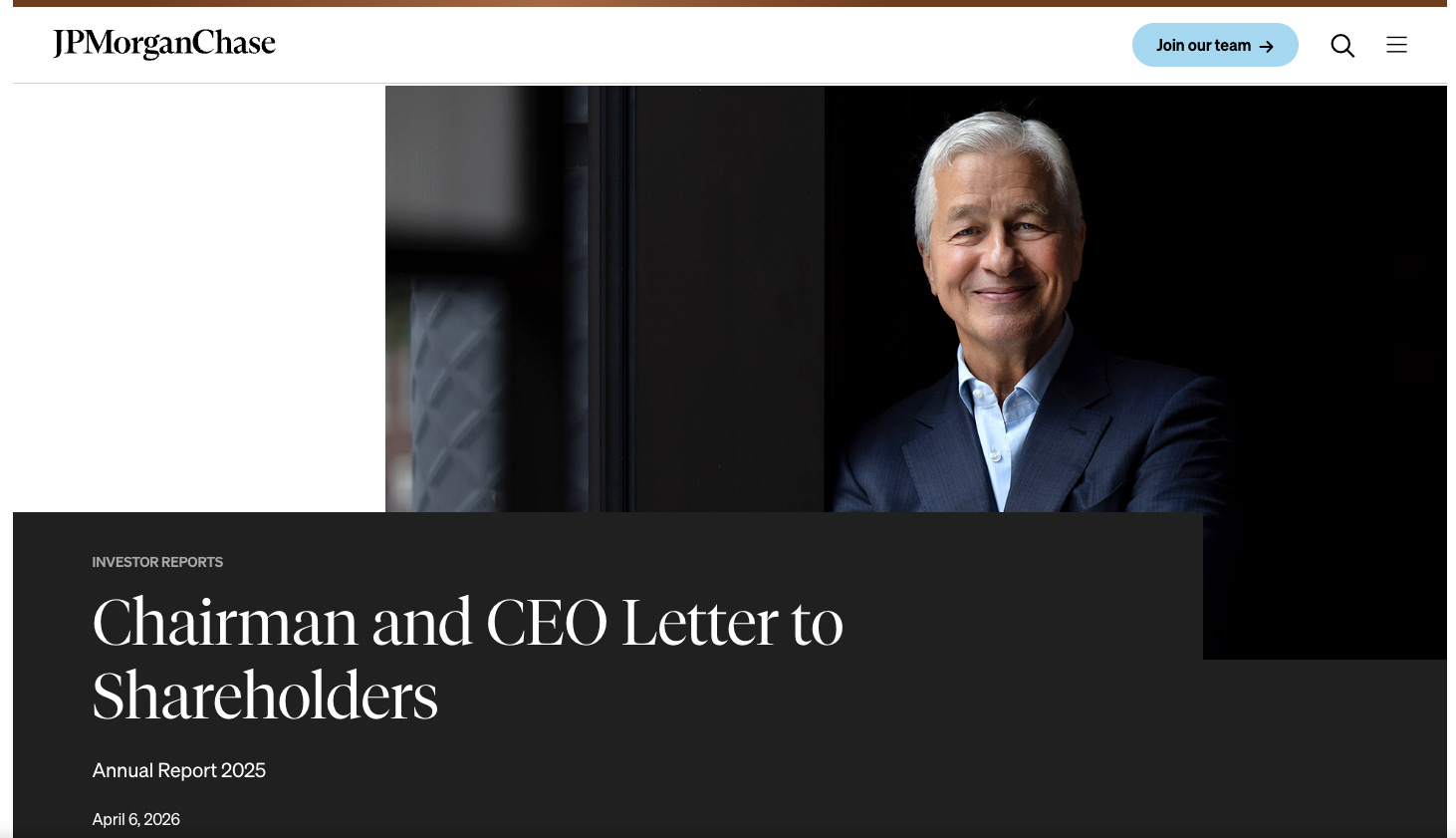
I read Jamie Dimon’s annual letter this week, which is not usually how I spend my free time, mainly because I do not enjoy being personally attacked by 50 pages of competent corporate seriousness.
And yet there I was.
Reading the whole thing.
Twice.
Because apparently I do not believe in sleep.
But buried inside the usual fortress-balance-sheet, America-needs-to-get-its-act-together, bank-CEO energy was something important. Actually, several important things. And for once, a lot of it felt uncomfortably close to the reality some of us in energy, infrastructure, and African markets have been shouting into the void about for years.
Not in exactly the same language, of course. Jamie says things like “AI, data and technology are key to the future.” I say things like “the robots are coming, and annoyingly they need a lot of electricity.” Same message. Different tailoring.
FAIR WARNING: This is going to be long. Not Dimon-long. Nobody is Dimon-long. But long. The man wrote 50 pages to shareholders who, let’s be honest, mostly just check the dividend line and close the PDF.
If you bill $1,200 an hour and are skimming for talking points, here is your TLDR:
TLDR: Jamie Dimon wrote his 2025 shareholder letter. It is 50 pages of fortress balance sheet, geopolitics, and a Rudyard Kipling quote that I am almost certain his comms team begged him to remove. Buried in there is a $1.5 trillion plan that is, if you tilt your head, an admission that America now needs to do all the things African energy developers have been doing since forever. AI is eating all the electricity. Geopolitics is chaos. Europe is quietly falling apart. Regulations are insane everywhere. Welcome to the club, Jamie. The hazing involves a diesel genset and a substation that catches fire on Tuesdays for reasons nobody can explain.
Still here? Let’s go.
First, a confession
There are two kinds of people who read Jamie Dimon’s annual letter.
The first are finance people, who pretend not to care and then read it secretly while muttering words like “macro” and “resilience” into a flat white.
The second are people like me, who read it because once every year the CEO of one of the biggest banks on earth accidentally writes 50 pages that explain why your job is both important and impossible.
I read it twice. Once for the macro, and once because watching a 70-year-old banker drop “Sturm und Drang” into a shareholder letter is the most fun you can have with your trousers on.
This year’s letter was especially irritating because he is not just talking about banking. He is talking about AI, industrial policy, national resilience, critical minerals, infrastructure, supply chains, and energy systems.
In other words, he is describing a world in which all the supposedly boring sectors are suddenly back in fashion.
Funny how that works.
For years infrastructure was treated like the boring cousin at the innovation party.
Now everybody is slowly realising the party does not happen if the boring cousin does not bring electricity.
The setup
You expect banker language. Safe language. Language with the emotional range of an audited receivable. Instead, Dimon’s letter basically says: the world is unstable, AI is real, inflation is still lurking in the bushes, credit markets have started doing creative writing, and the people who think this is all abstract are about to be slapped by physical reality.
And honestly? Relatable.
Because if you work in energy, infrastructure, project development, industrial decarbonisation, or anything adjacent to “things that must exist in the real world before PowerPoint can become prophecy,” none of this sounds theoretical. It sounds like Tuesday.
The bank stuff is, as always, a flex. $185.6 billion in revenue. 20% return on tangible common equity. Eighth consecutive year of record revenue. They move $12 trillion a day. Per day. Not a typo. Twelve. Trillion. Dollars. Per day. For context: the GDP of Nigeria, one of the largest economy in Africa, is about $400 billion a year. JPMorganChase moves that in roughly 1 hour before the first cup of cappuccino is done.
Yes Jamie, we get it, you’re winning, please put the receipts down.
The interesting part is everything else. Because Dimon, very politely and in a very expensive accent, has just written the African energy thesis. He has no idea that’s what he did. But that’s what he did.
Allow me.
Exhibit A: The $1.5 trillion industrial policy that dare not speak its name
JPMorgan launched something called the Security and Resiliency Initiative. $1.5 trillion over 10 years. $10 billion of direct equity to start. Five pillars:
Supply chain and advanced manufacturing (critical minerals, shipbuilding, robotics)
Defense and aerospace
Energy independence and resilience, including battery storage, grid resilience and distributed energy
Frontier and strategic technologies (AI, cyber, quantum)
Pharma and health tech
Read pillar three again. Slowly. Battery storage. Grid resilience. Distributed energy.
Friends. That is a C&I solar developer’s pitch deck. That is, word for word, what every Energy-as-a-Service shop in Africa wakes up and does. We just don’t call it “national security.” We call it “your factory cannot run on diesel anymore because the FX is eating your children.” Same energy. Different vocabulary. Way worse PowerPoint templates on our side, admittedly.
Then comes the quietest sentence in the whole letter:
“Unfortunately, we need industrial policy to guarantee our national security and resiliency.”
Sorry, what.
The Chairman and CEO of JPMorgan Chase. The high priest of free markets. The man who has spent two decades telling everyone the government should kindly shut up and sit down. Has just written the words “we need industrial policy” in a shareholder letter. In English. With his actual name on it. The word “unfortunately” in that sentence is doing about ten years of therapy.
In Lagos we call this Tuesday. The bankability of any African renewable project is a Jenga tower of MIGA, EAAIF, GuarantCo, IFC, FMO, AFC and DFC, held together with prayer and a credit committee that has been awake for eleven hours. The thing Dimon is now proposing for America is the financial duct tape we have been improvising with since 2003.
Plot twist: we were ahead the whole time. We just thought we were behind because nobody told us we were doing the future.
Someone owes us back pay.
Exhibit B: “We have a lot to catch up on and not much time”
That sentence appears twice in the SRI section. It is also, word for word, the unofficial motto of every African energy developer I have ever met. It should be printed on a mug at AEF in Cape Town. It should be tattooed on the Energy Minister of Nigeria. It is the slogan of my entire career, my PhD, and approximately 80% of my WhatsApp messages after 9pm.
Dimon is talking about America’s critical minerals dependency, semiconductor exposure, and merchant marine atrophy. I am talking about 600 million Africans without electricity, 700 GW of installed deficit, and the fact that Nigeria’s grid trips more often than my router. Same vibes. Different timeline.
When the most powerful banker on Earth starts talking about “catching up,” the rest of us get to enjoy a rare and beautiful moment: the frontier is no longer a place you visit on a fact-finding mission with a per diem and a malaria pill. The frontier is now a strategic asset class. We are the precedent. We are what you do when you cannot rely on a working grid and have to build the future anyway.
Please update your LinkedIn headlines accordingly. I have already updated mine. Twice.
Exhibit C: AI is not in the cloud, it is in someone else’s substation
For the last few years, AI has been discussed like it descended from heaven fully formed, floating six inches above the ground, untouched by boring earthly limitations like transmission capacity, land rights, cooling systems, diesel backup, political risk, customs delays, and the fact that somewhere, somehow, one procurement manager is still asking for three stamped copies and a company profile in PDF.
But physical reality is undefeated.
AI is not floating six inches above the earth, untouched by material reality.
AI is about to be slapped in the face by material reality.
And I say this with love.
Because every time somebody says AI lives “in the cloud,” a part of me dies a little.
My brother in Christ, the cloud is just someone else’s power bill. And their land issue. And their water issue. And their transmission issue. And somewhere in the background, their exhausted energy team trying to explain for the seventh time that compute does not run on vibes.
That is why one of the most important things Dimon gets right is that he takes AI seriously as a real structural force. Not a toy. Not a side feature. Not something that only matters to people who use words like “wrapper” without embarrassment.
He treats it like infrastructure.
Good.
Because that is what it is becoming.
That is where my industry enters the chat. Because AI is not just software. AI is electricity with good PR.
And yet vibes remain a major asset class.
Here is the number that should chill you, or excite you, depending on which side of the trade you sleep on:
“Huge increase in AI-driven capital spending and construction by the five hyperscalers. In 2025, this number was $450 billion, and in 2026, it will be approximately $725 billion.”
$725 billion. From five companies. In one year. On AI infrastructure. That is roughly 1.5x the total annual capex of the entire global oil and gas industry. It is approximately the GDP of Switzerland, give or take a chocolate factory. It is also, and this is the part nobody is willing to say into a hot mic, almost entirely a bet on cheap, abundant, reliable electricity that does not currently exist anywhere near where they’re trying to build the data centers.
I wrote about this last August in Energy is how Africa wins at AI. The thesis was simple: the people spending $4 trillion on AI infrastructure forgot to do the thermodynamics homework. They are putting data centers in places where electricity costs 17x what it should and the cooling physics actively hate them. I made a lot of jokes about thermometers. None of those jokes have aged.
Dimon does not say any of this. Dimon says, in his most carefully manicured voice:
“The landscape will change rapidly, with shifting assumptions about power consumption, costs, chip technologies and the speed at which data centers are deployed.”
That, my friends, is JPMorgan-speak for “we have absolutely no idea where these things are going to end up but we know it isn’t where they currently are.” Translation: the great migration is coming. The only question is whether African energy ministries understand they are about to be on the most expensive blind date in human history.
If you work in siting decisions in Lagos, Mombasa, Casablanca, Accra, or Cape Town, please for the love of God check your inbox. The next hyperscaler deal is in there somewhere, probably in your spam folder, probably from a Gmail address that ends in numbers.
Exhibit D: Europe is cooked, and Jamie says so out loud with full Catholic guilt
This is the part of the letter where Dimon stopped being a banker and became a strategist who has clearly been holding this in for years. EU GDP relative to America has gone from 90% in 2000 to 70% today. Internal EU market barriers, per Mario Draghi, function as “hard tariffs” of 45% for goods and 110% for services. A hundred and ten percent. That is not a market. That is a polite suggestion to please not trade with each other.
If you are an African developer who has spent the last decade chasing European DFIs, this should make you blink. European money is not going away. EIB, AFD, KfW, Proparco, BII and the rest will keep showing up to events with branded tote bags. But the relative weight is shrinking. The new money is American, Gulf, still some Chinese, possibly Indian, possibly Japanese if METI ever finishes its meeting.
A significant portion of the development finance that flows into African renewable energy deals comes from European institutions. I have been in deal processes where the timeline from term sheet to disbursement stretches past two years. Not because the project is bad. Not because the offtaker is bad. Because the institutional machinery on the funder side requires seventeen rounds of due diligence, three independent consultants who all say the same thing, two board approvals in different currencies and a partridge in a pear tree.
Africa needs hundreds of billions in clean energy investment every year for the next decade. It cannot afford a funding architecture that runs at the speed of European committee culture.
Update your capital stack template. The 2018 vintage, where you assumed a European senior tranche, an Anglo mezzanine, and a local equity sliver, is being quietly replaced by something that looks more like an American DFI, a Gulf sovereign, and a corporate offtaker with an SRI mandate. Get there first. Bring snacks.
Exhibit E: Regulation
There is a section in this letter where Dimon uses phrases like “convoluted and distorted,” “intensely inaccurate,” and, my personal favourite, “frankly, it’s not right, and it’s un-American.”
Reader, I felt this.
Not about banking regulations specifically. About permitting, tariff regulation, grid code compliance, environmental impact assessment requirements and the seventeen-step approval process for connecting a solar installation to a grid that barely works to begin with.
Dimon’s critique of bad regulation is that it creates the appearance of safety while generating real costs, locks up productive capital in compliance theatre, and produces outcomes that are the opposite of what was intended. He could be describing the regulatory environment for renewable energy project development in West Africa, word for word, sentence for sentence.
He also has a line I want to put on a t-shirt:
“You probably need to have real-life experience in dealing with regulations to understand this.”
Yes, Jamie. Yes, you do. After 12 years of trying to close renewable energy deals across markets where every week brings a new requirement from a different regulator who has not spoken to the previous regulator, I understand this deeply and personally.
Exhibit F: The line that is going on my fridge
Buried in the section on city competition, where Dimon is mostly grumbling about his New York property tax bill, there is this:
“No city, or company or country, has a divine right to success.”
I need every African leader, every infrastructure minister, every regulator who sat on a license application for nine months while it accumulated dust and supernatural powers, every utility CEO who thinks the capital will keep showing up because it always has, to write that on a Post-it and stick it to their monitor. Then take a photograph of it. Then frame the photograph.
The continent does not have a divine right to capital. We are competing for it. With America, which now has industrial policy. With Europe, which is finally panicking. With China, which never stopped. With India, which just discovered ambition and is ordering shoes.
The good news: we have what they need. Sun. Land. Cooling. Biomass. Critical minerals. A young workforce. A demographic bulge that is, depending on your priors, either the next great opportunity or the next great catastrophe.
The bad news: having it is not the same as monetising it. Diamonds in the ground are also just rocks until somebody digs them up, cuts them, certifies them, and convinces a 28-year-old in Antwerp to buy one. Nothing about this happens on autopilot.
In Other news - The cloud, sadly, still needs steel
This is the part I think too many people miss. Technologies do not arrive in neutral markets. They arrive in structures. And structures decide who wins.
If the rails are owned elsewhere, the chips are made elsewhere, the data centres are financed elsewhere, the standards are written elsewhere, and the power is more stable elsewhere, then “AI opportunity” can quickly become a very elegant way of saying:
Congratulations. You may now consume the future from the comfort of your own underpowered economy.
I am sorry, but no.
That is not a strategy. That is premium dependency. And this is why I keep coming back to energy. Because when people talk about AI in Africa, they often go straight to talent, software, policy, apps, training, startup ecosystems, and all the other shiny bits.
All good things. All necessary.
But underneath all of it sits the more irritating question nobody can joke away: What powers the stack? Not metaphorically. Literally. Because a data centre cannot run on optimism.
Inference does not happen because a minister said “innovation” with confidence. A GPU cluster does not care how inspiring your panel session was. A model does not train on narrative.
It trains on compute.
And compute, in a cruel act of physical realism, runs on electricity.
This is also why the physical world is becoming more valuable, not less
A lot of people seem to think AI will make the physical world less important.
I think the opposite.
I think AI is about to make the physical world brutally, embarrassingly, gloriously important again.
More power generation. More storage. More transmission. More cooling. More data infrastructure. More real assets. More industrial policy. More project finance. More grid planning. More actual grown-ups in the room.
Not fewer.
Because AI is not escaping the old economy. AI is marrying it. Messily. With expensive catering. And a prenup written by lawyers billing in six-minute increments.
That is why I find this moment so funny.
For years the physical industries were treated like the old world. Slow. Unsexy. Complicated. Full of hard hats and CAPEX and men named Peter who say things like “let us revisit the assumptions.”
Now the future’s hottest sector has discovered it is entirely dependent on all of that.
Delicious.
The productivity conversation, which gets morally serious fast
Dimon also says something that people should not skip past: AI will eliminate some jobs, and deployment may move faster than workforce adaptation. He argues that business and government need plans for retraining, reskilling, relocation support, and income assistance.
Yes. Exactly.
Because one of the most irritating habits in tech discourse is that people love disruption right up until they have to talk about displaced humans in full sentences. Then suddenly everyone becomes very abstract. “New categories will emerge.” “History shows labor adapts.” “Net productivity gains.”
Lovely. Tell that to the 29-year-old analyst, call-center worker, junior designer, or ops staff member whose function just got atomized by a model trained on the internet and several billion dollars of compute.
Even in advanced economies, adaptation will be messy. In African economies, where informality is high, social protection is thin, energy access is inconsistent, and labor absorption is already structurally weak, messy can become dangerous very quickly.
So no, I do not think the right African AI strategy is to cosplay Silicon Valley and pray. It has to ask: where will real demand come from? What local problems justify deployment? What infrastructure exists beneath the shiny demo? Who captures value? Who gets displaced? Who gets retrained? Who gets financed? Who gets left holding the motivational quote?
The one thing Dimon did not write, and it is loud
Dimon spent 50 pages writing the African energy thesis without ever mentioning Africa.
The continent with the fastest-growing population on Earth. The continent that holds an extraordinary percentage of the world’s critical mineral reserves, the same minerals he describes as essential to national security and the AI infrastructure buildout. The continent that is projected to have the largest workforce in the world by mid-century.
“America” appears 89 times in the letter. “Africa” appears zero. I counted.
That is either the saddest oversight of 2026 or the greatest accidental endorsement we are ever going to get. I am choosing endorsement. It is cheaper than therapy.
This is not a personal complaint. I am not writing an invoice to JPMorganChase. This is a structural observation: the global financial system’s most articulate spokesman wrote 50 pages about the future and forgot a continent. Which means the people who will build the infrastructure that matters in these markets are the people who did not forget the continent existed.
What I am taking away, written in bullets because my edit deadline is in twelve minutes
Industrial policy is now bipartisan and trans-Atlantic. Argument over. African policymakers have a 25-year head start in living with industrial policy and should be exporting playbooks, not importing them. Print receipts.
Energy resilience is the new national security. The C&I solar, BESS, and biomass deals we do every day just got upgraded, in the mind of the most powerful banker on Earth, to “critical infrastructure.” Adjust your tariffs. Adjust your pitch decks. Adjust your hourly rate.
The AI energy migration is real. $725 billion of hyperscaler capex cannot find a home where the lights flicker every six minutes. Africa is not “an option.” Africa is the rational answer to a thermodynamics question that has not yet been asked at board level. Be in the room when somebody finally asks it.
Europe is wobbling. Make new friends in Houston and Abu Dhabi. Send Christmas cards.
Nobody has a divine right to anything. Not me, not you, not the developer down the road who has been “about to close” the same deal for three years and is starting to feel like a meme.
In closing
People think AI will replace the physical world. I think it will make the physical world more valuable. More grids. More generation. More storage. More transmission. More data infrastructure. More industrial capacity. More discipline around what is actually bankable. More adults in the room.
Because AI is not escaping the old economy. AI is about to marry it. Messily. With expensive catering.
For years, infrastructure was treated like the boring cousin at the innovation party. All those sectors people looked down on while throwing money at apps that delivered premium oxygen to dogs. Now everyone is slowly realising the party does not happen if the boring cousin does not bring electricity. Funny how that works.
Which is excellent news for those of us in energy. We have spent years being told we are in a “traditional” industry. Suddenly everybody has discovered that the future runs on our balance sheet.
And beneath every clean product demo, every AI wrapper, every shiny forecast of abundance, there is still a very old question waiting in the dark:
Yes, but where will the power come from?
And somewhere, an energy developer who has not slept properly in six years whispers back:
Finally. A question I know how to answer.
Now if you’ll excuse me, I have a Steam Purchase Agreement to finalise and a CHP plant in Abidjan to dispatch-model. The future, it turns out, is not waiting for permission. It also doesn’t take Sundays off, which I’m choosing not to think about.
- Kay
P.S. If you are a JPMorgan SRI team member who wandered into this post by accident: hi. The third pillar of your initiative has a natural extension to the African C&I market that I suspect nobody on your 30-person team has properly socialised yet. My DMs are open. My coffee order is reasonable. I will even let you expense it.
P.P.S. I tried to count how many times Dimon used the word “fortress.” I gave up at fourteen. The man loves a fortress. The Normans would have approved.
P.P.P.S. Also, “America” appears 89 times. “Africa” appears zero. I checked. We have work to do. Some of that work is writing better blog posts. Some of it is getting somebody at 270 Park Avenue to read this one. If you know somebody, forward it. I’ll owe you a jollof.
Standard disclaimers: I do not work for JPMorgan and they did not pay me to write this. I do work for a company that builds the things in Dimon’s third pillar, so in the grand tradition of this blog I am absolutely talking my own book and have the decency to admit it. Past performance is not indicative of future results, but past Jamie Dimon letters are extremely indicative of future Jamie Dimon letters. If I’m wrong about anything here, I warned you. If I’m right, please remember my consulting rates are very reasonable and I take payment in jollof, project finance gigs, or both.