

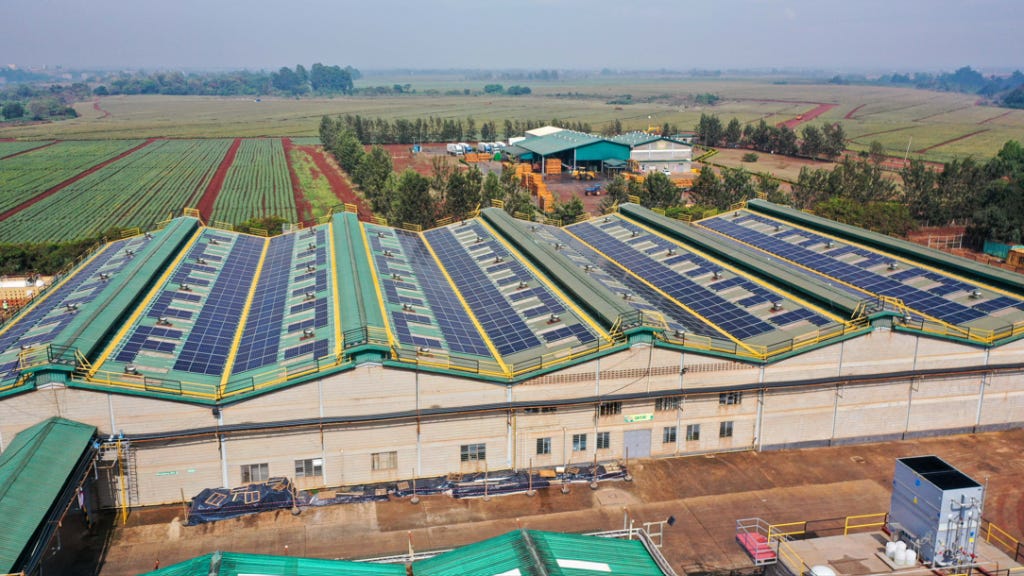
Every C&I solar developer in Africa is, whether they admit it or not, building for one of two exits: a trade sale or a refinancing. The trade sales are no longer hypothetical. Shell bought Daystar Power, the Lagos and Accra C&I platform, in a deal that closed in December 2022 and was described at the time as the oil major’s first power acquisition in Africa. Helios and AIIM merged Starsight Energy with SolarAfrica to create a pan-African C&I platform that completed with 520 MW of installed and contracted solar and 60 MWh of storage across seven countries. At utility scale, Infinity Power’s purchase of Lekela’s 1 GW wind portfolio was billed as Africa’s biggest renewables deal.
The consolidation phase of African clean energy has started, and it will accelerate: AFSIA’s 2026 outlook identifies 23.4 GW of operational solar on the continent, and possibly as much as 63.9 GW once Chinese module export data is factored in, growing faster than any other region on earth. By project count, more than 80% of the operating projects AFSIA tracks are C&I. Thousands of small contracted assets, in other words, most of them built by developers who will eventually want to sell.
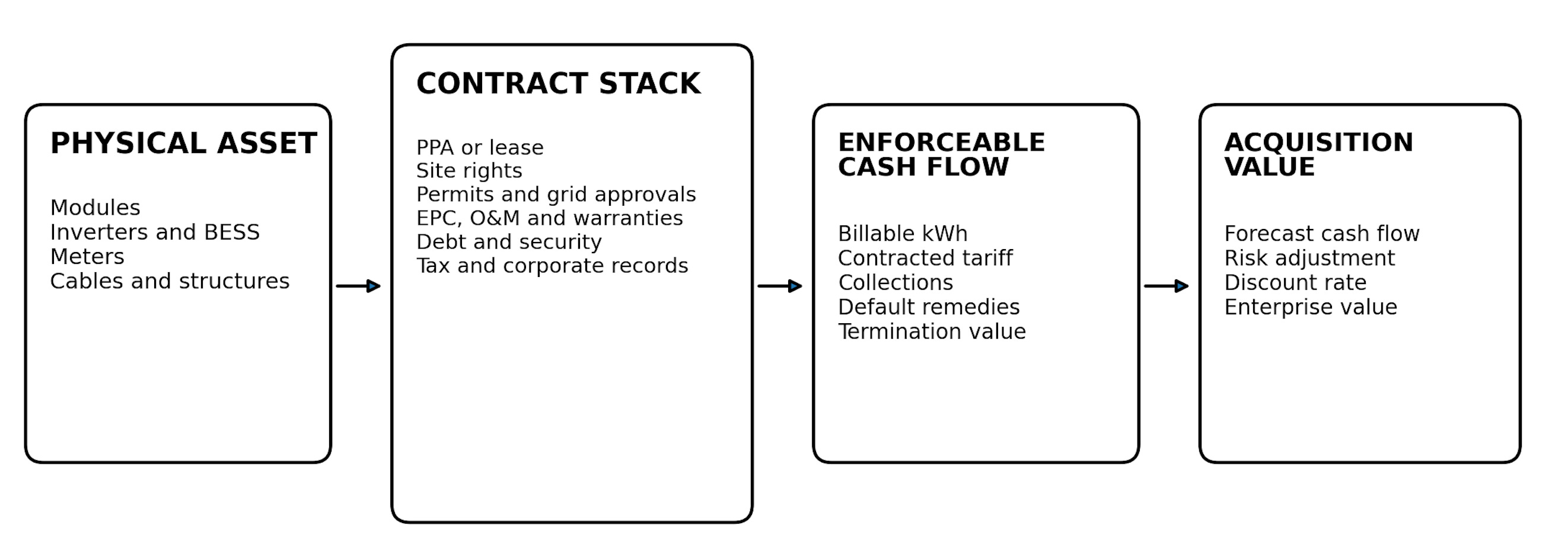
When a buyer does arrive, they do not buy your panels. Panels are a commodity that loses value the moment it clears the port. What they buy is a bundle of paper: power purchase agreements, leases, land documents, permits, EPC and O&M contracts, loan agreements, shareholder agreements, tax filings. The panels convert sunlight into electricity; the paper converts electricity into a legally enforceable cash flow; and the discounted value of that cash flow, adjusted for everything that could go wrong with the paper, is the price. A megawatt with bad paper is not a discounted megawatt; past a certain point it is scrap on a roof you may not even have the right to access.
I have spent twelve years on the sell side, buy side, and occasionally the confused-bystander side of West African energy transactions, and the pattern repeats. Deals rarely die because the solar resource was overstated or the inverters were the wrong brand. They die, or bleed out through price chips, because of clauses written years earlier by people who were optimising for signature speed, not exit.
This guide is an attempt to be exhaustive about those clauses. It is written with a C&I bias, because that is where I live and where the portfolio problem is most acute, but utility scale and mini-grids get their own sections, because they fail differently.
How bad paper shows up in a deal
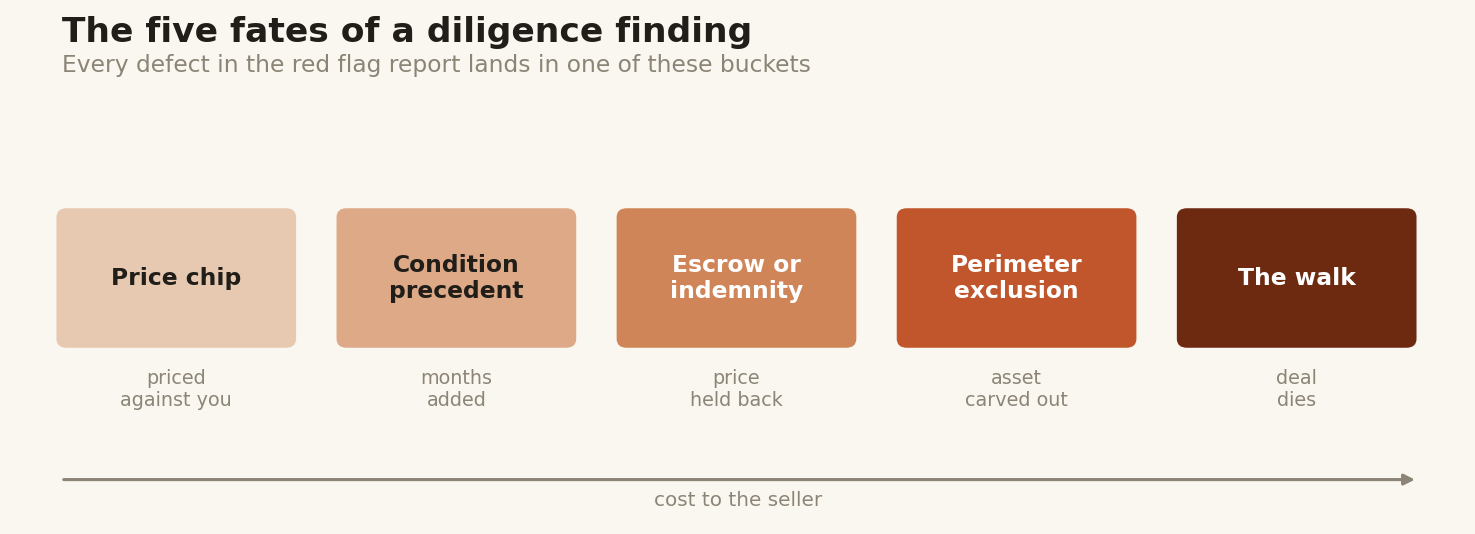
Before the catalogue, it helps to understand the mechanics. A buyer’s diligence team (lawyers, technical advisers, financial advisers, increasingly an ESG adviser too) produces a red flag report. Every defect in that report is triaged into one of five buckets, and knowing the buckets tells you how expensive each defect is:
The price chip: quantifiable risk gets priced. A portfolio where 30% of revenue sits with offtakers who can walk away in 90 days is not worthless; it is worth what a 90-day revenue book is worth, which is a lot less than what your model says a 15-year revenue book is worth.
The condition precedent: fixable defects become CPs to closing (obtain this consent, stamp that lease, register this charge). Each CP adds months, and time kills deals, because currencies move, boards change and rival sellers appear.
The indemnity, escrow or holdback: unquantifiable but bounded risk (a possible tax reassessment, a threatened dispute) gets covered by holding back part of your price, sometimes for years. Warranty and indemnity insurance, which softens this in developed markets, remains thin on the ground for African C&I portfolios, so the escrow comes out of your pocket.
The perimeter exclusion: individually rotten assets get carved out of the transaction. You keep the problem children, which is exactly as fun as it sounds.
The walk: risk that cannot be quantified, bounded or excluded ends the process. Walks rarely trace back to a single catastrophic clause. They happen when the buyer realises, somewhere around week six, that the data room is a museum of improvisation and nothing in it can be relied upon.
Legal diligence practitioners describe the same dynamic from the other side: sparse or inconsistent data rooms do not merely slow a transaction, they broaden the red flag classification across every workstream, because a buyer who cannot verify one thing stops believing everything.
Standard renewable M&A checklists (Enverus publishes a representative one, and FTI describes the platform-level version) all converge on the same short list of value drivers: offtake quality, site control, permits, construction and equipment paper, and financing terms. So that is the order I will take them in, with the African complications attached.
The offtake contract: the crown jewel and the crime scene
The PPA (or solar lease, or energy service agreement; the label matters less than the economics) is 70 to 90% of the value of a C&I asset. It is also where the worst drafting lives, because early-stage developers negotiate PPAs under commercial pressure against procurement departments whose bonus depends on extracting concessions. Every concession you made in year two gets repriced against you in year eight.
1. Termination for convenience without a real make-whole
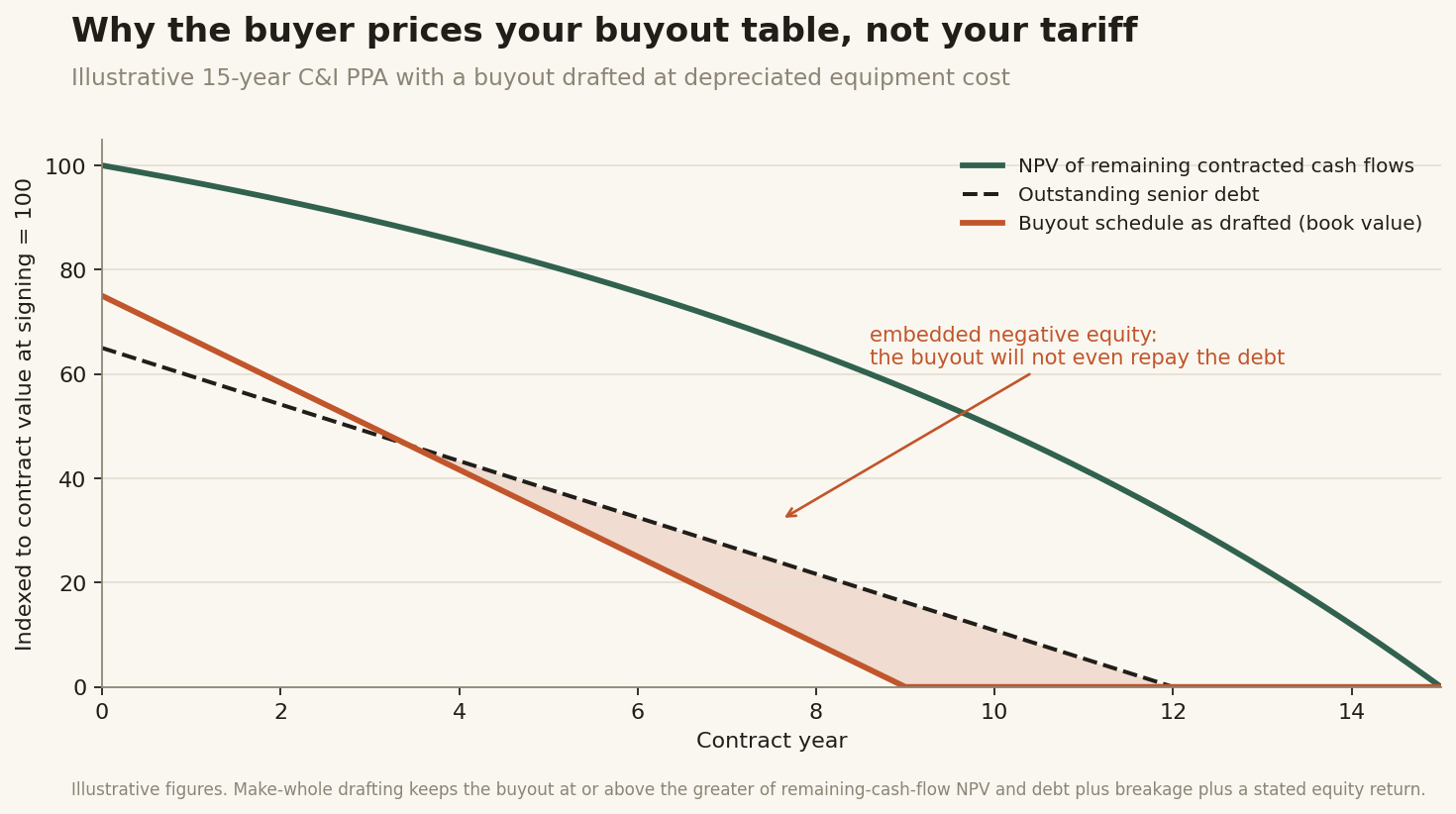
The single most value-destructive clause in African C&I solar, and the most common. The customer negotiates a right to exit the contract early, “for convenience”, on 60 or 90 days’ notice, against payment of a termination sum. The termination sum is where the crime happens. I have seen buyout schedules set at depreciated book value of the equipment, at “outstanding equipment cost” with no definition, at a flat percentage of remaining invoices, and, memorably, at a number “to be agreed in good faith at the time”. None of these covers the net present value of the remaining contracted cash flows plus debt breakage costs, which is the only definition a buyer or lender respects.
The consequence is mechanical: a rational buyer values your contract not at the tariff line, but at the lower of the tariff line and the buyout schedule, because the buyout schedule is what the offtaker will pay if it is ever cheaper to leave. If your buyout table dips below the outstanding project debt at any point in the term, you have drafted a contract with embedded negative equity. Lenders’ lawyers find this in about eleven minutes.
What good looks like: a buyout table appended as a schedule, calculated as the greater of (a) NPV of remaining payments at a stated discount rate and (b) outstanding senior debt plus breakage plus a stated equity return, updated for any capex additions, with no “good faith” language anywhere near it.
2. Assignment and change of control clauses that hand your customer a veto over your exit
This is the clause nobody reads at signing and everybody reads at exit. Two separate mechanics matter. First, assignment: whether the SPV can transfer the contract itself (relevant in asset deals and refinancings). Second, change of control: whether a transfer of shares in the SPV, or in the holding company two levels up, requires the offtaker’s consent. Badly drafted C&I PPAs require written consent for any direct or indirect change in shareholding, with no deemed-consent mechanism, no reasonableness standard, and no carve-outs.
Now multiply. Starsight alone had over 656 sites across Nigeria, Kenya and Ghana at the time of its merger announcement. A platform sale over a portfolio like that, on bad assignment language, requires hundreds of individual consents from procurement departments who have zero incentive to hurry and every incentive to reopen pricing in exchange for a signature. Buyers call this hold-up risk, and they price it savagely, or they restructure the deal to close over the missing consents with indemnities you will be paying against for years.
What good looks like: consent not to be unreasonably withheld or delayed; deemed consent after 15 to 30 days’ silence; express carve-outs for transfers to affiliates, to lenders enforcing security, and to any transferee meeting objective criteria (a stated net worth, a stated MW of operating experience); and change of control defined at the SPV level only, not at the ultimate-parent level, so that a platform-level transaction does not trip 200 site-level triggers.
3. Offtaker credit that exists only in the logo
The African C&I model was built on a seductive syllogism: multinationals are creditworthy, our offtakers are multinationals, therefore our revenue is creditworthy. Except you did not contract with the multinational. You contracted with a locally incorporated subsidiary whose balance sheet you never saw, with no parent company guarantee, no letter of comfort, and a payment security package consisting of one month’s deposit that was quietly consumed by an invoice dispute in 2021. Buyers unwind the syllogism in the first week of diligence. They sort your revenue book into: investment-grade parent paper (guaranteed), local blue chip, SME, and “aspirational”. Each tier gets its own default assumption. The absence of any security (deposits, standby letters of credit, escrowed collections) moves an offtaker down a tier; a clean 36-month collections history moves it up. Which is why your billing and collections ledger, reconciled and exportable, is worth real money at exit. A portfolio with a documented 98% collection rate is an asset class. A portfolio where collections live in a WhatsApp thread with the finance manager is an anecdote.
4. Currency clauses that were stress-tested against the wrong decade
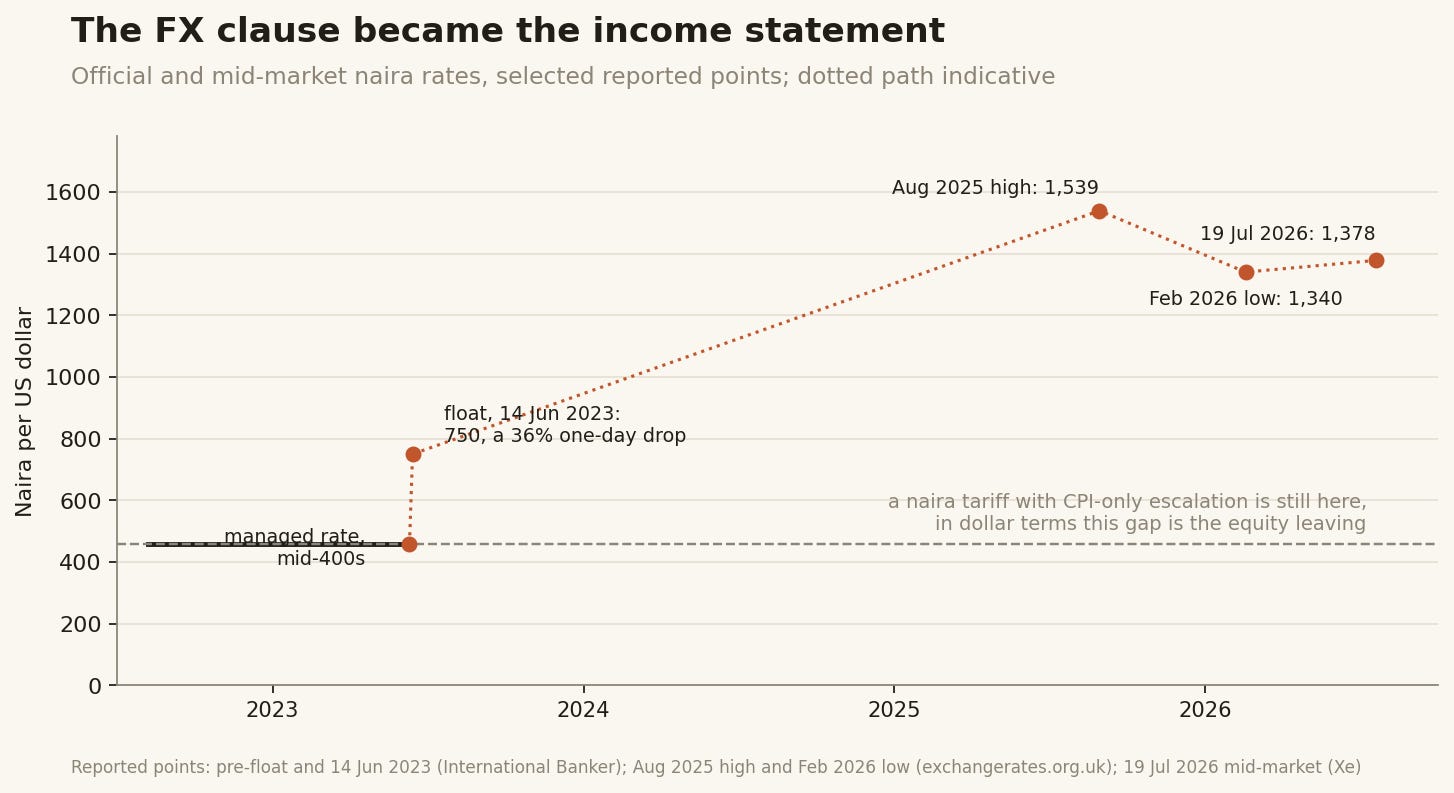
Most West African C&I contracts price in local currency because offtakers earn in local currency. The question is what happens when the currency does what West African currencies do. Nigeria answered it in June 2023, when the new administration collapsed the managed exchange rate windows and let the naira float, dropping it 36% in a single day, from the mid-400s per dollar to 750, on its way to considerably worse. Ghana’s cedi had its own 2022 annus horribilis. For a dollar-funded portfolio with naira tariffs, the FX clause stopped being boilerplate and became the income statement.
The defect spectrum runs from fatal to merely painful. Fatal: pure local-currency tariffs with CPI-only escalation, funded with dollar debt (the equity is simply gone; buyers will value the asset on a restructured-tariff basis, if at all). Painful but survivable: USD-indexed tariffs with a capped adjustment, or indexation to an official reference rate that lags or diverges from the rate at which anyone can actually source dollars. The structurally sound version is in Nigeria’s bankable utility-scale documentation, where payments are calculated in US dollars but payable in naira, indexed to the exchange rate on the payment date, so the FX risk sits with the party best able to pass it through.
A perfectly drafted USD-indexed tariff, though, is only as good as your offtaker’s ability to absorb a 250% naira-terms price increase without defaulting, disputing or demanding renegotiation. Post-float Nigeria has been a live experiment in this. Industry analysis after the float estimated that the currency move alone could raise C&I project costs by around 40% and the resulting cost of electricity by 27%, sustainable only because diesel, the alternative, is itself dollar-linked. Buyers therefore diligence two things: the indexation clause as written, and the collections data showing whether it was actually applied and actually paid. A contract you never dared enforce is, for valuation purposes, the contract you actually have, not the one you signed.
5. Volume risk dressed up as partnership
C&I tariff structures in the region come in three broad flavours, in descending order of acquirability: fixed tariff per kWh with a minimum offtake or capacity charge; fixed tariff with no minimum (you carry consumption risk); and “discount to grid or diesel” pricing, where your tariff floats at, say, 15% below whatever the customer would otherwise pay. That last structure sold beautifully in 2019 and is a valuation horror in 2026, because your revenue is now short the grid tariff, short diesel, and short the regulator, with no floor. When a market reform or a fuel-price collapse moves the reference price, your cash flow moves with it, and no buyer will underwrite an uncapped short position they cannot hedge.
Adjacent defects in the same family: no deemed-energy clause when the offtaker’s site is unavailable (factory maintenance shutdowns become your production losses); no protection on relocation or closure of the site (the customer’s business risk becomes your stranded-asset risk); ambiguity on excess energy, metering standards and meter-failure fallbacks (every ambiguity eventually becomes an invoice dispute, and invoice disputes become the collections data that poisons your valuation); and contract volumes that ignore panel degradation, so that year-12 you is contractually committed to year-1 output.
6. The paper trail itself
The final offtake defect is incompleteness itself. Unsigned annexes. Tariff schedules marked “to be agreed” that never were. Amendments evidenced by email chains, or worse, by conduct (”we agreed the new rate on a call and they have been paying it”). Contracts that expired in 2023 and rolled over into an undocumented holdover. Side letters granting discounts that live in one sales director’s inbox. In Nigeria this shades from sloppy into legally dangerous, because an unstamped agreement is inadmissible in evidence until stamped, with penalties for late stamping under the Stamp Duties Act. In practice the buyer’s counsel cannot even rely on your contract as evidence of itself. Every one of these gaps costs more to fix during a transaction, under time pressure and adversarial scrutiny, than it would have cost to fix on a quiet Tuesday in the year it happened.
Site control
C&I solar has a structural quirk that developed-market templates never contemplated: very often, the entity buying your power does not own the building your panels sit on. The factory is leased. The landlord never signed anything. Your entire site right is a clause in the PPA saying the offtaker “grants access to the roof”, which is a right the offtaker may not have had to give. Now run the failure cases a buyer’s counsel will run.
The offtaker’s lease ends in year 6 of your 15-year PPA. The landlord’s bank enforces its mortgage over the building and the receiver regards your array as a fixture of the property. The offtaker relocates and you discover your removal rights, reinstatement obligations and continued access rights after termination were never drafted.
A proper site package for a rooftop asset is boring and short: a direct licence or lease from the building owner (not just the tenant), coterminous with or longer than the PPA, with access rights that survive PPA termination, a waiver or subordination from the landlord’s financiers where they exist, and clarity that the system remains your movable property and not a fixture.
Ground-mounted C&I and captive projects import all of the region’s land-law complexity. In Nigeria, the Land Use Act vests land in state governors, and Section 22 makes it unlawful to assign, sublease or mortgage a statutory right of occupancy without the Governor’s consent first obtained; transactions done without it are voidable, and instruments that are unstamped or unregistered cannot be registered and are inadmissible as evidence. Consent processes take months and cost percentage points of assessed value, which is why so many portfolios are sitting on unperfected leases that “everyone was going to sort out later”. Ghana adds stool and family land, with the associated risk that the signatory who took your money did not bind the family; Kenya adds county-level approvals; francophone West Africa adds its own titling regimes. None of this is exotic to a buyer who works the region, but all of it must be paper-perfect or priced.
The standard buyer responses are a CP to perfect title (adding three to six months to your deal) or an indemnity backed by escrow. The worst version is the ground lease whose term is shorter than the PPA it supports, which I keep seeing, and which converts your terminal value into a question mark.
Permits
Regulatory diligence in African C&I is a moving target, because the frameworks themselves keep moving; the discipline is to be current, documented and conservative at every threshold. Nigeria is the worked example. The Electricity Act 2023 replaced the 2005 framework and allows licence-free generation up to 1 MW per site and distribution up to 100 kW, while the constitutional amendment let states build their own electricity markets: where a state has established its own regulator, NERC’s role recedes to interstate matters, and by mid-2026 15 of Nigeria’s 36 states had created their own power regulators.
For a portfolio owner this is a full compliance matrix: an asset compliant under federal rules in 2022 may now sit in a state market with its own licensing, tariff and reporting regime, and the transition paperwork is precisely the kind of thing that never got done.
The recurring C&I defects: the 1.2 MW plant that was described as “below threshold” because someone measured the inverter rating creatively; the phased expansion that crossed a licensing line in phase 3 and nobody noticed; captive generation permits never obtained because “we are behind the meter”; missing environmental permits and building approvals; and wheeling or third-party supply arrangements entered into without the trading or supply licence the structure actually required.
The buyer’s problem with permit gaps is that the downside is not a fine you can price; it is the theoretical unenforceability of the revenue contract sitting on top of the unpermitted asset. Unquantifiable downside is bucket five. That is the walk.
Construction and equipment paper
Operating C&I portfolios in the region were mostly self-built: the platform was its own EPC, procurement arm and O&M contractor. Efficient, and fatal to the warranty stack. There is no arm’s-length EPC wrap, no defects liability period enforceable against anyone who is not you, no performance ratio test conducted at commissioning (so no contractual baseline for degradation claims), and no liquidated damages regime that ever bound anyone. Where there was a third-party EPC, it was frequently a related party at a related-party price, which invites the buyer to restate your capex, and therefore your asset base, and therefore your price.
Equipment paper has its own traps. Manufacturer warranties on modules, inverters and batteries are typically personal to the original purchaser and require consent to assign; a share sale may preserve them, an asset reorganisation may void them. Battery warranties are conditional on operating envelopes (cycling, depth of discharge, temperature) that you must be able to prove you observed, which loops back to monitoring data; a battery warranty without the telemetry to demonstrate compliance is a decorative PDF. Serial-number traceability matters twice over: once for warranty claims, and once because institutional buyers, especially those with DFI capital in their chain, now run supply-chain provenance checks on modules as standard, and “we bought whatever the Lagos distributor had that quarter” is not an answer that survives an investment committee.
Data and operations
A megawatt without data is a rumour. Buyers underwrite yield from actuals: monitored generation history against irradiance, availability records, curtailment logs, O&M tickets, and a billing ledger that reconciles metered energy to invoices to cash. Where that exists, they will finance your P50 with confidence and banks in the more mature corners of the market are now comfortable with 18-year tenors against private PPAs. Where it does not exist, they underwrite a theoretical yield with punitive haircuts, or decline the asset. Missing SCADA history, estimated billing, uncalibrated meters and undocumented downtime do not make your portfolio look scrappy and entrepreneurial. They make it unauditable, and unauditable is a valuation, and the valuation is low.
The debt stack
Project and platform debt is paper too, and it is paper with tripwires. The classic: your facility agreement’s mandatory prepayment on change of control, which converts your exit into your lender’s exit, on your lender’s terms, including make-whole and breakage costs nobody modelled. DFI-sourced debt (and in African C&I, most institutional debt has a DFI somewhere in it) adds environmental and social covenants, action plans and reporting obligations that travel with the loan and that a buyer inherits; undisclosed E&S non-compliance is a modern deal-killer because the buyer’s own capital providers will not waive it. Then the quieter defects: shareholder loans advanced over the years with no loan agreements (creating tax exposure on imputed interest, withholding tax questions, and subordination ambiguity in any enforcement); security never perfected, charges never registered within statutory windows at the companies registry, leaving your lender unsecured in fact and furious in diligence; negative pledges in one facility that conflict with security granted under another; and cross-default clauses knitting every SPV in the group into a single point of failure. A buyer can live with debt. A buyer cannot live with a debt stack whose true terms can only be established by forensic archaeology.
The corporate layer
Everything above can be immaculate at asset level and the platform can still be unsellable, because platform buyers acquire shares, and shares carry the entity’s whole history. The recurring defects, from the merely embarrassing to the fatal: contracts signed by the parent company while the SPV operates the asset, with no novation, so the revenue and the asset live in different legal persons; board and shareholder approvals absent for the very contracts being sold; the share register and the companies-registry filings telling different ownership stories; equity promised to early employees by email and never papered, surfacing mid-transaction as a claim; shareholder agreements with pre-emption rights but no drag-along, handing a 6% holder a veto over your exit; and unresolved founder separations that everyone stopped mentioning but nobody documented.
Then tax. Payroll and pension arrears; withholding tax on cross-border service and interest payments never remitted; VAT treatment of the PPA (is it a supply of goods, services or a lease? the characterisation drives the invoice, and the invoice history is discoverable); transfer pricing on all those intra-group EPC and O&M charges; and capital gains exposure on the transaction itself. One structural mercy in Nigeria is that share transfer instruments attract only nominal stamp duty, one reason regional deals are overwhelmingly share deals rather than asset deals; the corollary is that share deals inherit everything, so the corporate hygiene you skipped is now the buyer’s problem, and the buyer will make it your price’s problem.
Governing law and disputes
International buyers discount contracts that resolve disputes exclusively in local courts. The reason is arithmetic, not disrespect: enforcement timelines measured in years change the present value of every remedy in the document. The bankable default remains arbitration with a neutral seat under recognised rules, in a jurisdiction whose awards travel well under the New York Convention, paired with governing law the parties’ counsel can actually opine on. The C&I-specific defects are mundane: dispute clauses copied across templates with the wrong seat or contradictory law-and-forum pairings; multi-tier clauses (negotiation, then mediation, then arbitration) with broken or impossible timelines; and asymmetric clauses that let the offtaker sue anywhere while confining you to one forum. Nobody reads these until the first serious invoice dispute, at which point they are the whole game.
The utility-scale detour
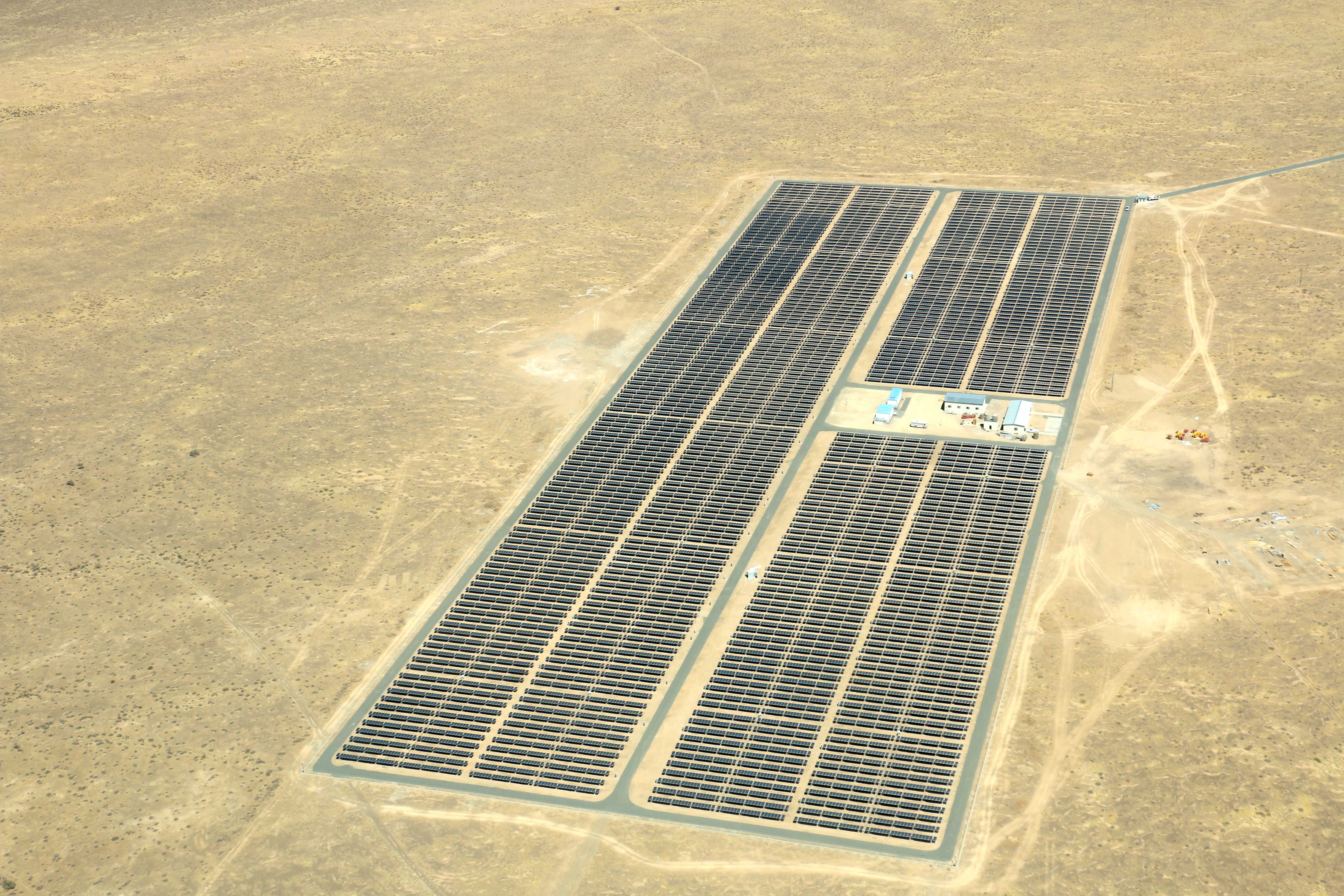
Utility-scale PPAs in Africa fail less through sloppy drafting and more through counterparty and sovereign dynamics, and the last seven years have been one long demonstration. The core structural problem is the single buyer: a state utility with a weak balance sheet, which is why bankable projects historically stacked sovereign guarantees, partial risk guarantees and MIGA-style political risk cover on top of the PPA before lenders would engage. When that support architecture is missing or ambiguous (a “letter of comfort” doing the work of a guarantee, termination compensation drafted vaguely, no deemed-energy protection against grid curtailment), the project may still get built in a good year, but it becomes very hard to sell, because the secondary buyer underwrites the documents, not the ribbon-cutting.
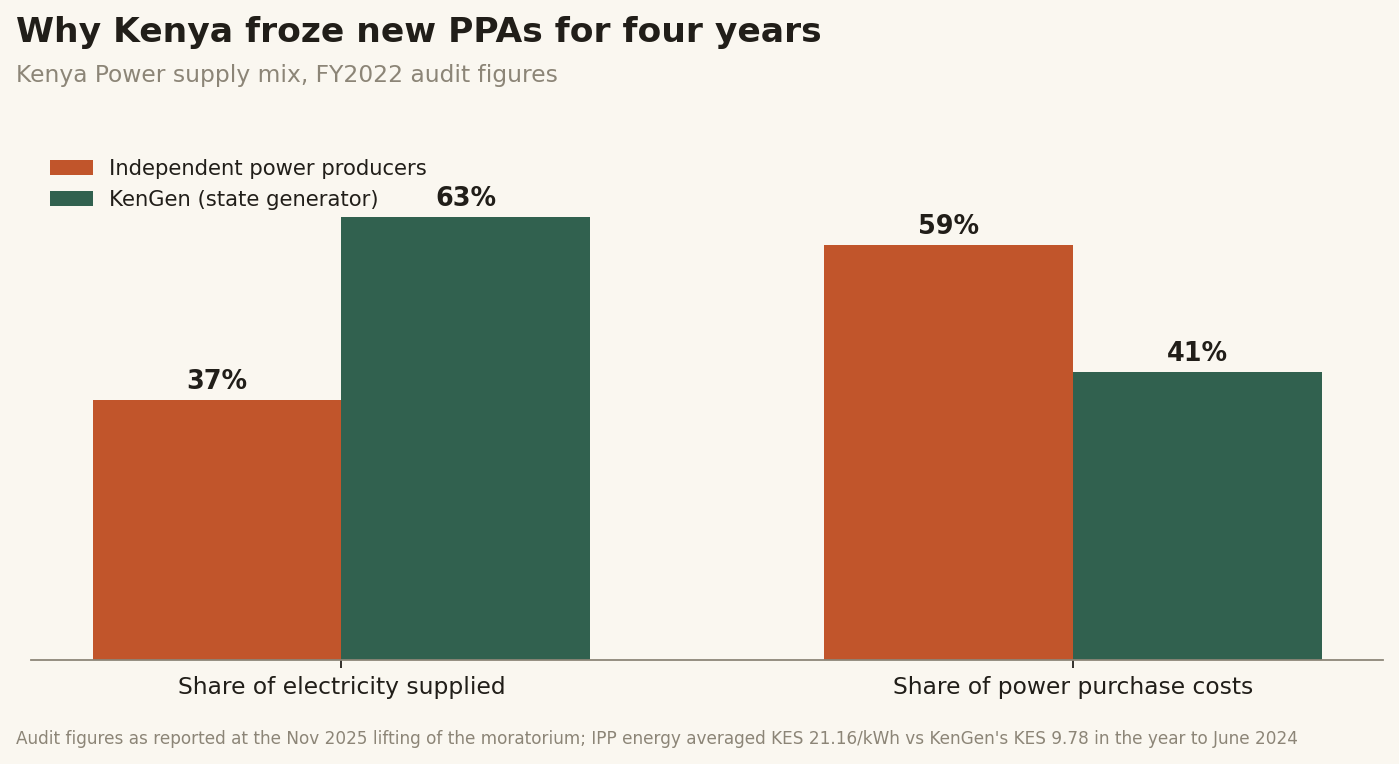
And even signed sovereign paper gets repriced when the fiscal arithmetic breaks. Ghana contracted so much take-or-pay thermal capacity that it was paying over $500 million a year for electricity it did not use, nearly $1 billion across two years by the government’s own account, prompting the Energy Sector Recovery Programme, a declared shift to take-and-pay contracting, and direct renegotiation with a dozen IPPs and their lenders; the Energy for Growth Hub’s case study of Ghana’s 32 PPAs is the best public autopsy of how uncoordinated contracting became a fiscal crisis. Kenya ran the same movie with different subtitles: a Presidential Taskforce on PPAs in 2021, a moratorium on unconcluded agreements, renegotiation pressure justified by findings that IPPs supplied 37% of energy but took 59% of power purchase costs, and a freeze that was only formally lifted by the National Assembly in November 2025, with a pivot toward competitive auctions, after years in which law firms openly warned the process was damaging Kenya’s standing with private capital. Nigeria’s cautionary tale is quieter: the 975 MW of utility-scale solar PPAs signed with NBET in 2016 that then spent years unable to reach financial close as tariff, guarantee and FX questions went unresolved.
For an acquirer, four lessons. First, the offtaker’s credit and the sovereign support package are the asset; diligence them as hard as the tariff. Second, renegotiation risk is real even for signed contracts, so contracts drafted with clear compensation mechanics, deemed energy, and robust arbitration survive renegotiation waves with their value intact, while vague ones get rewritten. Third, curtailment without deemed-energy protection converts grid weakness into your equity loss. Fourth, transferability again: government consents and support instruments (guarantees, put-and-call option agreements, political risk policies) must be assignable to a new owner, or your exit needs a minister’s signature, and ministers change.
The mini-grid detour
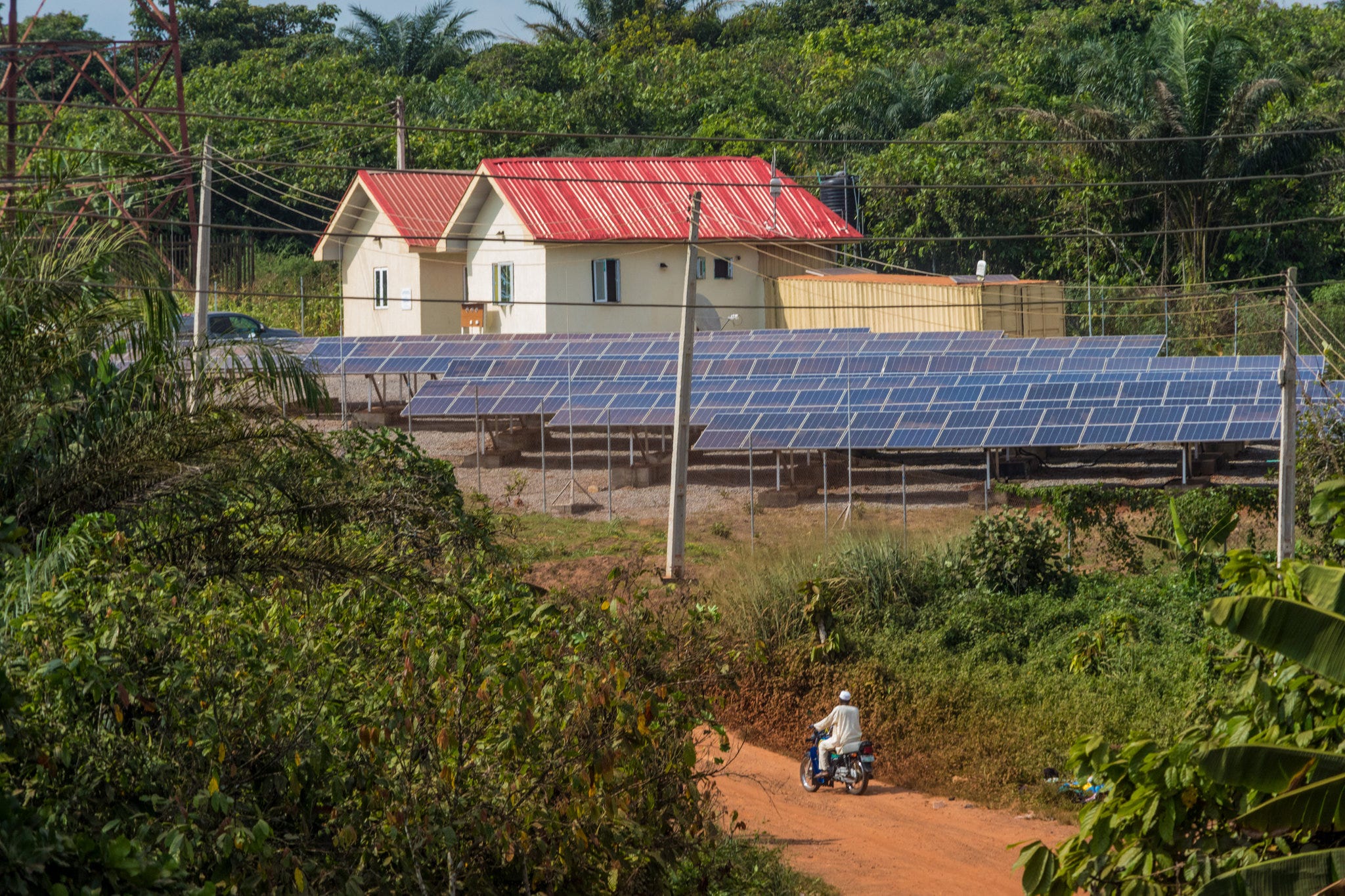
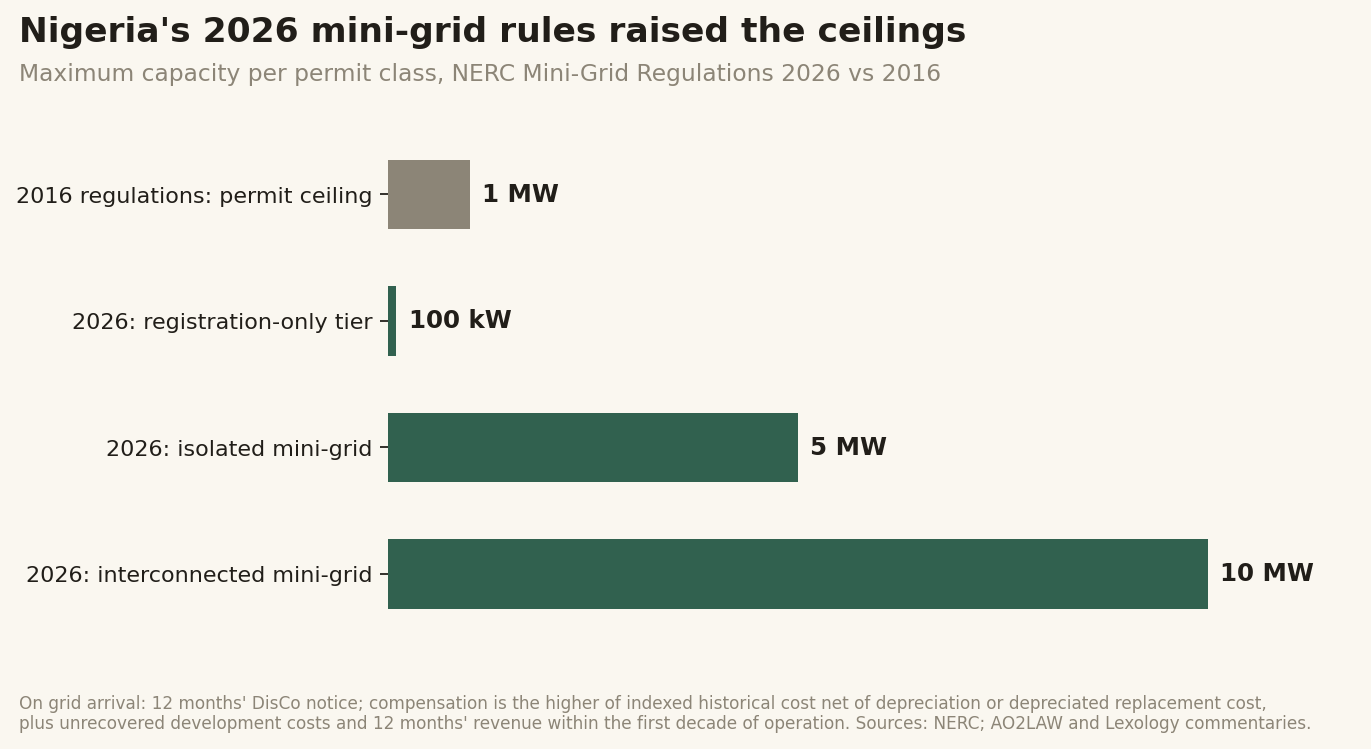
Mini-grids are the inverse of C&I: instead of one contract with one creditworthy offtaker, you have a regulated tariff over thousands of retail customers, plus a lattice of permits, community agreements and grant contracts. The acquirability problems follow. Tariffs are set or approved by regulators (in Nigeria via cost-based methodologies under NERC’s framework), so tariff-review risk replaces offtaker-credit risk. The historic existential fear, the main grid arriving and stranding your asset, has been progressively addressed in Nigeria: the framework has moved from the 2016 rules through the 2023 update to the Mini-Grid Regulations 2026, which raised capacity thresholds to 5 MW for isolated and 10 MW for interconnected mini-grids with a unified licence and registration-only treatment up to 100 kW, require 12 months’ written notice from a DisCo before grid extension into a mini-grid area, and define compensation on asset transfer as the higher of indexed historical cost net of depreciation and net depreciated replacement cost, plus unrecovered development costs and 12 months’ revenue where grid arrival occurs in the first decade of operation. That is a genuinely bankable protection, and a buyer will check whether each site in your portfolio actually holds the permit class that unlocks it, because unregistered or informally operated sites do not.
The rest of the mini-grid diligence pain is portfolio heterogeneity. Fifty sites developed over eight years under three regulatory regimes, four grant programmes and two management teams means fifty slightly different permits, community land arrangements of varying formality, plus grant and results-based-financing agreements whose fine print contains clawbacks and change-of-control consent rights held by the funder. Selling a subsidised portfolio without the grant provider’s consent can convert grant income into a repayable liability at exactly the wrong moment. Sector coordination is improving (Nigeria’s REA and the Africa Minigrid Developers Association have formalised cooperation on this kind of standardisation), but for now the seller’s job is the unglamorous one: a site-by-site matrix of permit class, tariff basis, land instrument, grant conditions and customer-level revenue data, maintained as if a buyer will read it, because one will.
A brief word on South Africa
South Africa’s contract stack grew up under different rules. Liberalisation from 2021 unlocked wheeling, and the market promptly grew a layer of licensed traders and aggregators between generators and offtakers, with Eskom’s virtual wheeling platform extending the model to multi-site, lower-voltage customers and rapid growth in trading licences issued. The acquirable asset there is increasingly a stack of contracts (generator PPA, trading agreement, wheeling and use-of-system agreements, municipal frameworks), as in the Mpact deal, where a paper producer buys solar via a licensed trader wheeling from a SolarAfrica plant, or NOA’s aggregation platform signing a 20-year PPA with a healthcare group across six Eskom-connected sites. The diligence question mutates accordingly: not just “is this PPA bankable” but “does every link in this chain (trader licence, wheeling agreement, municipal framework, settlement mechanics) survive a change of control simultaneously”. Back-to-back risk is the new termination risk. The SALGA municipal wheeling status report is the reality check on how uneven the municipal layer still is.
What good looks like
Everything above reduces to one habit: draft and file, from the first contract, as though a buyer’s counsel were already reading. The checklist I wish someone had handed me in year one:
Run one PPA template and version it ruthlessly, with every deviation logged in a register alongside the commercial reason. A buyer who can diligence one template plus a deviations schedule prices a portfolio in weeks; a buyer facing forty bespoke documents prices it in quarters, against you.
Engineer assignability in at signing: deemed consent, permitted-transferee carve-outs, lender step-in, change of control defined at SPV level. The clause costs nothing on day one and everything at exit.
Attach a buyout schedule to every contract that is a genuine make-whole, never below debt plus breakage plus a stated equity return, with no good-faith placeholders.
Perfect the boring paper in real time: stamp, register, obtain consents, file charges, novate contracts into the right entity in the year it happens, not the quarter you sell.
Keep a contract register and consent matrix as living documents: every agreement, counterparty, term, consent trigger and security interest in one place, reconciled to what is physically in the data room.
Reconcile metering, billing and collections monthly, and keep the output exportable. Your collections history is your credit story; treat the ledger as an asset under management.
Once a year, read your own portfolio the way a hostile buyer’s counsel would, and fix what you find. This is cheaper in every year except the year you sell, when it is priceless.
None of this is intellectually difficult. All of it loses to the urgent, every week, for years, which is why clean paper commands a premium: it is scarce because discipline is scarce. The developers who got bought (Daystar by a supermajor, Starsight and SolarAfrica into a pan-African platform) were not the ones with the shiniest panels. They were the ones whose paper could survive being read by strangers with an incentive to find problems.
The best time to draft for your exit was the day you signed your first PPA. The second-best time is before a buyer’s counsel opens your data room with a highlighter, a checklist, and a professional obligation to assume the worst.
- S
The Impostor is not your lawyer, and given what you have just read about his early contracts, you should be relieved.
P.S - Nothing above is legal advice. It is scar tissue, arranged by section heading. Proper lawyers exist, they charge by the hour, and the hours are cheapest years before a transaction and ruinous in the middle of one. Book them in the boring years.
P.P.S - The views are mine alone. Not my employer’s, not any lender’s credit committee’s, and not those of the counterparties who may recognise a clause or two above. Any resemblance to contracts living or dead is, regrettably, not coincidental.
P.P.P.S - Three of the defects above are autobiographical. I will not be indicating which three, but the counterparties know, and one of them still sends a Christmas card.
P.P.P.P.S - No confidential deal information appears above. Every example has been sanded down to the point where four different former colleagues will each be privately certain it is about them. It is about all four.
P.P.P.P.P.S - A reader will ask why I do not simply publish a model PPA. Because a template without the discipline is just a nicer museum. Also because my lawyer, who is real and long-suffering, asked me not to.
P.P.P.P.P.P.S - The consent matrix and the deviation register are spreadsheets, not software. You could build both this week. You will not, but you could.
Sources and further reading
The heavyweight documents behind this piece, for the sufficiently masochistic: the Energy for Growth Hub case study of Ghana’s PPAs; the Kenya Presidential Taskforce report on PPAs and Bowmans’ running commentary on the moratorium and its lifting; CrossBoundary on PPA bankability beyond sovereign guarantees; the GCF funding proposal for Nigeria’s solar IPP programme, which doubles as a field guide to Nigerian power-sector risk allocation; commentaries on Nigeria’s Electricity Act 2023 and the Mini-Grid Regulations 2026; AFSIA’s Africa Solar Outlook; and the SALGA report on municipal wheeling in South Africa.