

One year ago, I wrote an article.
The title was: Why Is No One Building the Software Stack for Energy in Africa?
I had watched a brilliant Nigerian developer demonstrate an AI coding assistant.
Beautiful interface. Impressive context awareness. Already had users. I asked whether they had considered building software for energy instead. They looked at me like I had suggested they abandon technology and begin rearing goats.
So I did what any reasonable energy professional would do.
I went home, opened several dozen browser tabs, ignored more urgent work, and wrote several thousand words accusing an entire continent of neglecting its digital energy infrastructure.
The argument was simple. Africa was preparing to deploy enormous amounts of distributed energy infrastructure, and much of the industry was coordinating it through WhatsApp groups, Excel models, scanned PDFs, screenshots of bank transfers, and Google Drive folders named NEW FINAL DATA ROOM V3 USE THIS ONE. The technology generating the electricity was becoming cheaper and more sophisticated. The technology coordinating everything around it was frequently WhatsApp.
I decided this was absurd. That part, I still believe.
The title was where I got into trouble. Because it turned out people were building. A lot of people.
I simply could not see them.
The article escaped
I expected the post to do what most of my writing did at the time: a few people read it, someone points out a wrong number, someone else asks whether I have considered blockchain, and we all continue with our lives.
Instead, founders sent it to founders. Investors forwarded it to portfolio companies. People I had never met began introducing themselves with some variation of:
“Hello. We are actually building one of the things you said nobody was building.”
Which was slightly embarrassing. It was also wonderful.
Over the following year I spoke with people building utility software, metering and billing systems, mini-grid platforms, payment infrastructure, asset-monitoring products, financing tools, carbon platforms and data products. Some were established companies operating across several countries. Some were small teams with one deployment and a dangerous amount of optimism. Some had excellent products and almost no public presence. Others had excellent public presence and a product I am still trying to understand.
That article genuinely changed my life. Not because it gave me the answer. Because it found the people.
An annoying correction
After enough of these conversations, I had to admit something. My original question was wrong.
Africa did not have a zero-builder problem. It had a visibility problem.
The companies existed, but the market could not see itself. A founder in Nairobi might be solving a problem an operator in Lagos had spent eighteen months trying to solve internally. An investor searching for African energy software companies would find the same six names repeated across every market report, while thirty smaller companies remained hidden behind outdated websites and conference brochures. Even the companies did not always know who their peers were.
There was no shared classification and no searchable view of the market. No reliable way to answer basic questions: who is building, what exactly do they build, who buys it, where has it actually been deployed, and is any of that information still current?
The ecosystem was not empty. It was unindexed. And an unindexed market behaves like a market that does not exist. Companies rebuild tools that already exist, badly, privately and repeatedly. Investors cannot fund a category they cannot describe. Engineers who want to work on energy cannot see the employers, so they go and build another AI meeting assistant, because at least that category is legible.
A visible market compounds. An invisible market keeps introducing itself from the beginning.
So I opened a spreadsheet
Of course I did. The first version of the Africa Energy Software Map was an Excel file. I understand the irony. Please allow me to have this.
It began with five columns. Then it developed tabs. Then tabs explaining the other tabs. At some point, the software map itself began demonstrating why the energy industry needed better software.
Two problems forced it to grow up.
The first was deciding what counts as energy software. Does a payment platform serving solar companies count? A solar developer whose internal monitoring platform is now used by third parties? An “IoT solutions” company, which can mean anything from a sophisticated distributed-energy control platform to a temperature sensor with excellent branding? The answer could not be “I know it when I see it.” That is how taxonomies become vibes with dropdown menus.
The second was more important. An organisation is not a product. A product is not a deployment. And a deployment is not a market. A company may be headquartered in London, founded by Africans, employ a team in Nairobi and have deployments in Nigeria, Ghana and Côte d’Ivoire. Which country does it belong to? The answer depends on the question being asked.
A logo wall cannot represent any of this. Logo walls are attractive. They are also where market intelligence goes to become decorative. Real markets are relationships: organisations build products, products solve problems, deployments happen in markets, financiers back organisations and assets. The interesting information lives between the boxes.
So the spreadsheet gradually became a connected database. That database is now the first version of the Africa Energy Atlas.
The first layer is live
Today, I am launching Phase 1:
The Africa Energy Software Map
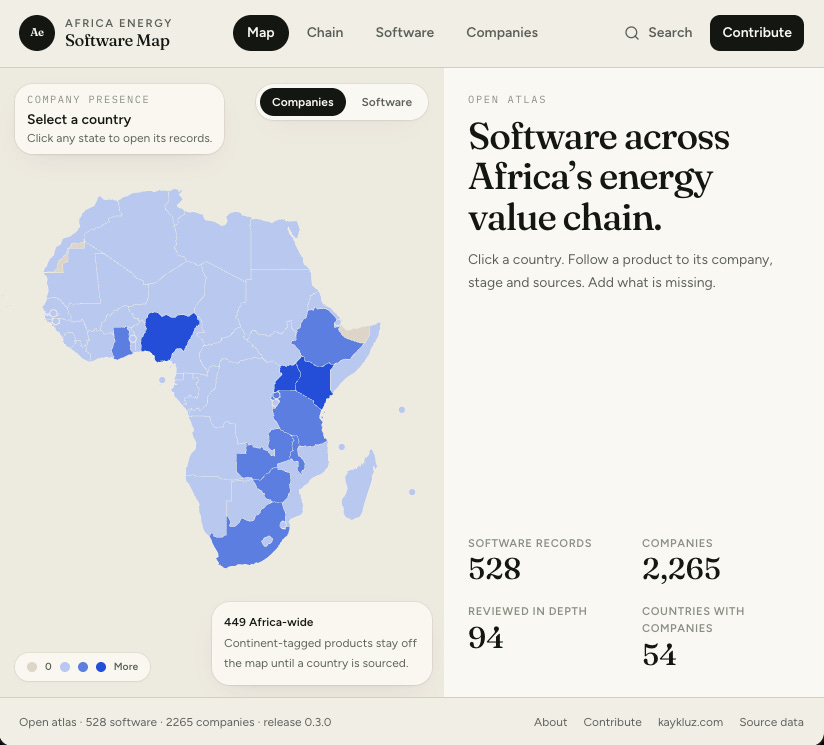
The first release contains 2,265 organisations, 528 products, activity across 54 African countries, and 41 software categories: grid and utility software, metering and billing, mini-grid and distributed-energy management, asset monitoring, project development, financial modelling, PAYGo and payment infrastructure, energy data and analytics, carbon measurement, design and engineering, electric mobility, and the infrastructure that refuses to fit neatly inside one box.
You can search by country, market segment, technology, role, product category and maturity. More importantly, the map separates the organisation from what it builds and from where it has been used. A company saying it operates “across Africa” is not the same as evidence of a deployment in twelve countries. A headquarters tells you where the company receives mail, not where the product has proved itself.
Every record should eventually answer three different questions:
Who are they?
What have they built?
Where is there evidence that it is being used?
Those are different questions. The database treats them that way.
What the map is not: a ranking. I do not know which company is best; in several categories I am still learning what “best” should mean. A beautiful interface may hide weak field performance. A visually tragic product may quietly manage ten thousand energy assets without complaint. The Atlas is not an endorsement, not an investment recommendation, and not a paid list of organisations that successfully found my email address. Please perform actual diligence before buying software, investing money or connecting anything to a national electricity system.
It is a living record, not a finished poster: who is building, what they say they have built, where evidence of activity exists, and when that information was last checked.
Why it is open source
There are fifty-four African countries, thousands of energy companies, and products launching, merging, failing and reappearing under new names. I cannot keep all of that accurate by myself. I cannot even keep my Downloads folder accurate by myself.
So the whole project is open:
Africa Energy Atlas on GitHub
You can contribute an organisation, correct a category, challenge a claim, add a deployment, report a company that has closed, improve the data model, or fork the project and build something I have not thought of. Open source is not a decorative badge in the footer. It is the collection method. Claims lead back to sources, corrections have a history, and the people represented on the map can improve the map.
It is also why the Atlas cannot become a commercial directory where companies pay for favourable placement. Visibility can be sponsored. Facts cannot.
I should be direct about one thing. I am building inside this market, and I am not pretending to have no commercial interest in African energy software. A competitor can correct its own listing. A founder does not need to become my friend before their company is included. Neutrality does not mean having no perspective. It means designing a process that does not require everyone to trust the person maintaining it.
The map will be wrong
Let us address this early. A company will be missing. A category will be debatable. A deployment will have changed. Someone will insist that their blockchain-enabled, AI-powered, decentralised energy orchestration protocol does not belong under “Data and Analytics”. They may be right.
This is not a defect in launching. It is the reason for launching openly. A private spreadsheet can remain wrong forever without embarrassment. A public database has the opportunity to be corrected.
It also makes claims falsifiable, starting with mine. One year ago, I wrote that nobody was building the software stack. Today, you can open the map and test that statement. You can show me which layers are crowded and which remain genuinely empty. The point of learning in public is not to preserve your original argument. It is to become easier to correct.
The invitation
Go to map.kaykluz.com. Search for your company. Search for a problem you are trying to solve. Search your country, or the category you think nobody is building.
Then do one of four things: use the map, correct the map, contribute to the map, or build something the map proves is still missing.
This is Phase 1 of a larger Africa Energy Atlas. Software came first because that was the original question, but energy companies do not exist in a software-only universe. Over time the same connected database can grow to cover developers and operators, financiers and advisers, projects and assets, transactions, policies and physical infrastructure. Not seven disconnected directories with seven conflicting copies of the same company: one living model of the ecosystem. A foundation should be small enough to inspect before someone builds another five floors on it. I have worked in infrastructure long enough to respect this principle, usually several months after ignoring it.
One year ago, I asked why nobody was building the software stack for African energy. The answer arrived slowly, one email, meeting and product demonstration at a time. People were building in Lagos, Nairobi, Cape Town, Kigali, Accra, Cairo, Dakar, Lusaka, and in dozens of places I still have not looked carefully enough. They were solving pieces of the system without always being able to see the other pieces.
The builders were here all along. They just could not always find one another.
Now, at least, we have a map. Let us make it accurate together.
Explore the map: map.kaykluz.com
Inspect, contribute or fork the project: github.com/kaykluz/africa-energy-atlas
Read the article that started this: Why Is No One Building the Software Stack for Energy in Africa?
—S
Chief Impostor, provisional cartographer, recovering spreadsheet architect
P.S. Yes, the open-source software map began in Excel. No, the irony was not lost on me. It was, however, saved in a separate tab.
P.P.S. If your company is missing, this is not a strategic statement about your importance. It means I did not find you. Please submit it before writing a seventeen-post thread about gatekeeping.
P.P.P.S. The repository currently has fewer circular references than the spreadsheet it replaced. This is the highest technical standard I am prepared to guarantee.