

Somewhere on my laptop there is a bill of quantities for a solar and storage plant in Ghana. A few weeks ago I was going through it line by line, doing the thing I do where I pretend to check the arithmetic but am really checking the brands.
Inverters: Huawei.
Batteries: Huawei.
Monitoring platform: Huawei.
Nothing unusual in that. Open a commercial and industrial solar tender in Lagos, Accra or Abidjan and the odds are decent that at least one of the three expensive boxes has the little red flower on it. In my corner of the market Huawei has become what I privately call the cheap premium: no longer the cheapest kit in the tender, because there are now six Chinese brands underneath it on price, but the kit the lender’s technical adviser stops asking questions about.
What made me put the laptop down was what happened next. I picked up my phone to make tea (I do not need my phone to make tea; this is a separate problem) and YouTube, which has correctly identified me as a man of simple pleasures, served me a forty-minute documentary on how the United States killed Huawei in 2019.
Killed. Past tense.
I sat in my kitchen holding a document that said otherwise.
Then I did the maths on my own week. The base stations along the road to every site I have ever visited in Ghana or Nigeria: Huawei, in all likelihood, because Huawei built about seven in ten of the continent’s 4G networks. The colleague in Johannesburg who sends me voice notes from a phone with no Google on it: Huawei. The inverter on page four of that bill of quantities: Huawei, first in the world by shipments for the tenth year running.
So either the documentary was wrong, or I was dealing in ghosts.
It turns out the documentary was right, and that is the interesting part. The United States really did take almost everything from Huawei between December 2018 and September 2020.
BUT….
The company is bigger now. Not in spite of the sequence; partly because of it. The mechanics of how are, I think, the most useful set of lessons this series has produced so far for anyone trying to build a billion-dollar energy company in a market that keeps trying to take things away from them.
I did what I do when my inbox and the internet disagree. I went and read everything.
Part 1: The company that keeps turning up
Huawei built roughly 70 percent of Africa’s 4G networks and about half its 3G, per the Atlantic Council and Merics. In Nigeria alone the count is reported at around 27,500 sites and 10,000 kilometres of fibre.
The rectifier in the cabinet, the battery under it, the solar array on the pole, the controller that decides when the diesel runs: Huawei sells all of that too, and has done since before anyone in Lagos said the words “energy transition” out loud.
The inverter on the roof: Huawei shipped 176 gigawatts of PV inverters in 2024, first in the world for the tenth consecutive year, with Wood Mackenzie singling out Africa as one of its strong regions. Huawei and Sungrow between them now hold 55 percent of the planet’s inverter market and nobody else has more than five.
The visible part of Huawei (Phones) got amputated. The invisible parts compounded. And the invisible parts, it turns out, had been prepared for the amputation since 2003.
Part 2: The amputation, in dates
I want to lay the sequence out plainly, because the strategy only makes sense against the exact timing of what was taken and when.
1 December 2018. Huawei’s chief financial officer, Meng Wanzhou, is arrested in Vancouver on a US extradition request during a stopover. She will spend almost three years under house arrest in Canada.

16 May 2019. The US Commerce Department adds Huawei and dozens of affiliates to the Entity List. American companies now need a licence to sell it anything, and the default answer is no.
19 May 2019. Google suspends the transfer of hardware, software and technical services to Huawei. Future Huawei phones outside China will ship without the Play Store, Gmail or YouTube. Within the week Intel and Qualcomm begin cutting chip supply, and ARM, whose architecture underlies almost every smartphone processor, follows.
15 May 2020. Commerce amends the foreign direct product rule specifically to catch Huawei’s workaround. The press release title says the quiet part loudly: “Commerce Addresses Huawei’s Efforts to Undermine Entity List”. Any chip made anywhere in the world with American tools now needs a licence if it is Huawei’s design.
17 August 2020. The rule is widened again to close the remaining gaps and 38 more affiliates are listed. TSMC, which had been manufacturing Huawei’s most advanced processors, stops taking orders in September.
November 2020. Huawei sells its Honor sub-brand to a consortium for a reported fifteen billion dollars plus, so that Honor can go back to buying Qualcomm chips and Google services.
Now the damage.
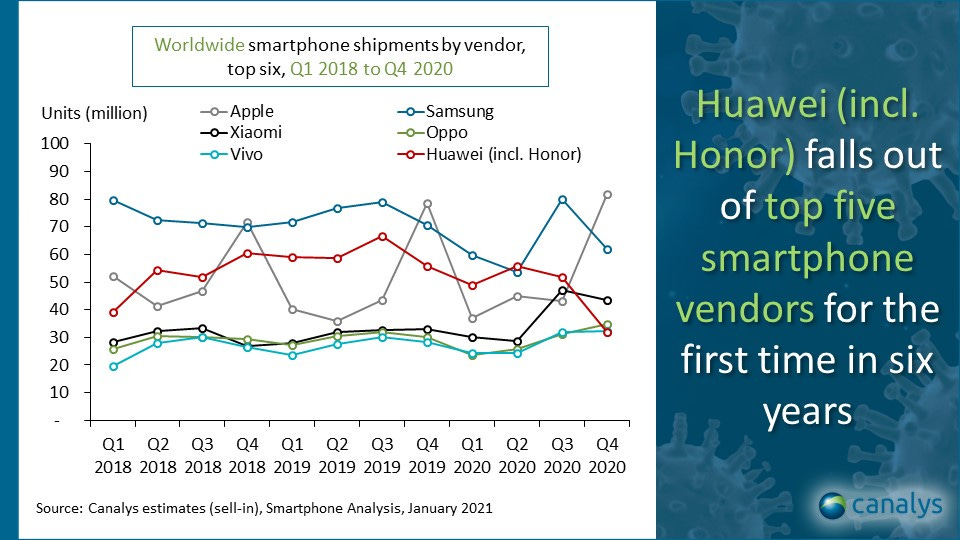
Huawei shipped 240.6 million phones in 2019, second in the world behind Samsung, ahead of Apple. In the second quarter of 2020, running on stockpiled chips, it was briefly the largest smartphone maker on earth. By the fourth quarter it had fallen to sixth. In 2021 it shipped 35 million, a fall of 81.6 percent, and its global share went from 15 percent to 3. In 2022 it was tenth, on 28.1 million. Group revenue fell 28.6 percent in 2021. Richard Yu, who runs the consumer business, later admitted the humiliation in one line: the company that led the world in 5G networks could not sell a 5G phone.
The industry consensus at that point was that Huawei’s handset business would wind down like Nokia’s had. Analysts wrote the obituaries. I would have signed one.
Here is the same sequence as a ledger, because I think in ledgers and because the right-hand column is this whole essay.
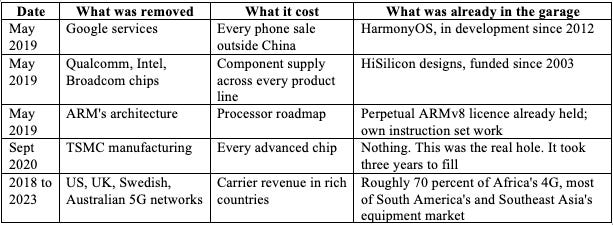
Read the last row again. Huawei was locked out of the markets that pay the most per site, and left alone in the markets that have the most sites.
Part 3: The letter
On the morning of 17 May 2019, the day after the Entity List announcement, an engineer called He Tingbo sent an email to the staff of HiSilicon, Huawei’s chip subsidiary. The internet had never heard of her. Within a day, most of Chinese tech had.
The letter said, in effect: we have spent years designing chips we hoped never to use. Tonight they become the main product. She described the unit’s job as “building a backup lifeline for Huawei and for the whole country”. Inside Huawei those chips had a nickname. Spare tyres.
I went looking for where the spare tyres came from, and this is where I uncovered the first strategic note.
In 2003, Ren Zhengfei, the founder, put He Tingbo in charge of chip development with an annual budget of 400 million dollars and an instruction that reads, from here, like paranoia.
Design the parts we currently buy from Americans. Not to sell them. To have them, in case the day comes when the Americans will not sell.
HiSilicon was formally created the following year. The first generation chips flopped; the K3V1 and K3V2 were widely mocked. Ren’s response, according to accounts of the period, was not to cut the budget. It was to complain that she was spending it too slowly.
Do the arithmetic at the 2003 run rate alone and you get more than six billion dollars spent on a component nobody was allowed to ship, over sixteen years, before a single sanctioned quarter. The real figure is higher because the budget grew.
This bit reorganised my thinking about the whole company. The discovery is not that Huawei survived the ban. Lots of companies survive things. The discovery is that survival had a line item. There was a budget for the flat tyre in the year the tyres were new.
I have sat through a lot of investment committees on African energy companies. I have built the models for some of them, which is worse, because I know where the bodies are. Every one of them had a single point of failure it had collectively decided not to think about. One inverter supplier. One currency. One offtaker. One bank. One import licence. One fuel contract. The spare tyre was never in the budget because the budget was already too tight to include a tyre we might never use, and every board I have ever presented to would have said so.
Ren’s answer to that objection, as far as I can reconstruct it, was three words: it must be spent.
If you have read the Foundry Problem series on this blog you will recognise the shape. Africa’s energy sector imports the foundational layer and builds on top of it, and calls the dependence “efficiency” right up until the supplier changes its mind. Huawei looked at the same dependence in 2003, with a much bigger balance sheet and a much nastier counterparty, and decided the efficiency was fake.
Part 4: Country and city
To understand why the spare tyres worked when they were finally fitted, you have to go back further, to the first time Huawei lost a supplier.
Huawei was founded in Shenzhen in 1987 with 21,000 yuan of registered capital, which was less than three thousand dollars then, as a sales agent for a Hong Kong company that made small telephone switchboards for hotels. In 1990 that supplier sold itself, and Huawei’s business ended overnight. Ren had to build a switch or close the company. Three years later Huawei shipped the C&C08, a 2,000-line digital exchange and later a 10,000-line one, the most capable switch made in China at the time.
I did not know until this month what the name means. The C&C stands for Country and City: the countryside surrounds the city. That was the marketing plan, written into the product code. Ericsson, Alcatel and Lucent owned Beijing and Shanghai. Huawei went to county exchanges the foreigners could not be bothered with, sold cheaper kit that broke more often, and left engineers on site to fix it until it didn’t. By 1998 it was the largest supplier of digital switches in the country.
Then it did the same thing to the world.
In November 2000 Ren travelled to Africa with China’s vice premier, and the contracts followed the trip: twenty million dollars in Ethiopia in 2003, a 200 million dollar CDMA network in Nigeria in 2005, then Ghana, Kenya, Morocco, Mauritius and Congo in 2006. Wharton was writing case studies about Huawei as a trailblazer in Africa in 2009, four years before it launched a phone anyone in Europe wanted. Africa and Russia were the training ground. Europe came after.
The purest expression of the doctrine is a product most of my readers have driven past without noticing. In 2017 Huawei launched RuralStar: a base station for villages of a thousand people, built by throwing out everything a base station is supposed to be. The tower became a pole. The microwave backhaul became a wireless relay hop off a neighbouring site, so no line of sight and no dish. The diesel generator became six solar panels and a battery. Deployment cost fell by more than half and the operator’s payback dropped from ten years to three. By the end of its first year there were two thousand of them across a dozen countries, including Ghana, Nigeria, Kenya and Côte d’Ivoire.
Notice what RuralStar is. It is a telecom product where the energy engineering is the innovation. The radio was fine. The site was the problem, and the site was mostly a power problem.
In the Citadel piece I argued that Citadel built its financial layer first and bought physical assets later, and that Africa forces you to build backwards.
Huawei is the company that built backwards on purpose. It started in the ugliest markets with the ugliest problems, learned to keep a network alive where the diesel does not arrive, and only then walked into Vodafone’s office. When the ban came, the ugly layer was the one that survived, because nobody in Washington had thought to sanction a base station in Kaduna.
Part 5: Huawei came with a bank attached
There is a second reason Huawei won the countryside, and it is the reason most relevant to the readers of this blog who spend their lives trying to close a project finance.
In 2004 Huawei signed a ten billion dollar credit line with the China Development Bank whose purpose was to lend money to Huawei’s customers so they could buy Huawei equipment. In 2009 it was tripled to thirty billion. The Export-Import Bank of China added its own facilities. The Center for American Progress went through the public record and found that between 1997 and 2019 Chinese policy banks had lent 14.8 billion dollars across 99 Huawei-related projects around the world, and that Africa was the largest borrower, with 57 loans worth 4.7 billion. The Wall Street Journal’s wider estimate of state support, in grants, credit, tax breaks and cheap land, was as much as 75 billion dollars. Huawei disputes the framing and says the CDB line has rarely been more than ten percent drawn, which may be true and is also beside the point.
The point was made by Fred Hochberg, who used to run the US Export-Import Bank, and who is not a man inclined to compliment Huawei. What Huawei did, he said, was make sure that “when they made a bid, it came with financing terms” the competition could not match.
Ask the Nigerian operators and you get the same answer from the buyer’s side. The chairman of the licensed telecoms operators’ association told DW that Huawei’s kit “comes with terms that are very attractive to operators”, and that it is simply easy to work with them.
Now stand this next to two earlier pieces in this series.
In the MOOVE Thesis I argued the machine was an IPP with wheels: buy the asset with debt, place it with an operator who cannot fund the capex, collect at source. In the Kobo360 anti-template the lesson was harsher: offtaker credit quality only counts once it is structured into the funding, and Kobo360 had better credit than Moove and died anyway because it never was.
Huawei did both, in 2004, to telecom operators, and the operator never had to structure anything. The quotation and the term sheet were the same document. The operator’s credit was underwritten by a policy bank before the operator had finished reading the bill of quantities.
I have lost tenders on tariff to competitors whose plant was worse than mine, because their bid had a bank attached and mine had a bank “in advanced discussions”. Every developer reading this has.
The African energy company that wins the next decade will not be the one with the lowest cents per kilowatt-hour. It will be the one that walks into the factory with the Afreximbank, AFC or local-bank term sheet already stapled to page one.
Part 6: The energy business was standing next to the base station
This is where my day job enters the story, and where I had initially the wrong mental model.
I had assumed Huawei “diversified” into energy the way conglomerates diversify: a strategy offsite, a new division, a logo.
It is not what happened.
The energy business was standing next to every base station Huawei had ever sold, and it had the largest line in the customer’s operating budget.
Africa has roughly 500,000 telecom towers. The majority run on diesel. CrossBoundary Energy puts it at about 70 percent, with energy accounting for 30 to 60 percent of tower opex in remote areas. Nigerian operators now spend around 400 million dollars a year keeping their sites powered after subsidy removal sent diesel up as much as 200 percent. Vodacom’s energy bill across its African operations was 300 million dollars in 2025.
Huawei sold the radio. Then it sold the rectifier the radio needed. Then the battery the rectifier charged. Then the solar array that charged the battery, the controller that decided when the diesel ran, and eventually the AI that predicts the weather and schedules the whole site’s power like a scarce resource: Orange Côte d’Ivoire reported a 45 percent reduction in rural site downtime on that system at MWC this year. RuralStar bundled all of it into one pole.
Then Huawei took that catalogue, the power electronics, the thermal management, the battery management, the cloud that watches it all, out of the telecom cabinet and put it on a factory roof. That is FusionSolar. Huawei Digital Power was carved out as a standalone company in June 2021, which is to say a year after the foreign direct product rule and while the smartphone business was in freefall. Its revenue went from 55.2 billion yuan in 2023 to 68.7 billion in 2024 to 77.3 billion in 2025, which at today’s rates is around 10.8 billion dollars. For scale, Tesla’s energy generation and storage division, the one Wall Street calls the good half of Tesla, turned over 12.8 billion in 2025.
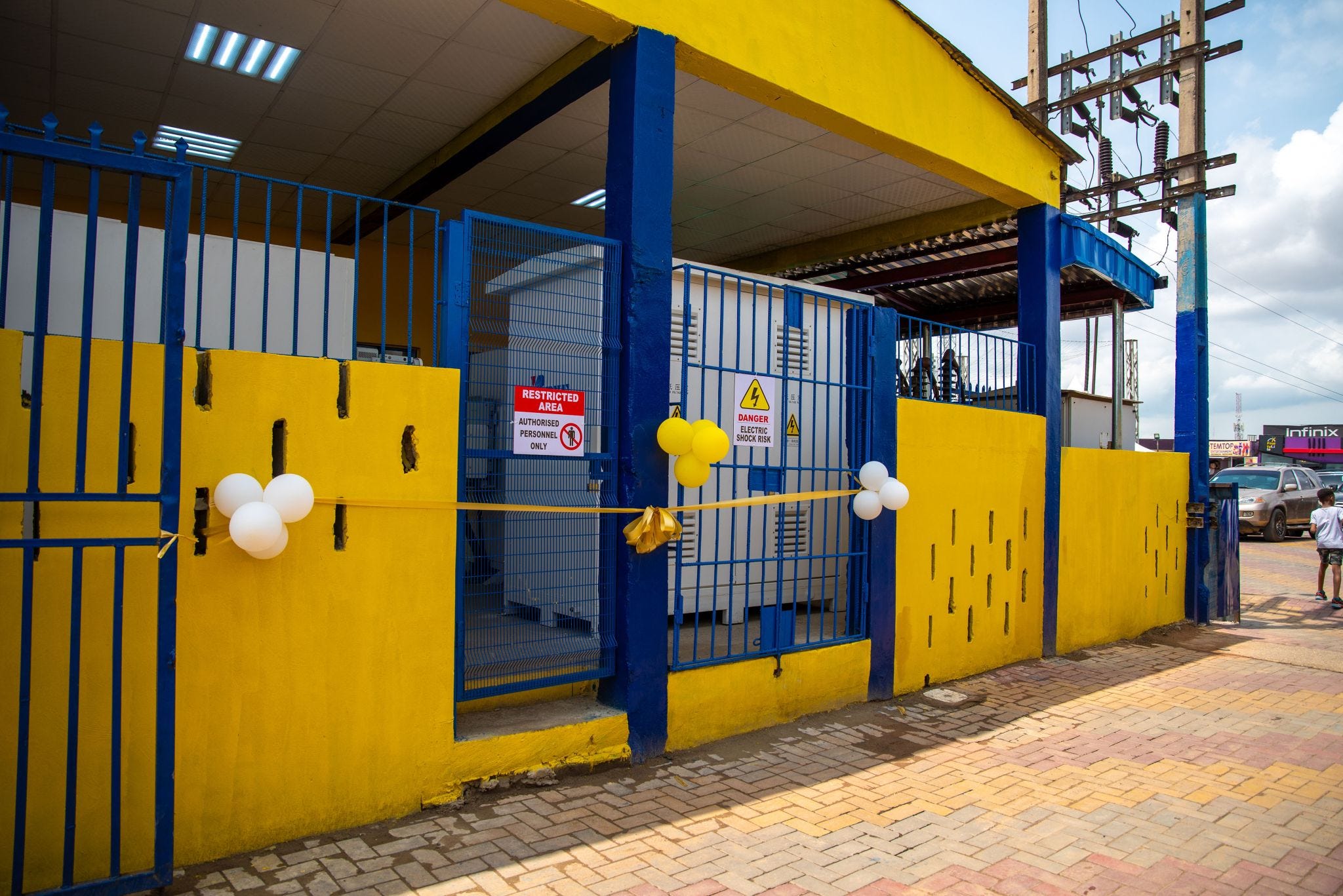
So when I see the little red flower on page four of a Ghanaian bill of quantities, what I am actually looking at is a telecom site power product, twenty years old, that grew up and moved out.
Two things follow for anyone building in African energy, and they point in opposite directions.
The first is the lesson. Huawei did not find a new market. It noticed that the energy bill was the biggest line in its existing customer’s opex and that it already owned the cabinet the bill lived in. If you run a solar plant next to an industrial load, the base station, the cold room, the borehole pump and the data centre are all standing there with the same bill, and you already own the cabinet.
The second is the warning. The company that taught the world to start in the countryside is, in African C&I energy, now the city. It is the incumbent on the bill of quantities, the safe answer, the brand the lender does not question. The countryside is open. Somebody is going to do to Huawei’s inverter business in Africa what Huawei did to Ericsson in Sichuan, and the six cheaper brands underneath it in every tender I see are the early signal.
Part 7: The thief who pays three times more than he collects
I need to deal with the intellectual property story, because it is the part of the Huawei narrative that most of my readers have absorbed without checking, and because the checking produced the single most surprising number in this piece.
In February 2020 the US Justice Department expanded its case against Huawei into a racketeering indictment alleging decades of trade secret theft. Huawei denies it. I am not a court and I am not going to adjudicate it here. What I can read is the public record of who pays whom.
In June 2019, one month after the Entity List, Huawei told Verizon it was using more than 230 Huawei patents and owed more than a billion dollars in licensing fees. In February 2020 it sued. In July 2021, days into a federal jury trial in Texas, Verizon settled on confidential terms. Verizon, which is barred from putting a single Huawei box in its network, pays Huawei.
The portfolio behind that is not something you assemble in a hurry. Huawei filed its first Chinese patent in 1995. It has been the largest user of the international PCT filing system since 2014, according to WIPO’s own assistant director general, with 6,600 international applications in 2024 alone. At the end of 2025 it held 165,000 active granted patents. Its 5G patents are licensed on more than 2.7 billion devices, its Wi-Fi patents on 1.2 billion, its video codec patents on 3.2 billion. About fifty Fortune Global 500 companies are licensees. It has signed more than 260 licence and cross-licence agreements with American, European, Japanese and Korean companies, and it charges a maximum of 2.50 dollars per 5G phone. Licensing brought in about 630 million dollars in 2024.
Huawei’s chief legal officer said at its IP forum in November 2025 that over the years the company has paid nearly three times more in royalties than it has received. Qualcomm’s own 10-K records 1.8 billion dollars booked from Huawei in a single quarter of 2020 under a settlement and a new licence, signed while the Entity List was already in force.
Whatever you believe about the indictment, that is not the balance sheet of a company that gets its technology for free. It is the balance sheet of the industry’s most reliable payer, who also happens to write a lot of the rules: Huawei submitted more than 10,000 technical contributions to standards bodies in 2024.
And the rules are where the toll booth is. A company that spends thirty years helping to write the 5G standard collects on phones it will never sell, in countries that have banned it, from carriers that cannot buy its equipment.
The energy translation is one I have been circling for two years without naming. In African energy nobody owns the standard. Not the PPA template, not the metering data format, not the settlement protocol, not the interconnection spec.
When I built the Africa Energy Software Map last month, the finding that stung was that 474 software products claim to serve the market and only 20 could evidence a deployment. The reason is that there is no standard for them to plug into, so every one of them is a bespoke integration and every integration dies with its champion.
Whoever writes the spec that the lenders adopt, the way Huawei’s polar-coding patents became part of the 5G spec that Verizon’s own suppliers had to follow, collects on plants they never built. In the NVIDIA piece I called CUDA a standard with a toll booth. Huawei’s patent portfolio is the same thing from the other side of the ban.
Part 8: If you cannot build the best chip, build the biggest room
I want to spend a moment on the chips, because the Ascend story is where the doctrine stops being defensive and becomes the most interesting infrastructure play in the world, and because it is, underneath, a telecom trick.
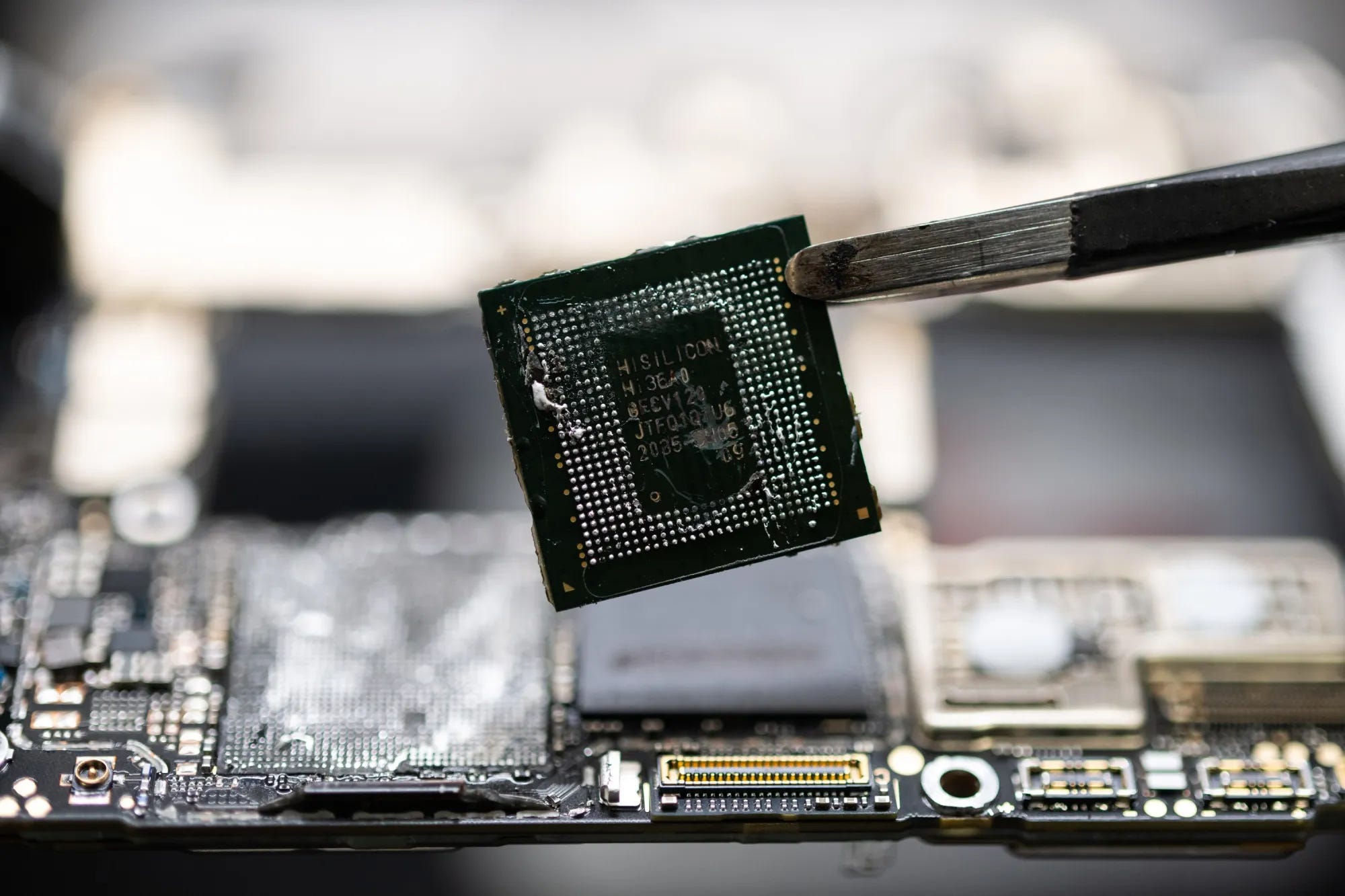
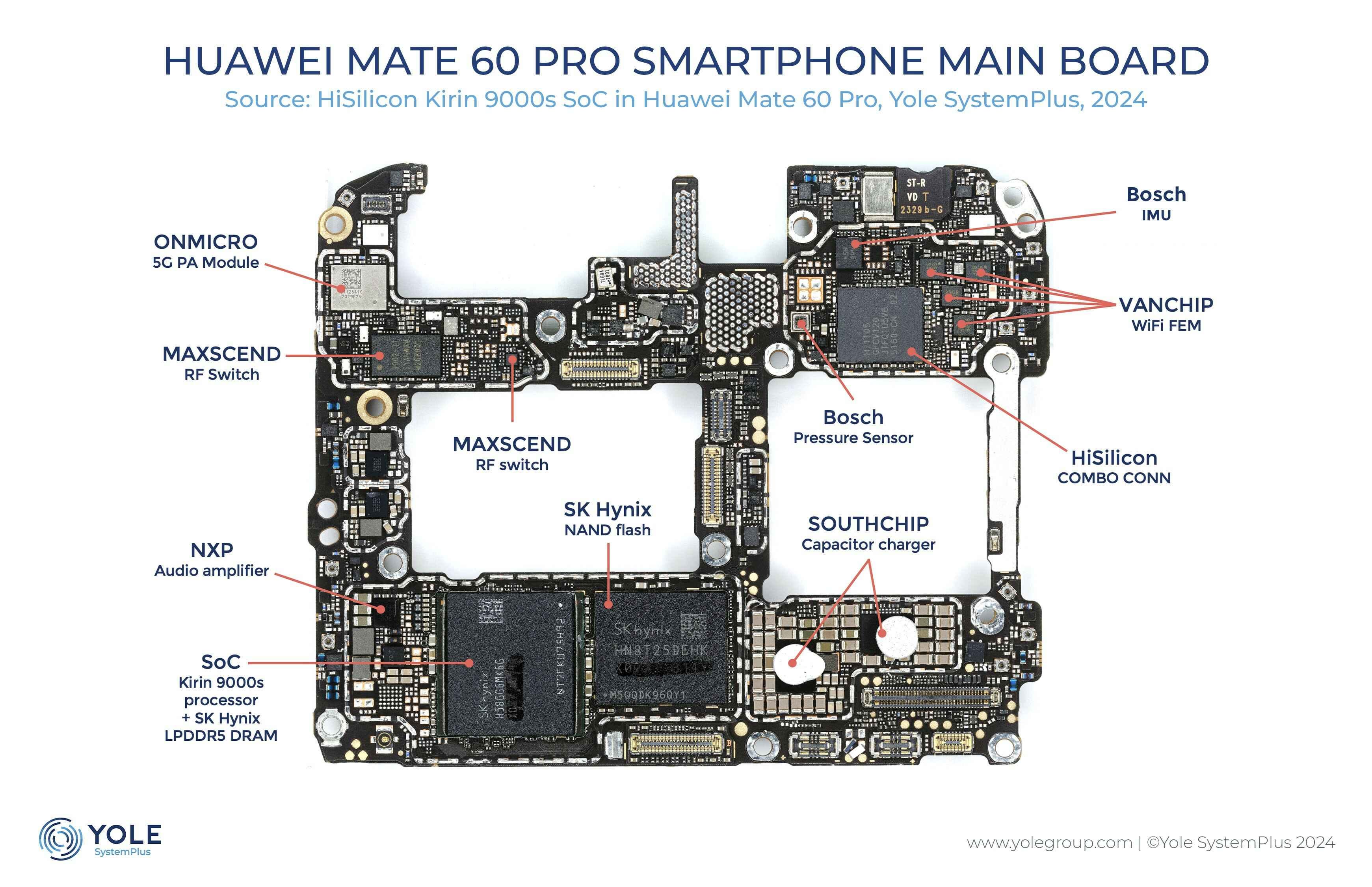
When TSMC stopped in September 2020, Huawei was left with chip designs it could not manufacture. For three years its flagship phones ran on Qualcomm chips deliberately restricted to 4G under limited licences. Then, in the last week of August 2023, while the US Commerce Secretary was on a visit to Beijing, Huawei put the Mate 60 Pro on sale without announcing what was inside it. TechInsights bought one, took it apart, and found a Kirin 9000s made by SMIC on a 7-nanometre process that the sanctions were supposed to make impossible. One TechInsights analyst called it a “slap in the face” for Washington. In 2025 Huawei was the largest smartphone seller in China, on 16.4 percent of the market.
The AI chips are the same story with more zeros. The Ascend 910C went into mass production in the first quarter of 2025. It is two older 910B dies packaged together, and on paper it delivers about 80 percent of an Nvidia H100, a chip from 2022. On its own it would not worry anyone in Santa Clara.
So Huawei does not sell it on its own. In March 2025 it launched the Atlas 900 A3 SuperPoD: 384 of those chips wired together across sixteen cabinets so tightly that, from the software’s point of view, they behave like one computer. The interconnect that makes that possible, UnifiedBus, is the thing Huawei spent thirty years learning to do in telecom: move enormous amounts of data between boxes that are individually unremarkable.
Then, at Huawei Connect in September 2025, the rotating chairman Eric Xu did something Western executives rarely do. He conceded that China would lag in semiconductor manufacturing “for a relatively long time”, and then laid out a roadmap built entirely on that concession: Ascend 950PR in the first quarter of 2026 with Huawei’s own high-bandwidth memory, 950DT in the fourth, 960 in 2027, 970 in 2028, each roughly doubling the last. The Atlas 950 SuperPoD, due in the fourth quarter of this year, links 8,192 chips. The Atlas 950 SuperCluster links 64 of those into more than 520,000 chips across 10,000 cabinets, and the 960 version scheduled for 2027 goes to a million. Huawei also said it would open-source the software stack, the CANN compiler and the Mind toolchains, by the end of 2025, which is the CUDA playbook run by a company that could not buy a GPU.
Whether the room is really faster than the chip is an argument for people who read benchmarks for pleasure. What matters for this series is what happened next on the demand side, because a supplier’s strategy is only a strategy if a customer turns up.
On 24 April 2026 DeepSeek released V4 with day-zero support on Ascend. DeepSeek gave Huawei early access to the model and did not give it to Nvidia. Huawei says part of the smaller V4-Flash was trained on its chips; the conservative reading, which I share, is that frontier training still happens on Nvidia and what moved to Huawei is inference, which is a different problem and a much bigger market.
On 17 July Moonshot released Kimi K3, a 2.8 trillion parameter model. On 19 July it paused new subscriptions because, in its own words, “our GPUs are feeling it”. A Chinese lab with a model competitive with the best American ones could not serve the customers who wanted to pay for it.
And two weeks ago Bloomberg reported that DeepSeek plans to install at least 160,000 Ascend 950DT chips at a gigawatt-scale data centre it is building in Ulanqab, Inner Mongolia, a hardware order reported at around 18 billion yuan. Neither company has confirmed it. Bloomberg’s sources also say Huawei can only make 950DTs in the low hundreds of thousands this year, and that the memory supply is a bottleneck, so filling the order could take more than a year. That is the honest state of the spare tyre in September 2026: the demand has arrived and the factory is the constraint.
Two observations from the energy side, since a gigawatt-scale campus is an energy project first and a compute project second.
The first is that the same catalogue that keeps a base station alive in Ulanqab’s -30 degree winters, the rectifiers, the batteries, the liquid cooling, the site controller, sits under the SuperCluster, and Huawei sells that too. If you read my Zuckerberg piece you know I think superintelligence is priced in kilowatt-hours. Huawei appears to agree, and it is the only company in the world that sells the chip, the interconnect, the cloud and the substation from one catalogue.
The second is the lesson. In the NVIDIA piece, move two was “sell the stack, not the component.” Huawei ran that move from the opposite direction. It could not get the component. So it sold the room.
The African energy builder is in Huawei’s 2020 position, permanently. You will never get the cheapest turbine, the cheapest capital, or the largest plant. Every asset you build will be small and individually unimpressive: a one megawatt rooftop in Ota, a two megawatt biomass boiler in Tema, a four hundred kilowatt mini-grid in Plateau.
The 910C is not the product. The SuperPoD is.
The portfolio, wired together with one metering platform, one O&M fleet, one SPV structure and one lender, is the thing a bank can underwrite as a single asset. Moove got to 2.1 billion dollars with 42,000 individually unremarkable cars and one bus.
Part 9: Did it work?
I promised myself I would not write “the ban backfired” because it is the lazy version, and because it is only half true. So here are both columns.
The ban worked. Huawei’s global smartphone business is gone outside China: of roughly 48 million phones shipped in 2024, about 46 million stayed home. It is out of American, British, Swedish and Australian 5G networks and has been designated on the Entity List with around 160 affiliates. Its CFO lost three years of her life. It sold Honor. Its revenue fell by more than a quarter in 2021. Its cloud business, the one that is supposed to monetise the chips, saw external revenue fall 3.5 percent in 2025 while Alibaba’s grew 36. And the company still cannot make enough advanced chips to fill a single customer’s order.
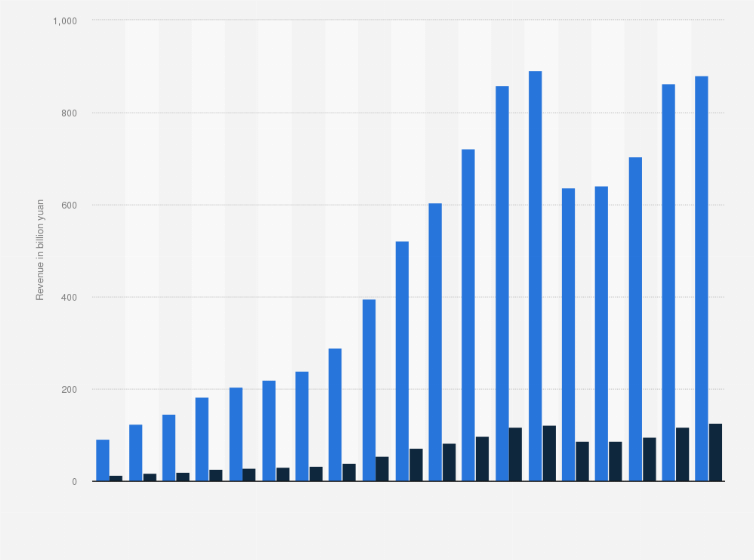
The company won. Huawei’s 2025 revenue was 880.9 billion yuan, about 127.5 billion dollars, its second-highest year ever and 1.05 billion yuan short of the 2020 record. Net profit was 68 billion yuan, up 8.6 percent. R&D was 192.3 billion yuan, 21.8 percent of revenue, which is roughly 27.5 billion dollars and about two and a half times what Ericsson and Nokia spent combined. Over the decade it has spent 1.382 trillion yuan on research. 114,000 of its people, 53.7 percent of the workforce, are in R&D. ICT infrastructure did 375 billion yuan, the consumer business 344.5 billion, digital power 77.3 billion, and the car business 45 billion, up 72 percent. The Ascend developer ecosystem passed four million.
And the annual report that carries those numbers was signed by Huawei’s rotating chairwoman, Sabrina Meng. Meng Wanzhou. The CFO who was arrested in Vancouver in December 2018.
The ban did what bans do. It removed the visible part of the company from the places that could see it. Then the invisible parts kept compounding, because the invisible parts had a spare tyre, a bank attached to every bid, a training ground in the hardest markets on earth, and a set of patents that made the people banning it into paying customers.
Part 10: The Spare Tyre Doctrine
Here is what I am taking from all of this for the African energy builder. Seven moves, in the order Huawei ran them, each with the test I would now put to a management team before I put their numbers in a model.
Move 1. Start in the country, not the city.
Huawei’s first breakthrough was a switch named after the strategy, sold to county exchanges Ericsson could not be bothered with. Its first foreign markets were Russia and Africa. Europe was the graduation, not the entry.
In African energy the city is the utility-scale tender, the DFI-backed IPP, the multinational’s headquarters plant with a global procurement team. The country is the tier-two industrial cluster, the agro-processor, the tower company, the cold chain, the loads that are too small for the big developers and too complex for the banks.
The test: would MASDAR bid for this customer? If yes, you are in the city. Go find the county. Benchmark: Huawei was the largest switch supplier in China within five years of the C&C08. Give yourself five years to become the default supplier in one neglected segment before you touch a capital-city tender.
Move 2. Sell the site, not the box.
RuralStar cut deployment cost by more than half not by making a cheaper radio but by redesigning everything around the radio: the tower, the backhaul, the power. The energy engineering was the product.
Do not sell a solar plant. Sell a powered site: generation, storage, cooling, monitoring, maintenance and financing as one contract with one counterparty. This is the argument I made in the “Decarbonize Your Factory” piece and Huawei is the proof it scales to a hundred billion dollars.
The test: can your customer buy any one piece of your offer without you? If yes, you are a box, and boxes are commoditised by the second Chinese brand to arrive.
Move 3. Bring the bank with you.
Ten billion dollars from CDB in 2004, thirty billion by 2009, 57 loans into Africa alone. The bid came with financing terms. The customer’s credit was underwritten before the customer asked.
Arrange the DFI, export credit or local bank line before the tender, not after the award. The quotation and the term sheet should be the same document. This is the Kobo360 lesson (credit only counts once it is structured into the funding) executed by the vendor rather than the borrower.
The test: does your bid contain financing terms your competitor cannot match? If not, you are competing on tariff, and tariff is a race to zero that Huawei’s cheaper cousins will win.
Move 4. Pack the spare tyre before the flat.
Four hundred million dollars a year from 2003 on chips nobody was allowed to ship. Sixteen years. The founder’s only complaint was the pace of spending.
Name the one input a counterparty can weaponise against you.
An import licence. A currency. A single inverter OEM. A single fuel supplier. A single offtaker. A single bank. Then fund the alternative before you need it, and protect that line in the budget from the board. Huawei’s own stated rule is that R&D never falls below ten percent of revenue; it is at 21.8 percent now. An energy company does not need that number. It needs a fixed slice of EBITDA, decided in advance, that pays for the second supplier’s qualification, the local-currency facility, the fuel contract you are not using yet.
The test: name the supplier who could end you with one email. What did you spend on their replacement last year? If the answer is zero, you do not have a tyre, you have a hope.
Move 5. Own the standard, then rent it.
Ten thousand standards contributions a year. 165,000 patents. 2.50 dollars per 5G phone from carriers that cannot buy a Huawei box. And, crucially, three times more paid out than taken in, because the point of a standard is that everyone uses it, including you.
Write the PPA template the lenders adopt. Write the metering data specification the regulator references. Write the settlement protocol the aggregators plug into. Contribute to the grid codes and the net billing rules (I have spent more hours on NERC’s than I would like to admit). Once your document is the standard, you collect on plants you did not build, from developers who compete with you.
The test: if you shut down tomorrow, does anyone still have to use your document? If not, you own a business. Not a standard.
Move 6. When you cannot build the best unit, build the biggest room.
The 910C is 80 percent of a three-year-old Nvidia chip. The SuperPoD is 384 of them behaving as one. The SuperCluster is 520,000. The interconnect is thirty years of telecom engineering. The concession that the unit will never be the best was made out loud, on stage, by the chairman.
Accept that every asset you build in Africa will be small and sub-scale. Make the portfolio the product. The bus is your data layer, your contract layer, your single SPV, your single O&M fleet, your single lender relationship. RAMCO’s instinct in Nigeria, whatever becomes of it, is exactly this instinct. Moove’s 42,000 cars are exactly this instinct.
The test: can a lender underwrite your portfolio as one asset? If each plant needs its own diligence, its own lawyer and its own model, you have 384 chips and no bus.
Move 7. Let the ban do the marketing.
DeepSeek gave Huawei early access and not Nvidia because Nvidia was not allowed in the room. Kimi K3 ran out of GPUs and the only domestic pool large enough to help was Huawei’s. Every restriction Washington added became a customer acquisition channel for the Ascend ecosystem. Four million developers did not arrive because the chip was best. They arrived because the alternative was banned.
In African energy the ban is the grid. Every collapse, every subsidy removal, every diesel spike, every FX crunch is a demand signal and a channel. Design the business so that when the crisis hits, customers are routed to you by the crisis itself. This is the argument of “The Demand Was Never Small” and Huawei is the proof at national scale.
The test: when the grid collapsed last quarter, did your pipeline grow or shrink? If it shrank, you are selling into good times, and Africa does not sell those.
Here it is as one table, because I know at least a third of you scrolled here first.
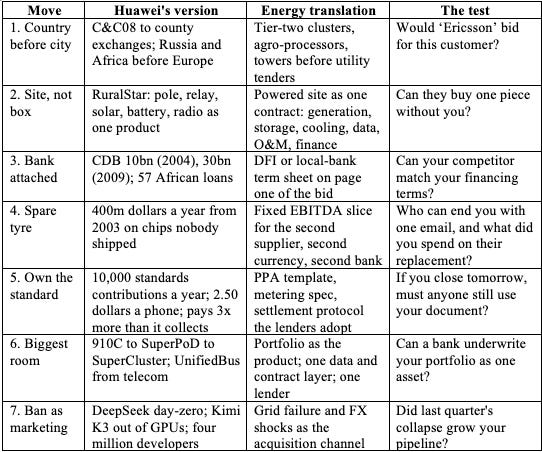
A note on sequence, because Huawei’s order matters more than its list.
Moves 1 to 3 were built between 1993 and 2009.
Move 4 ran in parallel from 2003 and was invisible until 2019.
Move 5 started with a patent in 1995 and only became a business after the ban made licensing the one revenue line nobody could sanction.
Moves 6 and 7 were only possible after 2020, and only because 1 to 5 were already there.
If you are building in African energy, 1 to 3 are your first three years, 4 and 5 start on day one at whatever scale you can afford, 6 becomes possible once move 3 has given you a repeatable capital stack, and 7 is a design principle rather than a phase.
Part 11: What does not cross the water
I owe you the other side, because a blueprint that pretends the balance sheet is copyable is a fantasy, and I have written enough of those in pitch decks to recognise one.
The state. Whatever the true number between Huawei’s “ten percent drawn” and the Journal’s 75 billion, no African energy company is going to get a thirty billion dollar policy bank line, and nobody is going to instruct MTN to buy seventy percent of its equipment from you, which is what Beijing reportedly did for Huawei and ZTE during China’s 4G build. Move 3 transfers. The scale of move 3 does not.
The patience. Huawei is privately held, with no listed shareholders asking why 400 million dollars a year is going into a product that does not ship. Your investors will ask. Move 4 transfers only if you decide the size of the tyre before the first board meeting and write it into the shareholders’ agreement.
The scale. 27.5 billion dollars a year of R&D and 114,000 engineers is not a number, it is a country. The doctrine scales down, though, and this is the part I find hopeful: your spare tyre is not a fab. It is a second qualified inverter OEM, a naira facility, a fuel supply contract you are not drawing on, a second offtaker in the same cluster. Those cost hundreds of thousands, not billions, and they are still almost never in the budget.
The controversy. Huawei is a company that half the world’s governments do not trust with their networks, on grounds that range from documented to asserted, and the racketeering indictment is unresolved. I have not tried to settle any of that here and you should not read this piece as a verdict on it. Being unwelcome in half the world is itself a constraint on the blueprint. Read it for the sequencing, not the geopolitics.
The home market. A billion domestic customers who cannot buy Google either is a floor no African company has. The nearest equivalent is a regional trade bloc that actually functions, and I will believe in that one when a Ghanaian inverter clears Seme border without a phone call.
-S
P.S. - Disclosures first.
In my day job I write Huawei equipment into bills of quantities, I have negotiated against Huawei’s pricing, and I have lost tenders to bids that came with a bank attached. Huawei has never paid me a kobo, and neither, for the record, has anyone else for writing this.
I worked on Empower New Energy’s Justrite solar-plus-storage programme in Nigeria. Empower financed it. Powercell built it. Huawei Digital Power supplied the kit. I have used a commissioning photograph from that project in Part 6. Huawei did not pay for the photograph or the essay.
If you think I have the ban wrong, that it worked and I am reading a survival story into a subsidy story, say so in the comments, publicly, so we can both be embarrassed later with a timestamp. I have changed my mind once already writing this and would prefer to do it in company.
If it was useful, send it to the one person you know who is currently carrying a single-supplier risk and calling it a partnership. If it was not, the unsubscribe link is at the bottom and it works even without Google services.
References
Huawei filings and statements
Huawei, 2025 Annual Report and press release, 31 March 2026
Huawei, 6th Innovation and IP Forum, 11 November 2025; PR Newswire version; Malay Mail version with WIPO remarks
Eric Xu, Huawei Connect 2025 keynote
Ren Zhengfei, interview with Chinese media, May 2019
Huawei, RuralStar Pro launch, February 2020; How three stars are making life better
2025 results coverage
Reuters via WHBL, Huawei posts slower annual revenue growth of 2.2%
TrendForce, Huawei 2025 R&D spending reaches record 192.3B yuan
Axis Intelligence, Huawei statistics 2026
Global Times, Huawei H1 2025 results
The bans
US Commerce Department, press release, 15 May 2020
Al Jazeera, Google suspends some business with Huawei
RUSI, Huawei’s ‘Spare Tyre 2.0’ and the limits of US sanctions
The collapse and recovery
PhoneArena, 2021 shipments down 81%
Light Reading, Huawei 2021 sales decimated by US sanctions
TechInsights, SMIC 7nm in the Mate 60 Pro; Reuters via Prothom Alo, teardown report
China Made & Tech, Huawei’s comeback
HiSilicon and the spare tyre
Reuters via US News, Huawei’s ‘chip queen’
Wikipedia, He Tingbo
Ascend, SuperPoDs and the AI demand
Converge Digest, Huawei unveils next-gen Ascend chips, SuperPoDs and UnifiedBus
TrendForce, Huawei unveils Ascend 950
RCR Wireless, Huawei outlines roadmap for Ascend AI chips
ScaleByTech, Huawei reveals Ascend 950, 960 and 970
Tech Insider, DeepSeek V4 on Huawei Ascend; AI Proem, What DeepSeek V4 means for Huawei and Nvidia
PYMNTS, Moonshot halts new Kimi K3 subscriptions; SCMP, Kimi K3 developer suspends new subscriptions
WinBuzzer on Bloomberg, DeepSeek reportedly bets on 160,000-plus Huawei chips; Big Hat Group, China AI Weekly, 13 September 2026
Patents and licensing
Insurance Journal (Reuters), Verizon, Huawei reach settlement; Bloomberg, settlement mid-trial
Mobile World Live, Verizon, Huawei settle US patent dispute
Qualcomm, Form 10-K FY2021
Africa: telecom and towers
Atlantic Council, The digital infrastructure imperative in African markets
WeeTracker, Ten Chinese companies building Africa’s connectivity
DW via Homeland Security Newswire, Africa embraces Huawei technology
Developing Telecoms, RuralStar self-contained cell site; GSMA, RuralStar Safaricom case study
Technology Magazine, Orange and Huawei at MWC 2026
AP, Africa’s cellphone towers turn to solar; CrossBoundary Energy, Energy as digital infrastructure’s advantage; GSMA, Tower power Africa
Africa: phones
Canalys via CNBC Africa, Africa’s smartphone market Q2 2025
Omdia, Africa Q1 2025
Intelpoint on StatCounter, Africa usage share; South Africa and Ghana
Energy and inverters
Wood Mackenzie, Global PV inverter shipments 2024; H1 2025 rankings
ElectroIQ, Huawei statistics 2024 segments; Baidu Baike, Huawei Digital Power Technology
History and financing
Knowledge at Wharton, Huawei: a Chinese trailblazer in Africa (2009)
EEWorld, Huawei’s ups and downs over 30 years
Washington Post / CAP, Huawei’s hidden advantage
IEEE ComSoc on WSJ, China’s financial support and Huawei’s rise
Light Reading, Huawei’s lucky number: 30B; phys.org/AFP, Huawei a key beneficiary of subsidies
Earlier in this series
Billion-Dollar Blueprints: Citadel, NVIDIA, the MOOVE Thesis, and Kobo360: The Anti-Moove
The Foundry Problem series; The Open-Source Map of African Energy Software and Companies; Decarbonize Your Factory. Don’t Spend Your Money; The Demand Was Never Small; The Future Is for Everyone With a Substation
Data Caveats
Things I could not nail down, or that I want to flag before somebody else does.
Huawei’s share of African inverters and batteries. There is no audited public number. I am relying on Wood Mackenzie’s global ranking, which names Africa as a strong Huawei region, plus what I see across the tenders I work on. Treat it as an informed observation, not a statistic.
27,500 sites in Nigeria comes from a secondary source (WeeTracker) and I could not trace it to a Huawei filing.
About two million Huawei phones sold outside China in 2024 is from a secondary source (chinamade.tech) summarising analyst data. The 48 million global figure is consistent with IDC and Counterpoint reporting; the domestic split is less firmly sourced.
Engineers sleeping in customers’ equipment rooms is from personal experience, I spent 3 years powering Huawei Radios in Nigeria with Solar+Batteries.
The DeepSeek 160,000 chip order is Bloomberg reporting as of 9 September 2026. Neither DeepSeek nor Huawei has confirmed it.
Whether V4 was trained on Ascend. Huawei says part of V4-Flash was. DeepSeek has not said. Most analysts read it as inference on Huawei, training still on Nvidia. I have written it that way.
Fortune Global 500 licensees. Huawei said 48 at its November 2025 forum and 55 on its IP page. I wrote “about fifty.”
Huawei’s numbers are Huawei’s numbers. The annual report is KPMG-audited but the company is unlisted, and segment definitions changed in 2023, so the long series is not perfectly comparable.
The six billion dollars is my arithmetic (400 million times sixteen years) and understates the real spend, because the budget grew and I could not find a disclosed cumulative figure.
Yuan to dollar conversions are at roughly 7.15 unless the source gave its own figure.