


In Summary
In May 2026, the Nigerian Electricity Regulatory Commission (NERC) signed the Net Billing Regulations 2026 (Regulation No. NERC-R-002-2026), made under section 226 of the Electricity Act 2023. For the first time, there is a clear, national rulebook for connecting your solar system to the grid and getting paid for the surplus you push back.
Here is the whole thing in five lines:
It is net billing, not net metering. You pay full price for what you take from the grid, and you get a separate, lower price for what you send back.
It covers solar systems from 50 kWp up to 1.5 MWp, one premises at a time (s5, s6(2)).
Your export credit can only ever reduce your bill, never turn into cash, and your bill can never go below zero (s19(8)).
The export price is built from the grid’s wholesale cost and then deliberately discounted: a factor of 0.55 for daytime (off-peak) and 0.75 for the 6pm to 9pm peak window (s19(5)).
And my view on this is that, because of all that, the real money is in using your own solar, not in selling it. In the worked example below, self-consumption delivers about 92% of the value and grid exports about 8%.
There is a companion Excel calculator with this article. Plug in your system size, your load, and your DisCo’s tariff numbers, and it shows your savings, your export credits, an eligibility check, and where the value sits. Link at the end.
First, the one word that changes everything
There are two ways a country can pay you for rooftop solar, and they are worlds apart.
Net metering lets you bank kilowatt-hours. Your meter spins backwards. A unit you export in the afternoon cancels a unit you import at night, one for one, at the same retail price. It is simple and generous, and it is what most people picture when they hear “selling power back to the grid.”
Net billing, which is what Nigeria has chosen, is different. Think of it like a shop credit. You bring the store your extra tomatoes; the store does not hand you cash, it records a credit on your account, and that credit knocks money off your next purchase of rice. Under the regulation, you buy from the grid at the full Retail Tariff (s19(1)) and you sell to the grid at a separate, lower Export Tariff that becomes a bill credit (s19(2)). The two are netted in naira on your monthly bill.
This is not a small accounting nuance but the entire design philosophy, and every other rule points the same way: self-consumption is where the value is, and export is a relief valve, not a revenue line. NERC has engineered it so you can never turn the grid into a profitable buyer of cheap daytime solar. Whether you think that is fair or stingy, it is the reality you have to plan around.
Why the rules are cautious: a quick look at the grid
It helps to know why the regulation is so conservative, because once you see the grid it sits on, the design makes sense.
Across 2025, the grid had on average only around 5,400 MW of available generation capacity, and actually delivered closer to 4,500 MWh per hour, according to NERC’s quarterly reports. That is very little power for a country of Nigeria’s size and ambition. The commercial picture is just as strained: in the fourth quarter of 2025, NERC reported aggregate technical, commercial and collection (ATC&C) losses of 34.90 per cent, and collection efficiency that dropped slightly to 79.36 per cent from 80.70 per cent in the previous quarter. On top of that, the metering gap is huge: as of late 2025 only about 55% of registered customers were metered, leaving roughly 5.36 million on estimated bills.
So NERC is balancing two things at once. Customers genuinely need cheaper, cleaner, more reliable power. But the DisCos cannot be turned into unpaid battery banks for uncontrolled exports, and weak feeders cannot absorb unlimited reverse flow. The result is a scheme that relieves demand (good) without creating an open-ended payment liability or letting any one feeder be overwhelmed (cautious). Hold that in mind, because it explains the discount on exports, the no-cash rule, and the feeder cap you are about to meet.
Who this is actually for
The regulation applies to (s5, s6):
Solar only, for now. Small wind and hydro can be added later once NERC publishes technical standards for them.
System size from 50 kWp to 1.5 MWp per user. Below 50 kWp you are out of scope. Above 1.5 MWp you are out of scope and into the world of bilateral and wheeled arrangements instead.
One premises, for your own use. You must own or legally hold the system, and you must consume the power on the same site where it is installed (Schedule 3, clauses 1.1 and 1.2).
Connected at 0.4kV, 11kV or 33kV (s6(3)).
So this is a framework for homes (the larger ones), and for small-to-mid commercial and industrial sites: a factory annex, a cold store, a shopping plaza, a hospital, a campus. If your site is bigger than 1.5 MWp, net billing is a complement to your other options, not a replacement.
One boundary quietly matters a great deal. The feeder limit in s6(3) says the total surplus that all prosumers push into any one network asset cannot exceed 30% of that asset’s average load, and access is first-come, first-served (s6(1)). On a busy industrial feeder, that headroom can fill up. The early applicant gets in; the next one can be blocked, no matter how good the project is. Feeder headroom is, in effect, a commercial asset, so lodge early.
The money: how your export price is built
Here is the formula that decides what you earn for every unit you export (s19(4)):
Export Tariff (ET) = Avoided Cost Delivered (ACD)  x  Export Tariff Factor (ETF)

                          GC + TC
where      ACD  =  -------------------
                          1 - TLF
In plain English, two steps.
Step one: work out the grid’s avoided cost. When you export a unit, you save the DisCo from buying that unit through the normal supply chain. That saving is the Avoided Cost Delivered (ACD). It is built from the Generation Cost (GC) plus the Transmission and admin cost (TC), then grossed up for energy lost in transmission using the Transmission Loss Factor (TLF) (s19(4)). All three come from your DisCo’s MYTO, the Multi-Year Tariff Order.
Notice what ACD is, and what it is not. It is the wholesale cost of getting energy to the edge of the distribution network. It deliberately leaves out the distribution wires, the losses inside the distribution network, and the DisCo’s retail margin. So even before any discount, the grid values your export at the wholesale gate price, not the retail price you pay at your meter.
Step two: apply the discount. NERC multiplies that ACD by the Export Tariff Factor (ETF), fixed at (s19(5)):
0.55 for off-peak (daytime, when solar actually generates), and
0.75 for peak (the 6pm to 9pm window, s4).
So the DisCo keeps 45% of the wholesale avoided cost on daytime exports, and 25% on peak exports. Put the two steps together and you get the punchline: you are paid less than it costs the grid to buy the same unit at the wholesale gate, and far less than the grid charges you at your meter. You are, in effect, a discounted upstream supplier.
Let us put real numbers on it
Two of the three inputs (Generation Cost and Transmission cost) live inside each DisCo’s MYTO and change with the dollar, gas and inflation, so I will be honest and label them illustrative: you must replace them with your DisCo’s values. The third input, the Transmission Loss Factor, we can pin down from a real source: NERC’s Order No. NERC/2026/026 (8 April 2026) records the national average TLF as 8.71 per cent in 2024, reduced to 7.24 per cent in 2025, against a 7% benchmark in the MYTO. I will use 7.24%.
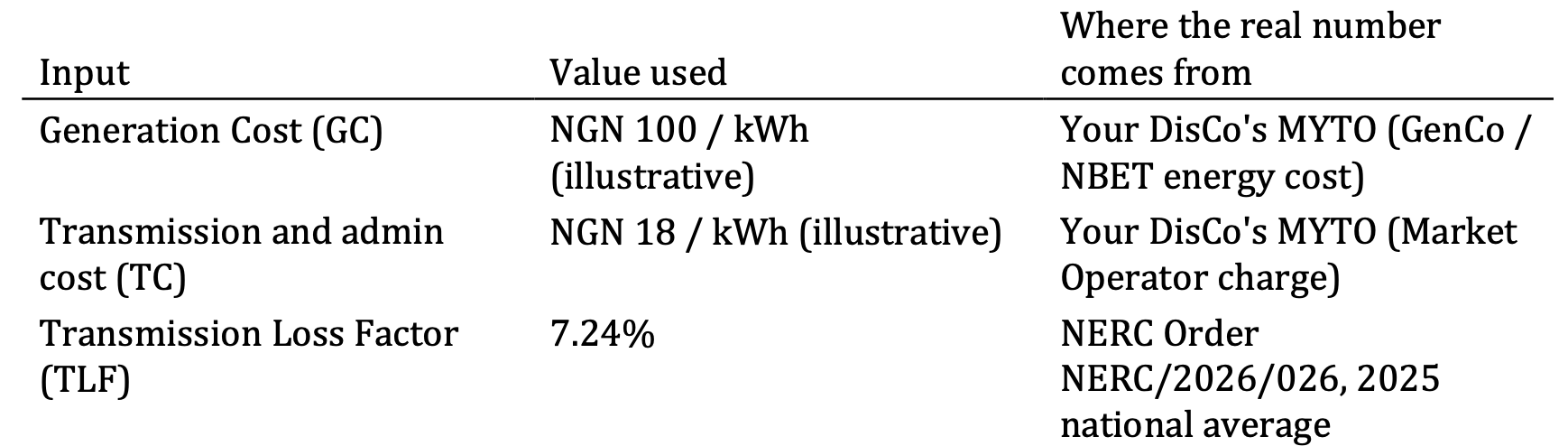
Run those through the formula:
ACD = (100 + 18) / (1 - 0.0724) = NGN 127.21 / kWh
Off-peak export tariff = 127.21 x 0.55 = NGN 69.97 / kWh
Peak export tariff = 127.21 x 0.75 = NGN 95.41 / kWh
Now compare those to what you pay. Through 2024 and 2025 the Band A retail tariff has sat at roughly NGN 209 per kWh (NERC’s cap is NGN 225, and Ikeja Electric reduced its own Band A rate to NGN 206.80). Commercial and industrial maximum-demand customers pay even more.
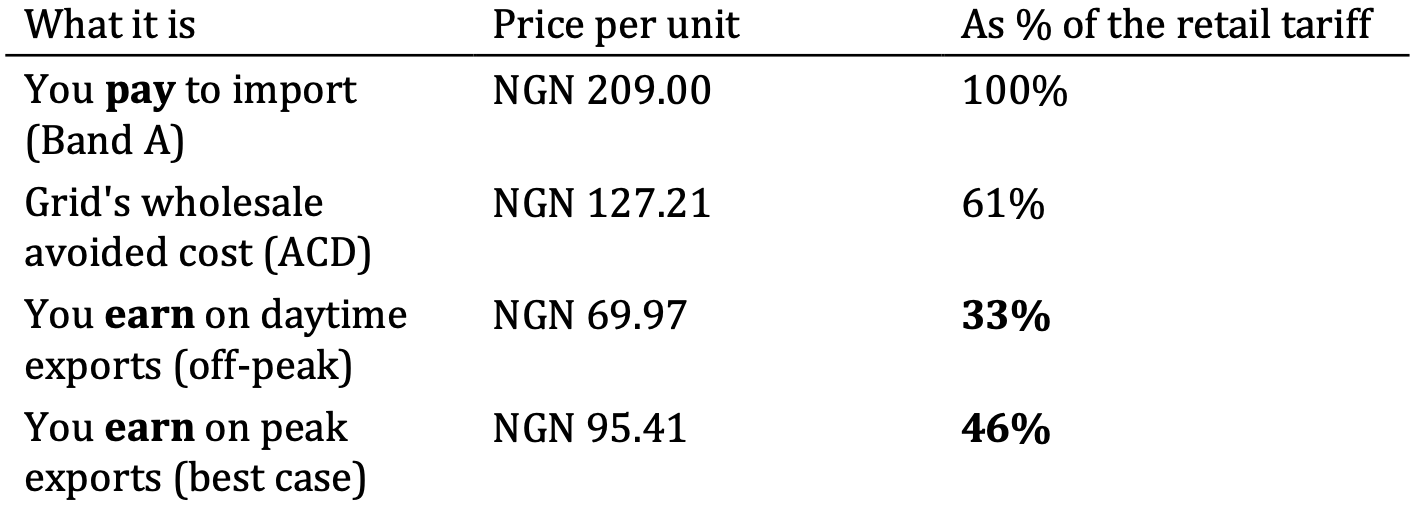
Read that table twice. A unit you export in the afternoon is worth about a third of a unit you import. Even in the best case, a peak export is worth less than half. That single fact is the foundation of every sensible decision under this regulation.
There is also a safety catch, s19(6): if your off-peak export tariff ever works out higher than your own retail tariff, it is capped at your retail tariff times the factor. For Band A and commercial customers this never bites, because your retail tariff is well above the avoided-cost-based export price. It is really there to stop arbitrage by heavily subsidised low-band customers. (The peak clause, s19(7), is drafted clumsily, but the evident intent is that the peak export tariff is uniform across all bands and is not subject to that retail cap.)
A worked example: a 500 kWp factory
Let us make it concrete with one site, using the same illustrative tariffs. Imagine a commercial site with:
A 500 kWp solar system, producing about 800,000 kWh a year (at an illustrative yield of 1,600 kWh per kWp).
Annual electricity use of 1,200,000 kWh, so the site is comfortably bigger than its solar (it stays a net importer, which is the healthy, normal case).
An 80% self-consumption rate: four out of every five solar units are used on site, and one is exported.
Here is how the year shakes out (these are the calculator’s outputs):
Energy Naira value Solar used on site (self-consumed) 640,000 kWh NGN 133.76m saved (at NGN 209 avoided import) Solar exported to the grid 160,000 kWh NGN 11.2m earned (at NGN 69.97 off-peak) Total annual benefit NGN 144.95m
And the before-and-after on the bill:
Annual bill without solar: 1,200,000 x NGN 209 = NGN 250.8m
Annual bill with solar (net of export credits): NGN 105.85m
Total annual saving: NGN 144.95m
Now look at the split, because it is the whole point:
Self-consumption: NGN 133.76m, which is 92% of the benefit. Export credits: NGN 11.2m, which is 8% of the benefit.
The grid exports are real money and worth having. But they are the garnish, not the meal. If you designed this system around selling to the grid, you would have designed the wrong system. You design around using your own power; export is what you do with the leftovers.
The trap
The marketing instinct will be to sell “earn money from the grid.” The regulation makes that a weak pitch, and here is the cleanest way to see why.
Every unit you use yourself is worth the full retail tariff you would otherwise have paid: about NGN 209 in the example. Every unit you export is worth about NGN 70. So a self-consumed unit is worth roughly three exported units.
This has two practical consequences.
First, right-size the system to your daytime load. The regulation lets you install export capacity up to 120% of your Eligible Load Demand (s6(4)), and it even lets your panels (DC) exceed your approved export (AC) so long as you cap the export with certified inverter settings (s6(8)). That is a gift for solar design: you can oversize the array to squeeze out more yield and clip the rare peaks. But oversizing purely to export more is value-destruction, because every extra exported unit earns a third of what a self-consumed unit saves.
Second, the regulation will not reward a system that produces more than the site consumes. And if you build one anyway, the next rule bites.
The exception worth knowing: buildings that sit empty at weekends
There is one important exception to “self-consumption is everything”, and it is easy to miss because it turns on the calendar, not the clock.
A great many commercial buildings run Monday to Friday and sit nearly empty at the weekend: offices, banks, a lot of schools, government buildings, some warehouses. Their solar does not know it is Saturday. The panels keep generating right through the weekend, but there is almost no load to absorb it. Before net billing, that weekend energy was simply lost, either spilled by the inverter or never harvested at all. Two days out of seven, more than a quarter of the system’s annual output, producing nothing of value.
Net billing changes that. On weekdays the building behaves like any other daytime site and uses most of its solar directly. At the weekend, with the building idle, almost all of the generation is exported and earns a credit. An exported unit is still worth only about a third of a self-consumed one, so this is not a licence to oversize. But it converts power that used to be thrown away into a real line on the bill.
In the calculator, this is the “Weekdays only, idle weekends” usage pattern. Switch a 500 kWp office to it and the exported share roughly doubles, from about 8% to around 18% of generation, and the annual export credit climbs from roughly NGN 11m to about NGN 22m. That extra NGN 11m is money the building could never capture before this regulation existed. For a weekday-only site, the export credit stops being a rounding error and becomes a genuine, if still secondary, part of the case.
if your building is dark at the weekend, net billing is worth more to you than it is to a 24/7 factory, because a bigger slice of your generation has nowhere else to go. Size for your weekday daytime load as usual, then let the weekend surplus earn its keep instead of spilling it.
The annual reset, and why over-building is punished
Here is one of the sharpest clauses in the whole document, and it is easy to miss.
When your monthly export credit (plus any credit carried over) is bigger than your monthly import bill, you pay nothing that month, and the surplus rolls forward as carried-forward credit (s19(7)). So far, so reasonable. But s21(2) says that carried-forward credit is netted off at the anniversary of your connection. In plain terms: use it within twelve months or lose it. You get 30 days’ written notice before it expires (s21(4)), and that is it.
For a properly sized self-consumption system, this never hurts you, because you are a net importer every single month: your import bill always swallows your export credit, nothing accumulates, and nothing is forfeited. The calculator shows this clearly: in the 500 kWp example, the carried-forward balance sits at zero all year.
But if you over-build for export, you will spend part of the year banking credits you cannot use, and watch them evaporate at the anniversary. The regulation is, once again, telling you the same thing in a different way: do not build a merchant export plant under this scheme.
A few more credit rules worth knowing:
Credits are tied to the premises, not to you. If you sell or hand over the property and transfer the agreement, the credits go with it (s22(2)).
If you move the solar system to a new site, the credits are zeroed and you start a fresh application (s21(3), s22(3)).
The DisCo must keep a monthly credit ledger for every prosumer, in a format NERC approves, and show it to you on request (s21(5), s20(4)). Ask to see it.
Read this before you buy a battery
The regulation dangles a premium: peak exports earn a factor of 0.75 instead of 0.55, a roughly 36% uplift. But that premium is gated behind a battery. To qualify for the peak rate, you need a NEMSA-verified Battery Energy Storage System (BESS) with usable capacity of at least two hours at 50% of your installed solar capacity, able to charge from the solar and discharge to the grid (s17(6)). Without a qualifying battery, your inspection certificate is stamped “Off-Peak Rate Only” and every export is paid at 0.55. There is a second gate: if a time-of-use meter is not available when you commission, all exports default to off-peak until one is fitted, within twelve months (s18(5)).
Now here is the catch the regulation quietly creates. The peak window is 6pm to 9pm (s4), which is after sunset. Solar generates in the daytime, which is off-peak, and produces nothing during the peak window. So a solar-only system can only ever earn the 0.55 rate. The only way to touch the 0.75 premium is to store daytime energy and discharge it to the grid between 6 and 9pm.
For a 500 kWp system, the qualifying battery is roughly 500 kW for two hours, so about 1 MWh of usable storage. That is a serious capital cost, and the premium it unlocks is small: in our example, shifting a quarter of exports into the peak window adds only about NGN 1m a year. A 36% uplift, applied to a three-hour window, on energy worth NGN 95 a unit, does not pay for a megawatt-hour of batteries on its own.
The deeper point: a battery’s most valuable job is almost never peak export. A stored unit discharged in the evening to power your own site saves you the full retail tariff, about NGN 209. The same stored unit exported at the peak rate earns about NGN 95. So any rational operator uses the battery for evening self-consumption first, which is worth more than twice as much. The peak export premium only matters for whatever surplus is left after the site’s own evening needs are met, which for most sites is very little.
The honest read: NERC is signalling that it wants storage on the grid, not that it is paying enough to fund it. Build the battery on the full value stack (shifting solar into the evening, managing demand charges, riding through outages) and treat the peak export premium as a small bonus, not the business case.
Metering and safety
You cannot export a single unit until the system is wired safely and metered properly. Two chapters of the regulation cover this, and a couple of details trip up real projects.
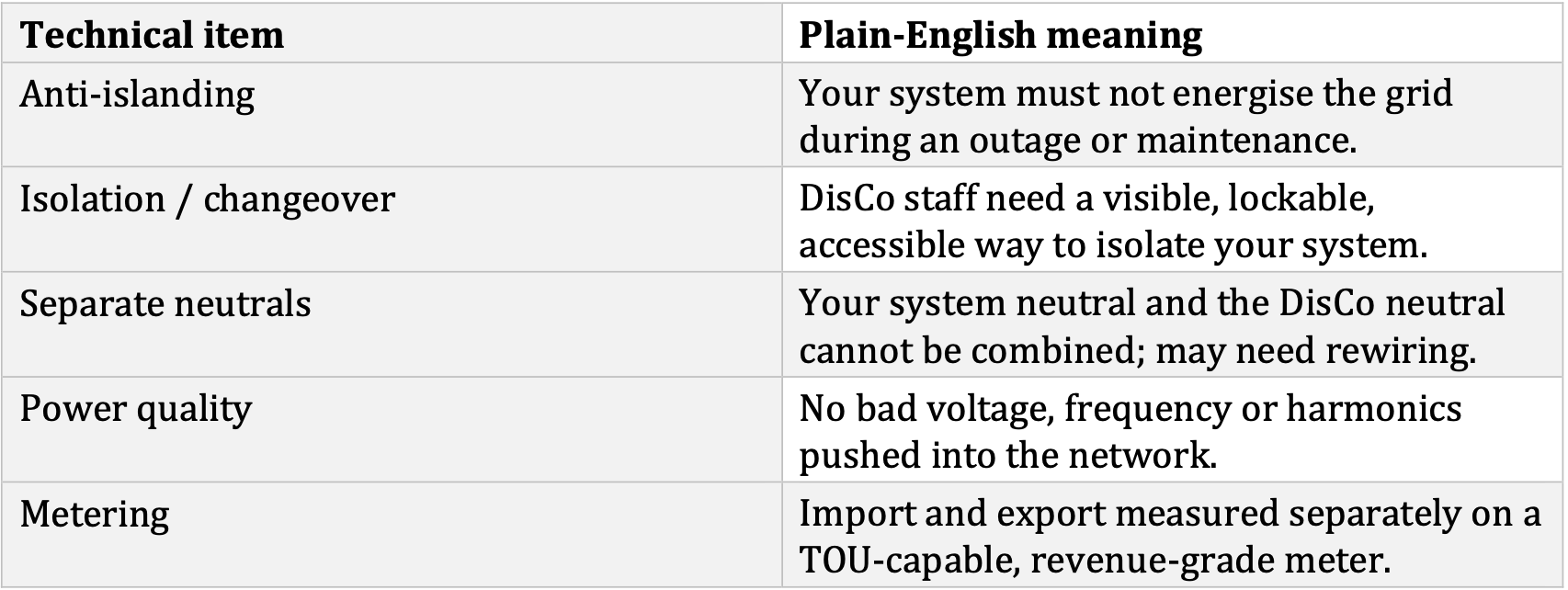
On safety and interconnection (s17): the system connects at a single point, must protect against over-voltage, under-voltage and frequency deviation, and must include anti-islanding, so it disconnects during a grid outage and only reconnects when normal grid conditions return. You must install a switching or changeover panel that can isolate the system both automatically and manually, and the isolator has to be visible, lockable in the open position, and accessible to the DisCo’s staff at any time without prior clearance (s17(3)). There is also a quiet but important rule: the DisCo’s supply neutral and your renewable system’s neutral must be kept separate, not paralleled or intermingled (s17(10) to s17(11)). That one sentence can mean real rewiring work on an existing commercial building, so get an electrical review early.
On metering (s18): once you pay the connection charge, the DisCo provides a revenue-grade import and export meter (or dual-register smart meter) with time-of-use capability, installed to the Metering Code (now in its 3rd edition, March 2026). It separately records what you import and what you export, and the DisCo is responsible for reading, validating and reconciling the data for settlement. As noted above, no time-of-use meter at commissioning means off-peak settlement until one is fitted (s18(5)).
The process and the timeline
The journey from application to export is laid out across Chapter II and summarised in the process flow in Schedule 9. In order:
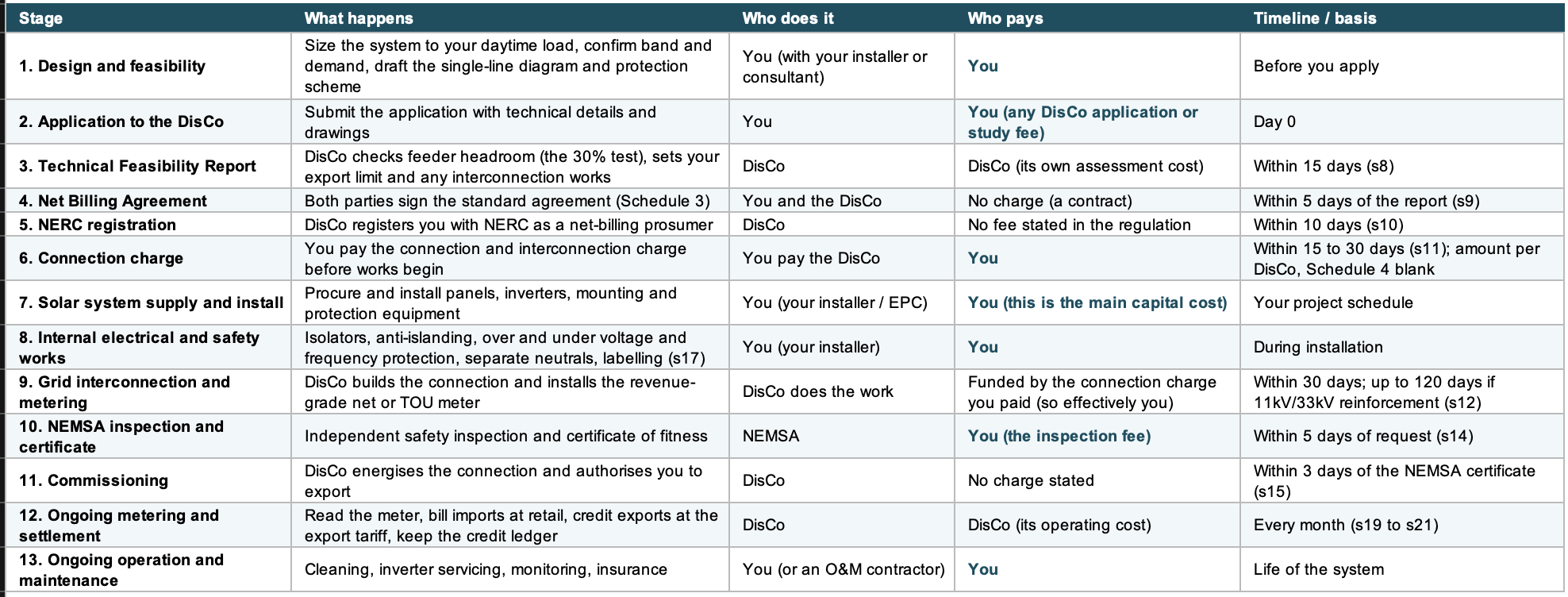
Two things dominate your planning.
First, the 30-versus-120-day fork for connection works (s12). If your site needs major reinforcement at 11kV or 33kV, the build can take four months on its own, and the whole process can run past six months end to end. A clean site with no reinforcement can be done in three to four months.
Second, the regulation does not tell you what the connection charge is. Schedule 4 lists the system-size bands and then leaves the naira amounts blank, to be set by each DisCo under a NERC-approved methodology. So a real cost line and the critical-path duration are both unknown until your feasibility study comes back. Do not promise a client a number you do not have yet.
Who gets the export credit: the contract question
This is the part that matters most for anyone doing a third-party deal, and it is easy to overlook.
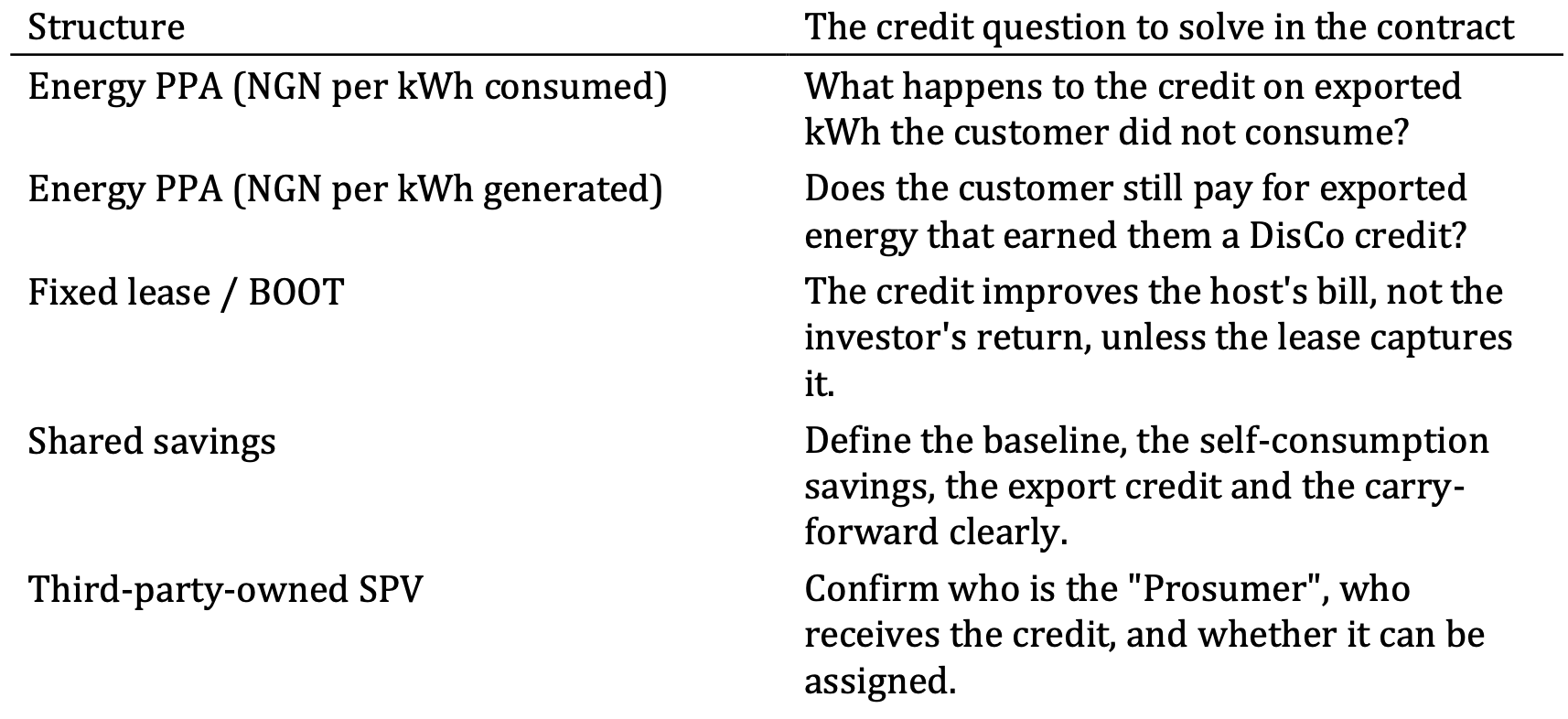
The export credit is applied to the electricity bill of whoever holds the DisCo account, which is almost always the host or occupier (the regulation’s “Prosumer”). In a self-owned system that is fine: you own the panels, you hold the account, you keep the credit. But in a third-party-owned structure (PPA, lease, BOO, BOOT) the developer or SPV owns the asset while the host is the account holder. The DisCo credit lands on the host’s bill, not automatically with the asset owner. If your PPA or lease does not say how that credit is captured, shared or passed through, the value can simply leak to the customer.
There is a deeper legal wrinkle. The template Net Billing Agreement in Schedule 3 (and its eligibility clauses 1.1 and 1.2) reads as if the Prosumer owns the system and consumes on the same premises. That raises a genuine question for third-party ownership: can a host be the “Prosumer” while an SPV owns the asset, and can the export credits be assigned or shared? Until that is confirmed with counsel and the DisCo, do not put export credits into base-case debt sizing. Remember too that credits are tied to the premises and transfer with the agreement (s22(2)), and are zeroed if the system is relocated (s21(3)), so they do not travel with the equipment in a portable asset-finance model.
The honest bit: where the regulation is unclear
I write under a banner that promises not to pretend, so here are the rough edges. For a document this important, knowing them is part of using it well.
The body and the process flow disagree on timelines. The Technical Feasibility Report is “15 days” in the text (s8(1)) but “10 days” in Schedule 9. The NEMSA certificate is “5 days” in the text (s14(3)) but “7 days” in Schedule 9. Let us assume clerical error.
The peak-tariff clause is grammatically broken (s19(7)). The evident intent is that the peak export tariff is the same across all tariff bands and is not subject to the off-peak retail cap, but it should not be relied on without confirmation.
There are two different “120%” tests that sit in different places and will confuse applicants: a capacity test (export capacity within 120% of your Eligible Load Demand, in kW, at s6(4) and again s18(9)) and an energy test (if projected annual generation is more than 120% of historical annual consumption, in kWh, NERC may impose export-limitation controls, at s18(10)). They are reconcilable, but tangled.
The tariff is only fixed for twelve months. The settlement parameters, including the Export Tariff Factor and the underlying GC, TC and TLF, are locked for just twelve months from your connection date, then reviewable (s23(3)), and sooner if avoided cost moves by more than 20% (s23(1)). Section 28 protects rights already accrued, but the export tariff itself is a “settlement parameter” subject to review, so it is not guaranteed for the 20-year life of your asset. Anyone financing a project on the strength of export revenue is carrying real tariff risk. It is yet another reason to keep export out of your base case.
A note for the engineers: the feeder limit is pegged to average load (s6(3)), not minimum daytime load. Reverse-flow risk is actually highest when load is lowest and the sun is highest, so pegging to average arguably overstates the true hosting capacity. Do not be surprised if this metric gets revisited, possibly tightened.
So what should you actually do?
If you are a homeowner or a small business thinking about solar: this regulation is good news, but adjust your expectations. The win is cutting your bill by powering yourself during the day. The export credit is a modest top-up for spillover, worth roughly a third of what you pay to import. Size the system to your daytime use, not to “selling to the grid.”
If you are a commercial or industrial energy buyer: net billing is now a sanctioned third option alongside behind-the-meter self-consumption and wheeled PPAs, but only for sites at or below 1.5 MWp. Lead with self-consumption value. Treat net billing as a way to give residual monetary value to daytime spill and to right-size up to 120% of demand with a credit backstop. On batteries, anchor the decision on the full value stack, not the peak export premium.
If you are a developer or installer: oversize the array (DC), clip the export (AC), maximise self-consumption, and lodge your feeder application early before the 30% headroom fills. Get the feasibility study done before you quote a connection charge, and settle the export-credit question in the contract before anyone signs.
If you are a DisCo: the regulation hands you a register, a quarterly reporting duty, and a prescribed monthly credit ledger (s20, s21(5), s25). It is, frankly, a software problem waiting to be solved: application intake, feasibility tracking, NERC registration, NEMSA scheduling, connection-charge billing, and monthly settlement, repeated across thousands of prosumers, with a metering base that is still only about half complete. Reach out to me, we have solved this.
Before you promise anything: a checklist
If you are scoping a real project, gather these before you put numbers in front of a client or a credit committee:
Bills and demand: at least 12 months of electricity bills and maximum-demand history.
Load profile: daytime, weekend and holiday patterns, so you can estimate self-consumption honestly.
Site control: Certificate of Occupancy, lease, or tenancy agreement (proof of ownership or occupation).
Technical design: single-line diagram, inverter and protection specs, isolation and export-control scheme, certified by a COREN-registered engineer.
Grid data: DisCo, feeder, transformer, voltage level, feeder average load, and any existing net-billing export on the same asset (for the 30% test).
Solar study: a yield estimate (PVSyst, Helioscope or similar) with self-consumption and export split.
Storage, if any: usable capacity and whether it meets the s17(6) basis for the peak premium.
Metering: current meter type, and the need for a TOU-capable revenue-grade net meter.
Commercial allocation: who holds the DisCo account, who receives the export credit, and how the PPA or lease treats it.
Approvals path: DisCo feasibility, Net Billing Agreement, NERC registration, NEMSA certificate, DisCo commissioning.
The bigger picture
Step back, and the export-tariff design tells you what NERC is really optimising for. By paying you a discount to wholesale avoided cost, capping your bill at zero, and refusing to pay cash, the Commission has built a scheme that delivers demand-side relief without creating a new class of merchant generators or handing strained DisCos an open-ended payment liability. Against a grid averaging around 5,400 MW and losing close to 35% of its energy to technical, commercial and collection losses, that caution is rational. The scheme eases pressure by letting big consumers shave their own load and put their spill to modest use. What it does not do, and does not try to do, is fix the structural shortage of generation and the foundry-level reliability that Nigerian industry actually needs. That is a different, larger problem. Net billing is a sensible, conservative tool for the demand side. It is not the answer to the supply side, and it was never meant to be.
Used for what it is, this regulation is a genuine step forward: clear rules, defined timelines, real protections, and a workable path to connect distributed solar. Mistaken for what it is not, a way to get rich selling power to the grid, it will disappoint. The number to remember is the one we started with. Roughly 92% of the value is in using your own power. About 8% is in selling it. Build accordingly.
Free Excel Calculator
The companion NERC Net Billing 2026 Calculator below turns everything above into a model you can use. Open the Inputs sheet, edit the blue cells, and replace the illustrative tariff numbers with your DisCo’s MYTO values. Then read your result across the tabs: an Eligibility check against the size, 120% and 30% limits; a Monthly settlement with the carry-forward and anniversary logic; a Summary with the self-consumption-versus-export split; a Scenarios comparison (no solar, self-consumption only, off-peak, BESS peak, and a low-daytime-load case); and a Sensitivity table showing how savings move with the retail tariff and the export share. The yellow cells flag exactly which inputs you must confirm before trusting the output.

Sources and references
The regulation
NERC, Net Billing Regulations 2026, Regulation No. NERC-R-002-2026, signed by the Chairman and dated May 2026. Section references (s4 to s28, Schedules 1 to 9) are to this instrument throughout.
Electricity Act 2023, section 226 (the enabling power).
Other NERC instruments and reports
NERC Order No. NERC/2026/026, Regional Transmission Loss Factor Reporting (dated 8 April 2026): national average TLF of 7.24% in 2025 (down from 8.71% in 2024), against the 7% MYTO benchmark, with TCN directed to reach 6.5% by December 2026. Reported by The Guardian, ThisDay and The Punch, April 2026.
NERC Q4 2025 Industry Report: ATC&C losses of 34.90%, collection efficiency of 79.36%, billing efficiency of 82.03%, and billing losses of about NGN 174.12bn. Reported by Legit.ng, April 2026.
NERC Q3 2025 Report: metering coverage of about 55%, with roughly 5.36 million customers unmetered. Reported via AllAfrica, January 2026.
Metering Code for the Nigerian Electricity Supply Industry, 3rd edition (March 2026): basis for the time-of-use net-metering requirement.
Tariffs and MYTO data (used for the illustrative figures; verify your own on your DisCo’s current MYTO at nerc.gov.ng and on your bill)
Band A retail tariff around NGN 209/kWh and the NERC cap of NGN 225/kWh: Nairametrics (February 2025); Proshare (April 2024). Ikeja Electric’s reduction of its Band A rate to NGN 206.80/kWh: Channels Television / Ikeja Electric notice (May 2024).
Commercial and industrial (maximum-demand) Band A tariffs run higher than residential (distribution-company tariff applications, 2024 and 2025).
A note on method The export-tariff figures (ACD of NGN 127.21, off-peak NGN 69.97, peak NGN 95.41) and the worked example are calculated using the regulation’s own formula (s19(4) to s19(5)). The Transmission Loss Factor input uses the 2025 national average of 7.24% from NERC Order NERC/2026/026; the Generation Cost and Transmission cost remain illustrative MYTO placeholders, because the official, DisCo-specific values change with macro conditions. They are clearly labelled and are fully editable in the companion calculator. Where the regulation is silent (for example, the connection-charge amount in Schedule 4), this article says so rather than guessing.
Disclaimer
This article and the companion calculator are for educational and analytical purposes only. They are not financial, legal, engineering, tax, regulatory, investment, or procurement advice, and they should not be treated as a substitute for advice from qualified professionals.
I have tried to interpret the NERC Net Billing Regulations 2026 carefully and to make the assumptions in the calculator transparent, but electricity regulation, MYTO parameters, tariffs, DisCo procedures, metering requirements, connection charges, and technical standards can change. The numbers used in the worked examples are illustrative unless expressly stated otherwise. Before committing capital, signing a contract, sizing a system, promising savings to a client, or submitting an application, confirm the binding figures and procedures directly with your Distribution Licensee, NERC, NEMSA, your current MYTO order, and your own legal, commercial, and engineering advisers.
The Excel calculator is a simplified decision-support tool. It is designed to help you understand the logic of the regulation and test scenarios, not to produce a bankable financial model, final engineering design, tariff approval, interconnection approval, or investment recommendation. You are responsible for checking all inputs, assumptions, formulas, and outputs before relying on them.
Where the regulation is unclear, internally inconsistent, or silent, I have said so and offered my best reading. That reading may be wrong, incomplete, or overtaken by later regulatory guidance, DisCo practice, NERC orders, or legal interpretation. Use the article and model as a starting point for better questions, not as the final answer.