

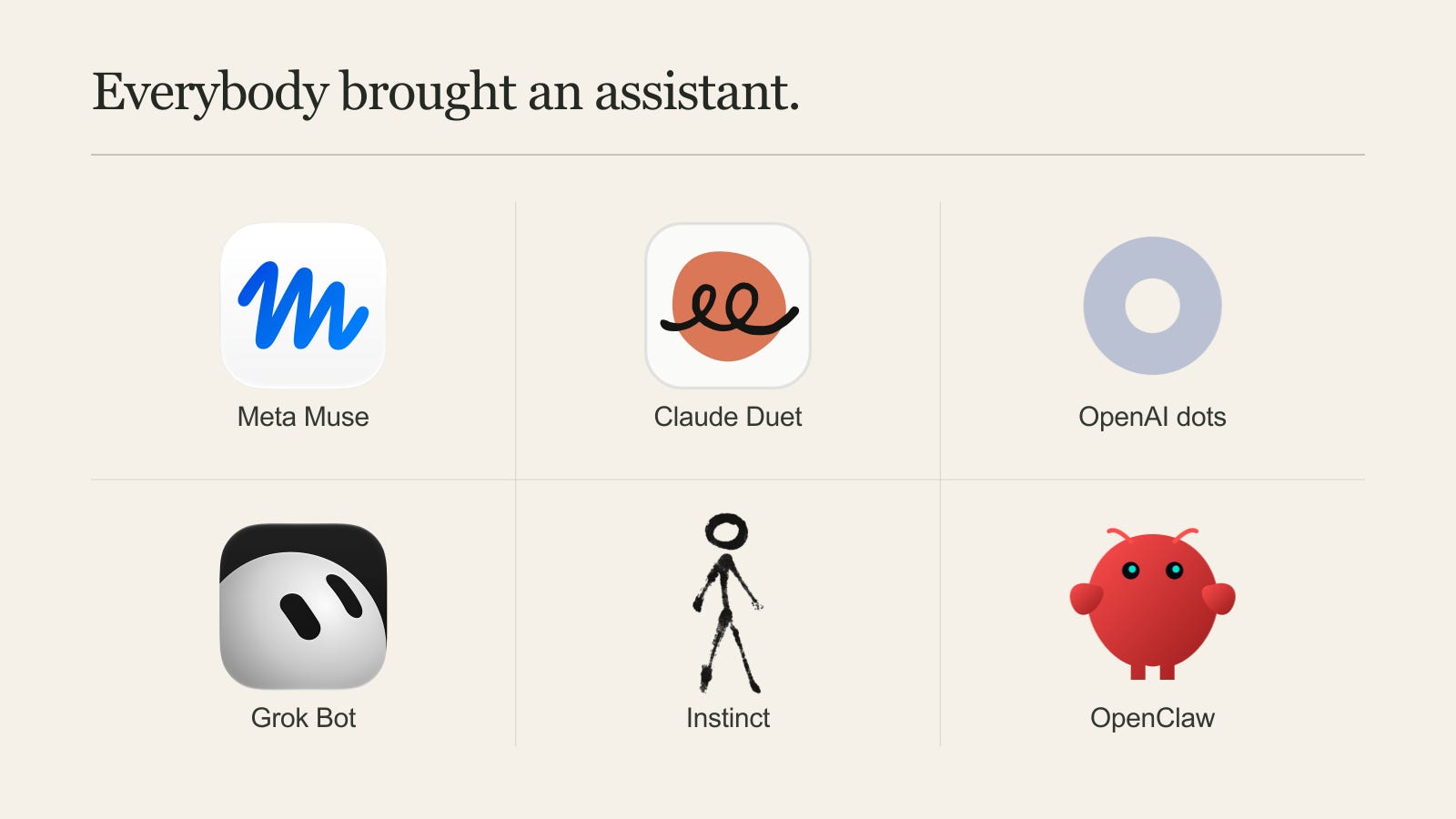
Everyone has an AI assistant now.
Meta has Muse. Anthropic has Claude Duet. OpenAI has Dots. xAI has Grok Bots. There is Instinct, which you can text or call like a suspiciously capable friend who never asks to borrow money. They can monitor inboxes, schedule meetings, book travel, fill forms, prepare forecasts, build software and continue working after you have closed the app and returned to the more important business of watching somebody renovate a kitchen on Instagram.
This all sounds wonderful.
The problem is that the person you are trying to impress also has one.
I have been thinking about this because we appear to have entered a new phase of artificial intelligence. The first phase was about answering questions. You asked ChatGPT to explain quantum mechanics, rewrite an email or produce a meal plan from one egg, half an onion and the terrible consequences of not going grocery shopping.
The new phase is different. The AI no longer wants to help you think. It wants your passwords.
Not in an openly criminal way. It simply wants access to your email, calendar, documents, browser, contacts and perhaps your bank account so that it can “act on your behalf.” This phrase appears throughout the marketing because it sounds much nicer than “we have given the computer power of attorney.”
Muse runs on its own cloud computer and can browse, send emails, fill forms and book things. Claude Duet checks connected accounts, prepares a morning briefing and continues working while you are away. Instinct lives inside messaging and phone calls. Grok Bots can coordinate multiple agents and turn repeated processes into routines.
These are not chatbots anymore.
They are employees who live inside your laptop and have never attended safeguarding training.
A lot of this energy came from OpenClaw, the open-source personal agent that went viral because it offered something closer to a do-it-yourself Jarvis. It could live in chat applications, use tools, follow schedules and carry out tasks on your machine. It also required enough technical confidence that ordinary people could look at the installation instructions and decide they were actually quite happy booking their own dentist appointment.
The initial noise around OpenClaw eventually became less interesting than what it unleashed. Meta later acknowledged that Muse was heavily inspired by OpenClaw, although it was built separately. The ambition was essentially to take the same idea, remove the part involving configuration files and make it usable by billions of people.
This is the normal life cycle of a technology idea now. Somebody builds a strange open-source tool. It becomes briefly unavoidable on X. Forty-seven people announce that software has changed forever. A large technology company recreates it with rounded corners. Then six other companies release versions with names suggesting friendship, intuition or mild artistic sensitivity.
Muse.
Duet.
Instinct.
Dots.
These are not software names. This is the lineup for a wellness retreat where your calendar will finally learn to forgive you.
And, because this is artificial intelligence, one assistant is no longer sufficient. Grok lets people create teams of bots. Muse can launch subagents. Your main assistant may soon have an assistant, who may have a research assistant, who will presumably complain that the main assistant keeps scheduling meetings without an agenda.
We have successfully automated management.
The same thing is happening with software.
AI has made it dramatically easier to build an application that looks like an application. You can describe the product, generate the interface, connect a database, add authentication and launch before the original thought has had time to become embarrassed.
This is extraordinary. It is also why everybody is building the same tool.

Someone sees a successful note-taking app and produces a “reimagined AI-native workspace.” Somebody else builds an AI voice recorder. Then an AI voice recorder for lawyers. Then an AI voice recorder for lawyers who enjoy running. By Thursday, somebody has built an AI agent that listens to all the recordings and tells everyone that the meeting should have been an email.
The cost of producing software has fallen faster than the cost of producing a reason for the software to exist.
That is the awkward part.
A large number of these products are reverse-engineered versions of something already popular. The interface may look professional—sometimes almost pixel-perfect—but the underlying performance, support and differentiation can still be thin. Many are launched, shown to friends, posted on Product Hunt and abandoned after the downloads fail to arrive.
This does not mean AI-assisted software development is useless. Far from it. It means building has become less conclusive.
We used to treat the existence of a working product as evidence that somebody had discovered something important. Building software required money, time, engineers, project managers and at least one person whose only apparent responsibility was asking when the API would be ready. If a product existed, somebody had suffered for it.
Now a product can exist because somebody had a free weekend and access to Claude Code.
The software may be real. The company is still awaiting confirmation.
When production becomes cheap, production stops being the impressive part. The scarce things become distribution, trust, judgment, proprietary insight, access to customers and the patience to maintain the product after the founder has discovered another exciting idea.
Unfortunately, those are precisely the parts AI cannot complete before lunch.
The proxy problem
But the stranger problem is not that everybody can build software.
It is that everybody can now build a proxy for themselves.
The original promise of these tools was to help us interact more effectively with the real world. AI would improve the website that customers visit. It would polish the proposal that investors read. It would rewrite the email before it reached a colleague. It would turn rough thoughts into a presentation suitable for humans with budgets.
The destination was always another person.
We were using machines to make ourselves more understandable, attractive and efficient to humans. The website looked better so that a human would trust us. The email sounded clearer so that a human would reply. The LinkedIn post had a dramatic opening, three lessons and an unnecessary reference to leadership because a human was expected to encounter it while avoiding actual work.
Then the other humans acquired AI.
Now I ask my assistant to turn my untidy thoughts into a professional email. I send it to you. Your assistant summarises the professional email into three bullet points because you are busy. You dictate a rough response. Your assistant expands it into four polished paragraphs. My assistant summarises those four paragraphs for me.
Two humans have exchanged eleven words using 900 words of artificial diplomacy.
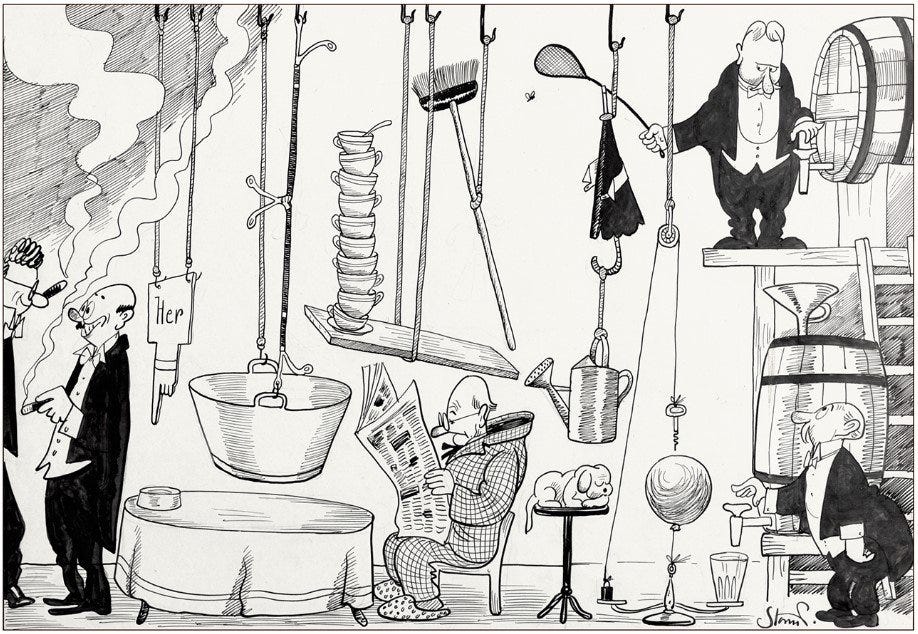

The computers are having a wonderful correspondence. We are barely involved.
Imagine the full process. My AI examines your company, studies your website and writes a personalised sales message. Your AI recognises that it is a sales message, summarises it and assigns it a low priority. My AI sends a follow-up. Your AI files it. My AI detects no response and sends something called a “gentle nudge.” Your AI identifies the nudge as neither gentle nor urgent.
For six weeks, our assistants maintain a professional relationship that neither of us knows exists.
Eventually, they schedule a meeting.
We both decline.
Better for whom?
This creates what might be called the proxy paradox.
We are building increasingly sophisticated AI systems to improve how we present ourselves to people who are using increasingly sophisticated AI systems to avoid examining what we presented.
If everyone is polishing, summarising, personalising and optimising at once, the advantage begins to disappear. The baseline simply moves.
A beautifully designed website once signalled resources, taste and seriousness. Now AI can generate a respectable one before the founder has decided what the business does. Elegant writing once suggested that someone had spent time organising a thought. Now elegance may merely indicate that the prompt included “make this more concise and professional.”
The output has improved.
The signal has weakened.
This is not redundancy in the strict technical sense. The assistants may genuinely save time. They may complete errands, reconcile information, build dashboards and prevent important tasks from disappearing into the swamp beneath your inbox.
The redundancy appears when we use AI to manufacture human-facing artefacts that another AI immediately removes.
My agent creates the presentation. Your agent extracts the numbers. My agent writes the background section. Your agent skips it. My agent adjusts the tone to sound warm. Your agent reports that “the sender is expressing warmth.”
At some point, the obvious question becomes: why are we still generating the PowerPoint?
If the machines are doing both sides of the exchange, perhaps they should communicate the actual intention, constraints and evidence directly. My assistant tells yours what I want. Yours checks your preferences, authority and calendar. They negotiate the available options. We receive the decision.
No introductory paragraph.
No “I hope this email finds you well.”
Nobody needs to be found.
AI slop is social slop
I suspect this is partly why people dislike AI slop so intensely.
The problem is not simply that a machine participated. People already accept machine assistance everywhere: spelling correction, photo editing, search, recommendations, navigation and the small miracle by which Microsoft Teams attempts to remove the sound of your neighbour drilling through concrete.
The insult is counterfeit effort.
A message arrives looking as though someone carefully considered you, but you can feel that nobody did. A post imitates conviction without anyone having risked an opinion. An article has headings, confidence and seventeen uses of “moreover,” but no identifiable reason for being alive.
The content is trying to trigger the social response normally earned by human effort.
Trust me.
Notice me.
Hire me.
Believe that I sat down and thought about this.
That last one matters. AI slop does not merely look artificial. It often feels like someone has outsourced the act of caring while retaining the expectation that you should care in return.
And audiences are becoming sensitive to it. Platforms have started responding to complaints about mass-produced synthetic material, while readers increasingly associate generic AI output with weak originality and emotional connection.
Again, this does not make AI the enemy. The distinction is not between “AI” and “human.” It is between amplification and substitution.
AI can help a person express an actual observation more clearly. That is amplification.
AI can also generate the observation, manufacture the emotion, polish the prose and publish it under the name of a person who encountered none of it.
That is administrative identity theft.

The world after polish
For the last two years, much of the AI conversation has assumed that the winning person will be the person with the most capable tools.
Perhaps.
But when everybody has capable tools, the advantage changes. It moves away from production and towards selection.
What did you notice that the model could not have noticed without you?
What do you know because you were in the room?
What are you willing to believe before there is enough public data to make the belief obvious?
Which customer trusts you enough to describe the real problem instead of the problem they put in the request for proposals?
What will you continue building after the viral excitement disappears and everyone else moves on to an AI app for interpreting their AI app analytics?
The answer may be that human advantage does not disappear. It relocates.
Writing becomes cheaper, but having something to say becomes more valuable. Software becomes easier to build, but choosing a durable problem becomes harder. Websites become more beautiful, but beauty becomes weaker evidence of substance. Assistants become more capable, but permission, trust and responsibility become more consequential.
The future may contain enormous amounts of machine-to-machine activity. Agents will schedule other agents, negotiate with agents, verify agents and perhaps complain privately about their human operators. That could remove a huge amount of administrative nonsense from everyday life.
Good.
I would happily delegate the part of adulthood involving broadband providers.
But the human-facing layer cannot consist entirely of machines producing increasingly polished material for other machines to compress. Eventually somebody must supply an intention that was not generated, a judgment that carries consequences or a relationship worth preserving.
Otherwise we have not automated communication.
We have created two very intelligent receptionists passing elaborate messages between two people sitting silently in the same room.
Muse is working. Duet is monitoring. Instinct is standing by. Grok has assembled a team of bots. Somewhere, OpenClaw is watching all its children become corporate.
And then there is me.
I still have to decide what I actually want.
As you can see, my assistant has not solved the difficult part.