

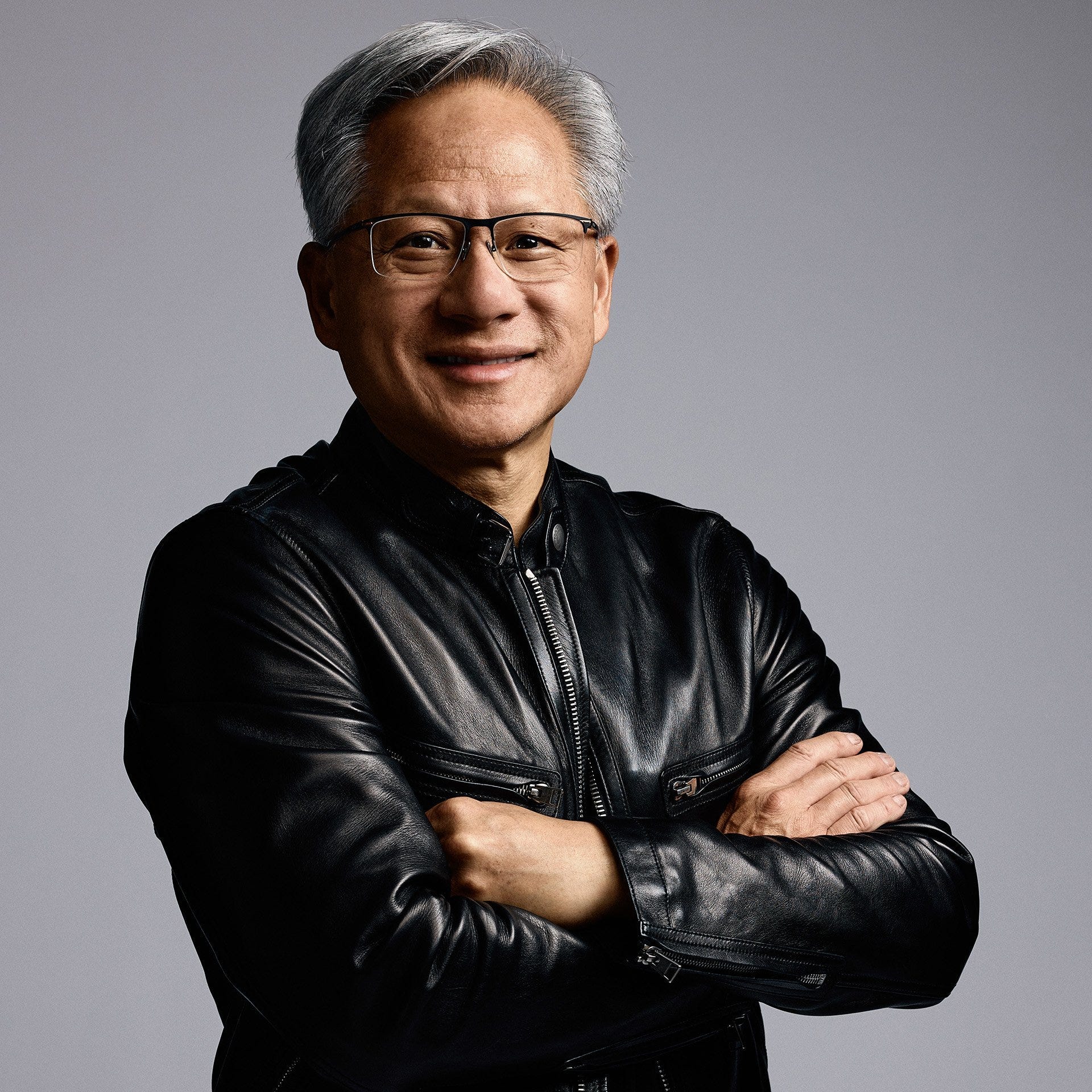
On Thursday morning Nvidia told the market that Jensen Huang had resigned as president, chief executive and director, with immediate effect. Colette Kress, the chief financial officer, is interim chief executive. Harvey Jones becomes the first chair the board has ever had (Nvidia’s filing). Huang co-founded the company in 1993 and ran it for 33 years.
The newspapers give several reasons, concerning his private life and an alleged link to Chinese intelligence. I will leave those to the newspapers and to Congress, where he has reportedly agreed to testify. I have no information and a strong suspicion that my opinion would not improve matters.
What I can do is arithmetic. The shares closed near $160 on Wednesday and opened 13% lower (MS NOW). For a company valued at about $4 trillion, that is roughly $500 billion gone between breakfast and the first coffee. My math might be wrong, so check it. Boston University counted every loan Chinese lenders committed to African governments from 2000 to 2024, the railways, the dams, the airports, the lot, and the total comes to about $181 billion.
One man left one building in California, and a sum more than twice the size of a quarter-century of Chinese lending to a continent left with him. It may come back next week. That is hardly reassuring. A number that large should not be able to move that fast because of one person, and the fact that it can is the subject of this essay.
Key-man risk
In my trade the term is key-man risk. Fund documents carry a key person clause: if the named partners leave, the fund stops investing until the investors decide what to do. Lenders ask ten-person developers for key-man insurance, and mark a small sponsor down for being, in the usual phrase, really just one guy.
Nvidia was really just one guy. Nobody marked it down. In January a reporter asked Huang how long he would stay, and he said the secret of a long tenure was not getting fired and not getting bored. The company had no announced succession plan, and shareholders were said to be uneasy about it, in the way that people are uneasy about a noise in the car they have decided not to investigate.
In July I wrote the NVIDIA Thesis, which held the company up as a template for building a billion-dollar energy company in Africa. I listed five things Nvidia did, including funding its own customers and standing behind their debts, and then five ways the playbook can kill you. “Reportedly dating a suspected intelligence asset” was not among them. Nor was the chief executive in any form, nor Taiwan, nor the export licence. I assessed one of the most valuable companies on earth and never asked what happens if the founder leaves, which is the first question I would put to a developer with three staff and a pickup truck. I will be more thorough in future templates.
The man was only the top layer. Nvidia holds something like 90% of the market for AI accelerator chips. Most of those chips are made by one foundry, TSMC, on one island, Taiwan. Nvidia also finances a fair number of its own customers, which is why a Yahoo Finance writer could file a piece on Thursday headed “The Bank of Nvidia just lost its banker”, and why the smaller cloud companies that live on its chips fell with it.
The sociologist Charles Perrow described this shape in 1984, in a book called Normal Accidents. When a system is complex and its parts are tightly coupled, he argued, failures are a property of the design. Nobody has to be stupid. The accident is waiting in the wiring diagram, and the only open questions are which component and which Thursday.
Everybody has a Jensen: a dependency so reliable for so long that it stopped appearing on the risk register. A founder, a supplier, a lender, a currency, a strait.
Trade wars
A graphics card used to be something teenagers wanted for Christmas. It is now a controlled export. Washington restricts which Nvidia chips may go to China, and when it relented on one model, the H200, the price was that Nvidia hands 25% of the revenue from those sales to the United States government. A sales commission, payable to a state.
In 1945 Albert Hirschman published National Power and the Structure of Foreign Trade, a study of how Germany in the 1930s made the small economies of south-eastern Europe dependent on its market and then used the dependence. His point was that trade is never only trade. Whoever can interrupt it holds power over whoever cannot afford the interruption.
In 2019 Henry Farrell and Abraham Newman updated the idea in a paper called “Weaponized Interdependence”. Global networks, they wrote, are built like hubs and spokes. States that control the hubs can watch what flows through them and can choke it off. Payment systems were their example. Advanced chips have since joined the list.
Read Thursday announcement in that light. The chief executive of the hub company became the subject of a national security question, and half a trillion dollars moved. I make no judgement on the man. The lesson I take is structural: once a product becomes strategic, the company that makes it becomes an instrument of foreign policy whether it likes it or not, and so do its suppliers and its customers.
Neither good nor bad
Melvin Kranzberg was a historian of technology at Georgia Tech, and in 1986 he set out six laws. The first is the one people remember: “Technology is neither good nor bad; nor is it neutral.”
The second half is the part worth keeping. People who say technology is neutral usually mean it is harmless until someone misuses it. Kranzberg meant the opposite. A technology rearranges who depends on whom the moment it arrives, before anybody has decided to use it well or badly. Asking whether AI is good for Africa is like asking whether weather is good for farming.
Huang’s career is the cleanest illustration I can think of. The same wave that made a graphics-chip company one of the most valuable businesses on earth is what made its chips a matter of state. Had Nvidia still been selling cards to gamers, the private life of its chief executive would have been a story for the business pages, briefly. The technology made him enormously rich and it made him strategically important, and the second of those is not a comfortable thing to be. He rose on it and he fell in the weather it created.
Daron Acemoglu and Simon Johnson spent a long book, Power and Progress, arguing from a thousand years of evidence that the gains from a new technology go to whoever has the power to direct it, and that broad benefit has always had to be organised and never simply arrived. That is uncomfortable reading for a continent with nearly 18% of the world’s people and 0.6% of its data centre capacity.
It need not be fatalistic reading. Epictetus, who began life as a slave and so had some standing on the subject, divided the world into what is up to us and what is not. Export controls on chips are not up to us. Neither is the price of oil, the mood of the American Congress, or a strait 6,000 kilometres from Lagos.
What we borrow in, what we build with, who we sell to, and how many of our eggs sit in each basket: those are up to us. Nassim Taleb’s whole body of work reduces to a sentence a grandmother could have supplied, which is that you cannot predict the shock and you can decide how much of you it is allowed to break.
Back to Thursday
Nvidia will be fine, probably. It reports results on Tuesday, it has a capable interim chief, and its order book did not resign. The more durable fact is that the most important company in the most important industry of the decade turned out to have a single point of failure that everyone could see and nobody priced.
Now look at home. Chinese lending to Africa has fallen more than 90% from its 2016 peak, yet 94% of the solar panels we install are Chinese. Rated African governments owe about $90 billion of external principal this year, in currencies we do not print. And when the Strait of Hormuz closed in February, a continent of oil producers found itself on the wrong side of the largest oil supply shock on record, because we import most of the fuel we burn.
We are not better than Nvidia’s shareholders. We have a continent’s worth of arrangements that work because one counterparty keeps turning up: one lender, one supplier, one currency, one fuel, one buyer. AI is tightening every one of those links, mostly without asking us. It will make some Africans rich and it will cost others their business, and in both cases the cause will be something that happened a long way away, on a Thursday.
P.S. This is written in a personal capacity. It is not investment advice, and if you were planning to take investment advice from someone who calls himself the Impostor, we should talk about your risk register first.
P.P.S. The Impostor has never run a four trillion dollar company and has had mixed results with a four megawatt one. If you think I have this wrong, and I suspect several of you do, say so in the comments. I would rather be corrected in public than be confidently wrong in private.
If this was useful, forward it to the person in your company who is the whole company. They will know why.