

One of my favourite people right now is Philip Johnston.
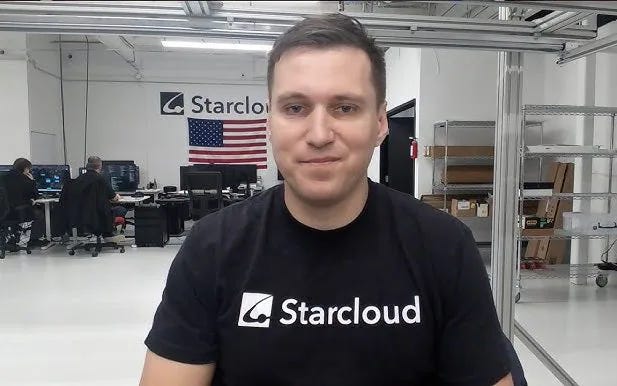
Philip is the co-founder and CEO of Starcloud, a company building data centres in space.
Not using space technology to improve data centres. Not software for satellite operators. Actual data centres. In actual space.
I feel this is a perfectly reasonable basis for affection.
You have to admire the clarity. Most companies spend six months with consultants looking for a tasteful way to describe what they do. Starcloud appears to have walked into the room, put a GPU on the table and said, “We are sending this upstairs.”
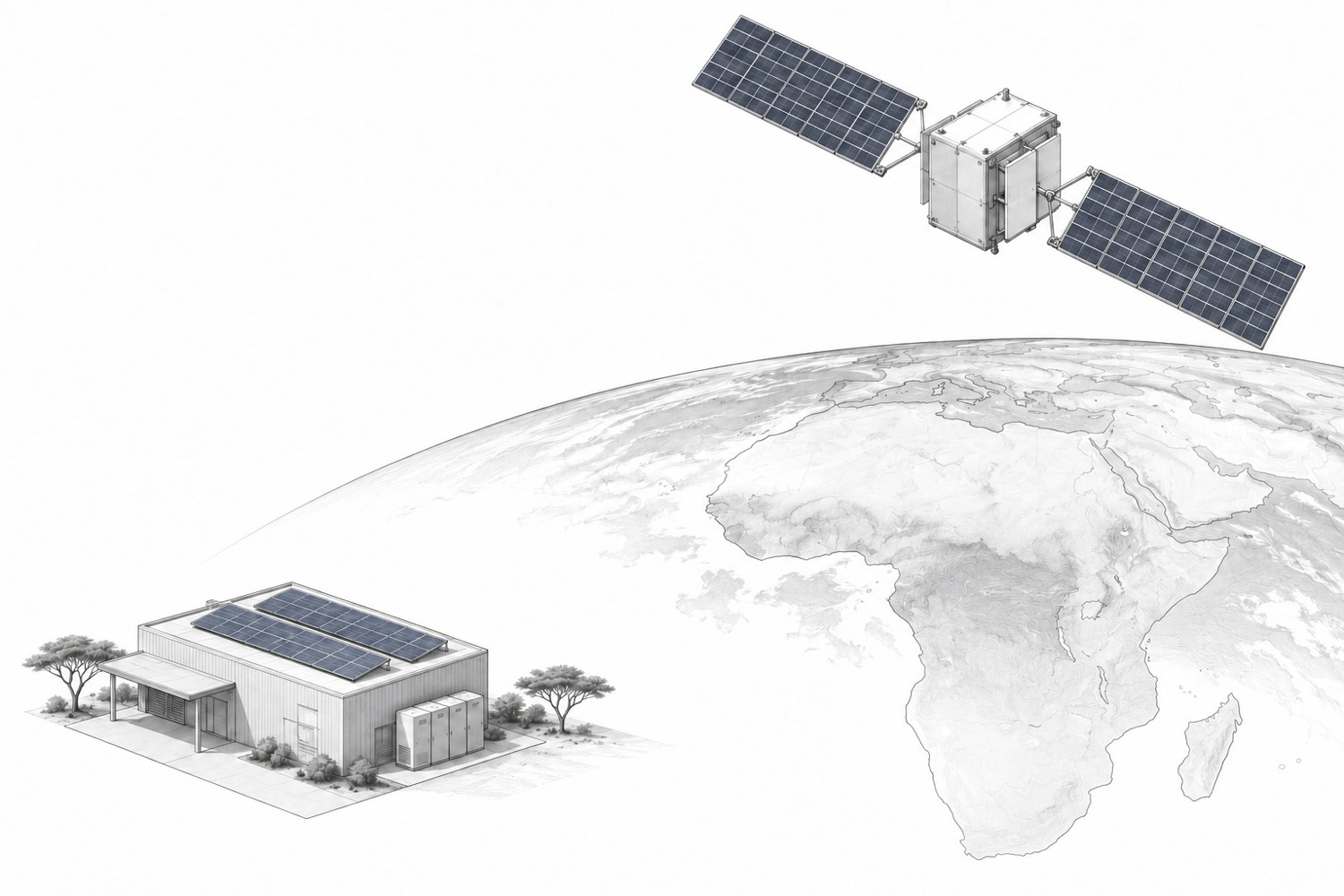
And then it did. In November 2025, Starcloud launched a 60 kg satellite, roughly the size of a small fridge, carrying an Nvidia H100: the sort of chip that normally sweats inside an expensive terrestrial data centre. A month later it trained a small language model in orbit. In March 2026 it raised $170 million at a $1.1 billion valuation, becoming the fastest unicorn in Y Combinator’s history, 17 months after demo day. In August it added another $250 million, and the valuation went to $2.3 billion. The company has about 25 employees.
Can somebody tell me this is normal?
Please do not tell me it is impressive. I know it is impressive. I want to know whether it is normal for a group of adults to decide that the answer to congested electricity grids is to fire the computers into orbit, and then be handed several hundred million dollars for their trouble.
Because this is precisely the behaviour that reminds me never to underestimate an organised group of reasonably intelligent people.
There is an important difference between ordinary stupidity and organised stupidity. Ordinary stupidity is impulsive. Somebody leans too far back on a plastic chair, physics remembers its responsibilities, and a lesson is delivered.
Organised stupidity has a WhatsApp group.
It has workstreams. Someone has built a budget. Someone else has prepared a risk register that rates “death” as medium probability, high impact. There is a procurement schedule, three extension cables and a man called Mike who says, “Don’t worry, I know somebody.”
Intelligent people do not fall into stupid ideas. They develop them. They run the numbers, commission a feasibility study and collect quotations from three approved suppliers.
Eventually somebody tries to restore order: “Are we sure this is a good idea?”
But nobody said it was a good idea. They said it was technically possible.
Once enough intelligent people discover that something ridiculous is technically possible, good judgement takes annual leave. The budget is approved. Mike is on his way.
Random stupidity can usually be interrupted by taking someone’s keys. Organised stupidity has already booked the launch window.
In Starcloud’s case, that is not a metaphor. Johnston told TechCrunch that securing launch capacity is now one of the company’s biggest costs. They have, quite literally, booked the launch window.
So I went to the company’s white paper, intending to be clever about the physics. Cooling in a vacuum, where there is no air to carry heat away. Radiation. The nearest technician being several hundred kilometres straight up in a location he cant solve the problem by asking “Have you tried turning it off and on again?”.
Instead, I got stuck on a table.
The table compares running a 40 MW computing cluster for ten years on Earth against running it in orbit. On Earth: $140 million of electricity, $20 million of backup power, $7 million of cooling, 1.7 million tonnes of water. In orbit: $2 million for the solar array, $5 million for one launch, $1.2 million for radiation shielding. Total: $167 million against $8.2 million.
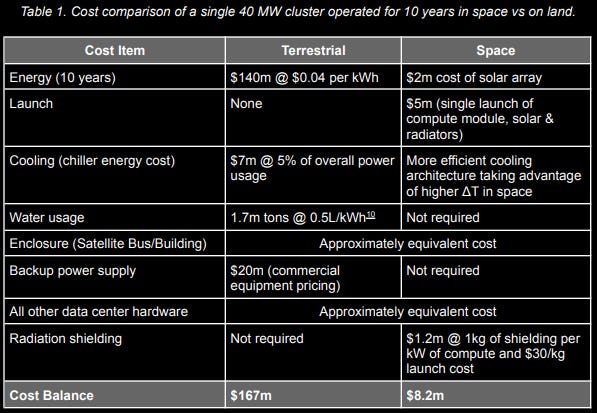
I have built that type of table before. Diesel against solar for a flour mill in Nigeria. Generator against power purchase agreement for way too many factories in the region. The rows are the same: energy, backup, cooling, and an unnamed line for whatever the grid decided to do this week.
That was when it clicked. Starcloud is not really a space company. It is an energy company that found a site with no grid queue, no permits, no night and no community meeting. Its whole pitch is a cost-of-electricity argument. And its long-term plan for selling to the biggest cloud companies, according to the research firm Sacra, is capacity reservations structured like energy offtake agreements.
It is an IPP. In orbit. (With better fonts).
Which brings me back to the question this series keeps asking. How do you build a billion-dollar energy company in a market like Africa, a market that seems determined to take back every margin you create?
Here is how Starcloud is doing it on a much harder site. And here is what transfers to ours.
Part 1: What Starcloud actually did
In about two years, Starcloud went from a white paper to a $2.3 billion valuation on roughly $450 million of capital and no disclosed revenue. The sequence matters more than the headline, so here it is, newest first.
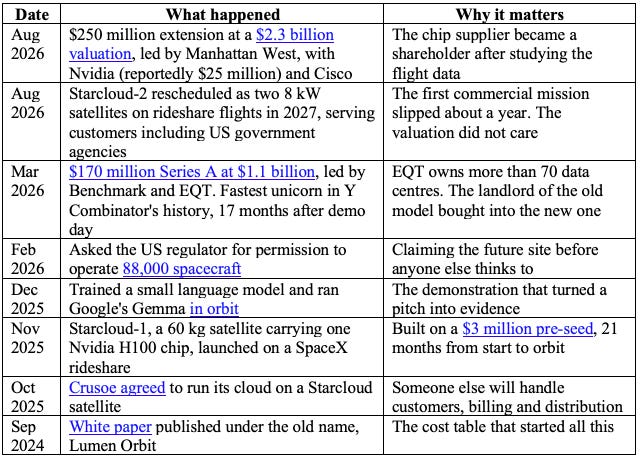
Two things stand out.
First, revenue is not in the table. Sacra notes the company had not disclosed revenue as of May 2026 and describes it as pre-commercial. Every dollar of that $2.3 billion is a price on a future that has been partly demonstrated and mostly not.
Second, the timeline slipped and the valuation still doubled. Investors were not paying for a delivery date. They were paying for the demonstration, the team and the size of the problem. I have known lenders who would reprice a project for a two-week slip in a land title. Different capital, different rules. We will come back to that, because it is the part that does not transfer cleanly.
Part 2: The strategy under the rocket
Take the rocket away and Starcloud’s strategy is eight moves. None of them needs orbit. All of them need nerve.
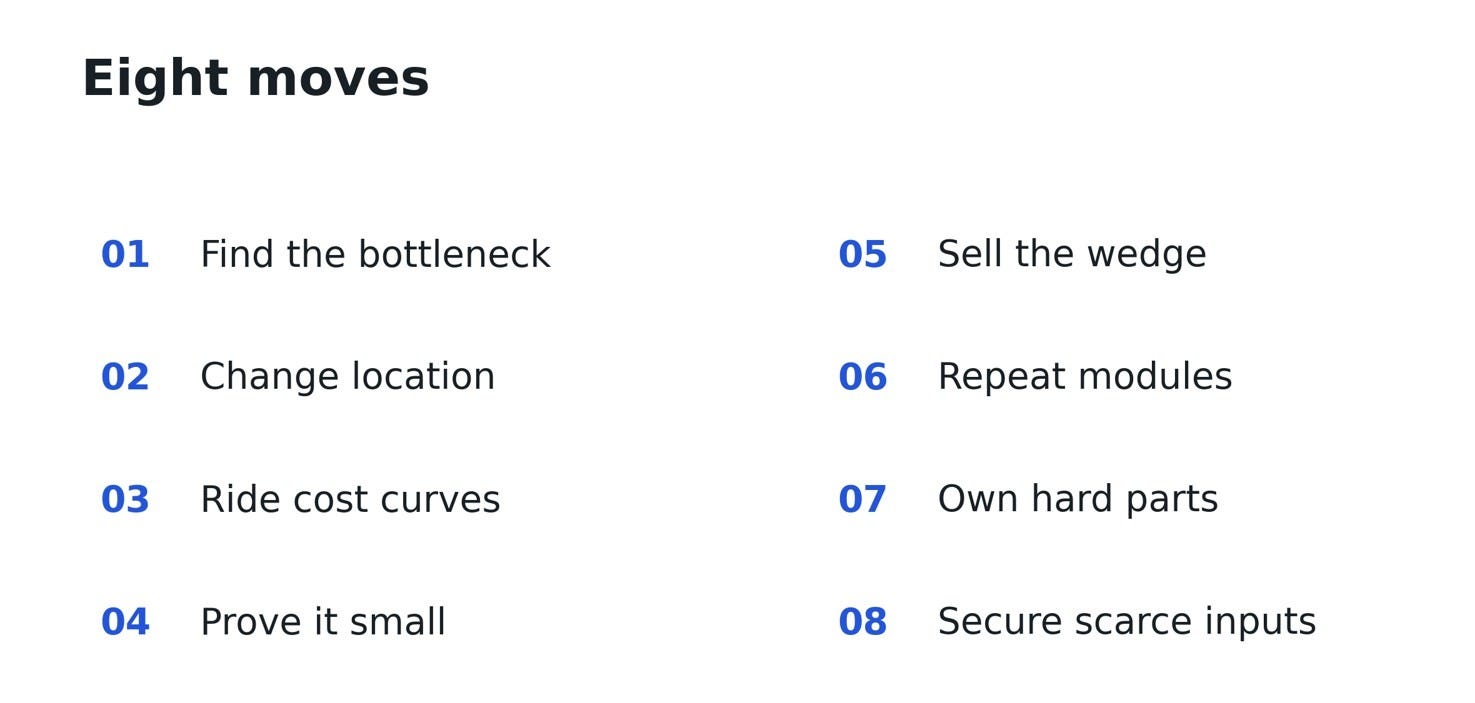
Attack the binding constraint, not the visible problem. Everyone could see the AI chip shortage. Starcloud bet that the harder limit was electricity: grid connections, permits and power plants that take years to build. Its white paper opens with energy, not chips.
Go where the constraint does not exist. In the orbit Starcloud chose, the solar panels see the sun more than 95% of the time. The white paper puts the median US solar farm at about 24%. No night, no weather, no grid queue, no planning committee.
Ride a cost curve someone else is paying for. Starcloud does not build rockets or chips. It assumes SpaceX will make launch cheap and Nvidia will keep making chips better, and builds the bit in the middle. One rival, Cowboy Space, went the other way and raised $275 million to build its own rockets. We will find out which is braver.
Prove it small, early and cheap. Three million dollars, 21 months, one 60 kg satellite, one chip. That single demonstration did more for the valuation than any slide deck could.
Sell the wedge that pays before the big thesis does. The grand claim, that orbit beats Earth on cost, needs launch prices that do not exist yet. So the first customers are satellite operators whose data is already in space, such as Capella’s radar imagery, plus government buyers who pay for resilience rather than cheapness. Sacra describes the value as architectural rather than cost-based. Customers pay for capability while everyone waits for Starship.
Design for Lego, not cathedrals. Design principle five in the white paper reads like a developer’s prayer: grow from one container to many, profitable from the very first, with no large jumps in capital spending.
Rent the front end, own the hard part. Crusoe handles the customer interface, billing and distribution. Starcloud keeps the spacecraft, the power and the cooling. The long-term plan is capacity reservations with the big cloud companies, structured like energy offtake agreements. In other words, contracted cash flows that can be financed far more cheaply than venture equity.
Lock up the scarce input before anyone else notices. Johnston told TechCrunch that securing launch capacity is now one of the company’s biggest costs, with SpaceX’s Falcon 9 due to retire in 2028. Hence the 88,000-spacecraft filing and the pile of cash. When everyone needs the same rocket, the person holding the booking wins.
If you have developed an energy project in Africa, every one of those moves should feel familiar. Most of us manage one or two, usually by accident. Starcloud does all eight on purpose, which is why it is worth $2.3 billion and most of us are worth a carefully worded LinkedIn update.
Part 3: The translation, move by move
Lesson 1: Find the bottleneck that actually binds
The theory. Eli Goldratt’s Theory of Constraints, set out in his 1984 business novel The Goal, makes one point over and over: a system can only produce as much as its tightest bottleneck allows. Improve anything else and you have improved nothing. You have just made the queue more comfortable.
The African evidence. Run through the usual suspects and most of them are not binding.
Sunshine is not the constraint. Africa has 60% of the world’s best solar resources and, when the IEA counted, 1% of installed solar capacity.
Hardware is not the constraint. In Nigeria, a 420 W panel retails for about $60, and Ember reckons the diesel it saves can repay it in about six months. Stationary battery packs fell to $70/kWh in 2025, 45% lower than a year earlier.
Demand is not the constraint. Nigerians spend an estimated $14 billion a year on generators and fuel, an IMF figure quoted by the African Development Bank’s president.
What binds is money and trust. The IEA found that the cost of capital for utility-scale clean energy in Africa is at least two to three times higher than in advanced economies and China, even though the technology risk is limited. The trust problem is the counterparty: whether the buyer, the utility or the government will still be paying in year eight.
The Test: Write down your company’s binding constraint in one sentence. If the sentence contains “solar panels” or “more sales”, you have probably written down a symptom.
Lesson 2: Leave the planet (the grid will do)
Starcloud’s boldest move was not technical. It was geographical. It looked at a site where every hard thing lived, permits, interconnection, night, and simply left.
African energy has its own version, and it is happening without anyone’s permission. Ember tracked 15 GW of Chinese solar panel imports into Africa in the 12 months to June 2025, up 60% in a year. Outside South Africa, imports nearly tripled in two years, to 11.2 GW. Nigeria was the second-largest importer. Ember’s lead analyst says the volumes go well beyond what listed utility projects need, which means most panels are going behind the meter: onto factories, shops, farms and homes that have quietly stopped waiting.
That bottom-up transition is the closest thing Africa has to orbit. The billion-dollar company does not fight the grid queue. It builds where the queue does not reach: captive plants, embedded generation, industrial parks, mini-grids, private wires.
One warning. Orbit has no landlord. African sites do. Leaving the grid is not the same as leaving the regulator, and a model that only works until the rules notice is not a strategy. It is a head start.
Lesson 3: Ride a cost curve you are not paying for
The theory. In 1936, an aeronautical engineer called Theodore Wright noticed that every time cumulative aircraft production doubled, the cost per plane fell by a steady percentage. That pattern, now called Wright’s Law, describes solar panels and batteries rather well. Rupert Way and colleagues at Oxford tested forecasting methods on more than 50 technologies and found that most energy models had underestimated how fast renewables would spread and overestimated what they would cost.
The African version. Starcloud does not build rockets. It waits for SpaceX to make them cheap. The African equivalent is obvious and widely ignored: let manufacturers fight their price war on panels and cells, and build the business that turns cheap hardware into reliable, financed, maintained power. Battery pack prices have fallen 93% since 2010, according to BloombergNEF. Somebody else paid for that. You get to use it.
The trap is the one from A Tale of Two Fifteen Billions. Northvolt raised about $15 billion, tried to own the factory, and died. Building factories in Africa may be good industrial policy. It is a different company from the one that becomes worth a billion dollars selling energy, and it needs a very different kind of capital and patience.
Lesson 4: Sell the wedge that pays today
The theory. In The Prosperity Paradox, Clayton Christensen, Efosa Ojomo and Karen Dillon argue that the innovations that build economies are market-creating. They turn non-consumers, people who could not afford or reach a thing at all, into customers. Their best example is Nigerian. Tolaram arrived in 1988 to sell Indomie noodles, invested more than $350 million, and ended up building its own logistics company, electricity, and water treatment, because the infrastructure it needed did not exist. The market pulled the infrastructure in behind it.
The Starcloud parallel. Starcloud’s big cost thesis waits on Starship. Its first revenue does not. Satellites already in orbit, with their data already up there, will pay now to process it in place. That is a wedge: a customer who values what you do for a reason that has nothing to do with the grand thesis.
The African version. My favourite example is not even an energy company. Gridless is a bitcoin miner, backed by Jack Dorsey’s Block, running in Kenya, Malawi and Zambia. Rural hydro mini-grids often generate more than the village can use, and the surplus is wasted. Gridless sits beside the plant as the buyer of that spare power. At one Kenyan pilot, the tariff to the community reportedly fell from 35 to 25 cents per kWh. That is Starcloud’s logic in reverse. Instead of taking the computer to the sunshine, it takes a computer to the stranded electrons. You do not have to love bitcoin to admire the structure.
For most developers, the wedge is duller and better: the diesel bill. A factory spending a fortune on generators does not need to believe in your ten-year vision. It needs a cheaper kilowatt-hour next month.
Lesson 5: Prove it small, then stage the bet
The theory. Real options thinking, developed in finance by Avinash Dixit and Robert Pindyck, treats each stage of an uncertain investment as buying the right, but not the obligation, to do the next one. Rita McGrath and Ian MacMillan turned this into management practice as discovery-driven planning: list your assumptions, then spend the least money possible testing the most dangerous one first.
Starcloud’s $3 million satellite was exactly that. It tested whether a data-centre chip could survive orbit before anyone spent a billion finding out.
The cautionary tale. In May 2024, Microsoft and G42 announced a $1 billion geothermal-powered data centre at Olkaria in Kenya: 100 MW to start, 1 GW eventually. Kenya’s entire installed capacity is roughly 3 GW, and President Ruto later remarked that switching it on at full size would mean switching off half the country. By May 2026 it had stalled, reportedly after the companies asked the government to commit to buying a fixed amount of cloud capacity every year and the government declined.
Compare the two first steps. Starcloud’s cost $3 million and could fail quietly. Olkaria’s required a sovereign to underwrite a cloud contract. One of those is an option. The other is a dare.
The Test. Before raising for the 50 MW plant, ask what the 500 kW version would prove. Usually it proves the thing that kills most African projects: whether the customer pays, on time, in a currency you can use.
Lesson 6: Build in Lego
The theory. Bent Flyvbjerg at Oxford has spent decades building a database of large projects. In How Big Things Get Done, written with Dan Gardner, solar comes out as the best-behaved project type of all, with average cost overruns of about 1%. Transmission averaged 8%, wind 13%, fossil plants 16%, hydro dams 75% and nuclear 120%. The reason is modularity. A solar farm is one small thing repeated many times, so every unit teaches you how to build the next one better.
In a 2026 paper, Flyvbjerg, Alexander Budzier and Maria Christodoulou go further. Across 11,011 projects, what they call “modular natives” (solar, transmission, wind and pipelines) overran by 12% on average, against 54% for everything else. The more important finding is about the bad outcomes. For modular natives, the risk is finite and predictable. For bespoke projects, the tail of disasters is so fat that the average stops meaning anything. In plain English: build in Lego and your worst day is survivable. Build a cathedral and your worst day has no floor.
Starcloud took this to its logical end. Its white paper wants the data centre to grow container by container, profitable from the first, with no big jumps in capital.
The older theory. In 1967, Albert Hirschman published Development Projects Observed, based on about a dozen World Bank projects, including railway expansion in Nigeria. He proposed the Hiding Hand: planners underestimate the difficulties, but they also underestimate their own creativity, so ambitious projects are often rescued by ingenuity nobody planned for. It is the most comforting idea in development economics. Hirschman himself used the Nigerian railway as his warning that trouble alone does not guarantee a rescue, and Flyvbjerg and Cass Sunstein later tested the idea against data and found the hand is usually far less kind.
My reconciliation is that: modular projects let creativity rescue you many times, in small pieces. Monolithic projects give you one chance to be rescued and many chances to be ruined.
Lesson 7: Rent the front end, own the hard part, then sell the cash flows
The theory. David Teece’s 1986 paper on profiting from innovation asked why inventors so often lose to imitators. His answer: the value goes to whoever controls the complementary assets, the distribution, service, financing and relationships a product needs to reach a customer. Tarun Khanna and Krishna Palepu add the emerging-markets twist. In markets like ours, many of those supporting pieces are missing altogether: no useful credit bureau, no long-term local-currency debt, no reliable collections. They call these institutional voids. The company that fills a void can end up owning it.
The Starcloud move. Starcloud lets Crusoe own the customer interface and billing and keeps the hard engineering. It then plans to sell capacity on contracts that look like offtake agreements, so that cheaper capital can fund the hardware.
The African version. Sun King is the best illustration I know. In 2025 it closed a $156 million Kenyan shilling securitisation, described as the largest ever completed in Sub-Saharan Africa outside South Africa. Securitisation sounds intimidating. It simply means turning thousands of small future customer repayments into one asset that banks and development financiers can buy. Sun King says it has now raised $450 million in local currency across Kenya, Nigeria and Tanzania.
Read that as strategy. The void was long-term local-currency capital. Sun King filled it for itself, and the filling became the advantage. That is how you attack the binding constraint from Lesson 1. You do not complain about the cost of capital. You manufacture a cheaper version of it.
Lesson 8: Lock up what is scarce, and pick fights incumbents cannot join
The theory. Hamilton Helmer’s 7 Powers lists the few ways a business earns lasting returns. Two matter here. A cornered resource is something valuable you control on preferential terms. Counter-positioning is a business model that incumbents cannot copy without damaging the business they already have.
The Starcloud move. Launch capacity is getting scarce, so Starcloud is booking early and has filed for 88,000 spacecraft. That is cornering a resource. Its model also counter-positions against terrestrial data-centre landlords, whose whole value sits in land, grid connections and buildings.
The African version. Ask what is genuinely scarce in your market. It is almost never panels. It is grid connection points with spare capacity, sites with clean title, licences, relationships with creditworthy buyers, good technicians and lines of local-currency debt. Lock those up early. Then look for the fight incumbents cannot join. A distribution company cannot happily sell solar to its best-paying industrial customers without eating its own tariff revenue. A diesel distributor cannot sell solar without cannibalising its fuel sales. Their hesitation is your opening.
Part 4: The Starcloud test
Here is the whole thesis as a test you can run on your own company, or on the next pitch deck that lands in your inbox. Give yourself one point for every row where you have a strong answer. Starcloud scores eight. I ran it on my own career and would prefer not to discuss the result.
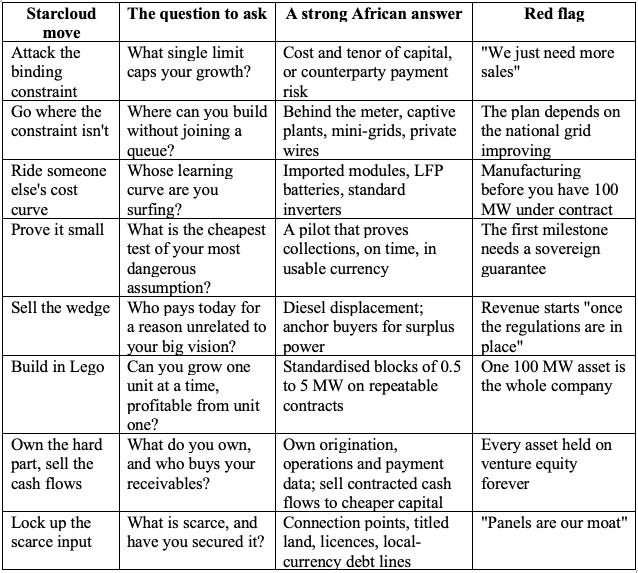
Six or more and you are building something investors can price as a platform. Three or fewer and you are building projects, which is honourable, profitable and very rarely worth a billion dollars. As I argued in the Moove piece, own only the electricity and the market pays you a yield. Own the system around it and the market pays you a multiple.
Coda: Okay, hear me out
AI has an electricity habit. The IEA’s Energy and AI report projected that global data-centre electricity use would more than double to around 945 TWh by 2030, and warned that grid constraints could delay roughly a fifth of planned projects. The machine can write your strategy in six seconds. Getting it connected remains a separate department.
This is also why I watch the Apple Series Foundation incorrectly. The visuals are extraordinary, and Lee Pace has perfected the art of standing in a room as though standing were an expensive form of government. The Galactic Empire is collapsing. Millions of people are in danger. The series gives us a weapon that destroys planets, and its visual-effects team has talked about the challenge of making that much energy look convincing.
Everyone else is processing the collapse of civilisation. I am wondering whether the planet killer has a dedicated substation. What is the generation mix? Is there spinning reserve? Did the project reach financial close, or did the Emperor simply issue a sovereign guarantee? Morally appalling, certainly. But may I see the single-line diagram?
Yes, I know it is fiction. I would prefer that planets remain available for housing, agriculture and the occasional holiday. What captures me is the abundance underneath the story: a civilisation that is not rationing electricity between a steel mill and a housing estate. Magic is often just infrastructure whose development history was cut from the television adaptation.
AI needs enormous amounts of electricity. That need is pushing companies like Starcloud to rethink where computing should happen. Better AI may help us design better grids, storage and materials. Those energy systems will power more AI. At some point, however intelligent the machines become, somebody will still need to ask whether the transformer has been ordered.
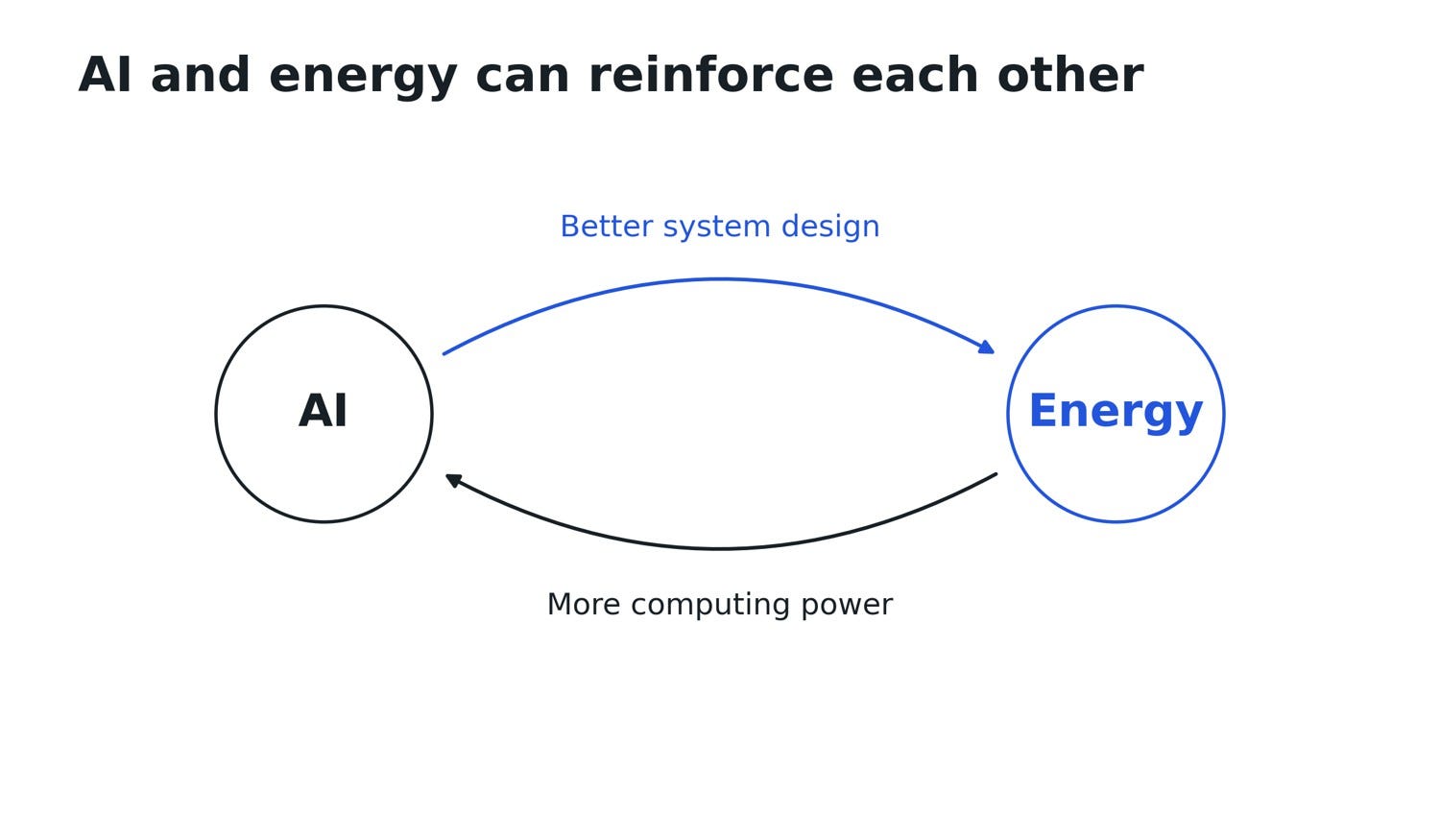
That is the part of the future I care about, and it is why this series exists. Physics may make a technology possible. The boring machinery of origination, development, finance, construction and operations decides whether anybody gets to use it. Africa has the sunshine, the demand and, increasingly, the hardware. What it has been short of is enough organised stupidity pointed at the right constraint.
Somewhere in Africa, a group of reasonably intelligent adults is looking at a problem.
One of them clears his throat.
“Okay, hear me out.”
Everybody should leave.
Instead, somebody opens Excel.
That is when the billion-dollar company begins.
- S
Disclaimers
P.S: I work in African energy for a living, so I have a commercial interest in the argument that African energy can be built as a platform rather than a pile of projects. Please read Lesson 7 the way you would read a barber’s essay on the benefits of haircuts. I hold no position in Starcloud. I have never worked with Starcloud. I have no non-public information about Starcloud, and on current evidence, Starcloud has no information about me at all. Every number above is public and linked, including the ones I wish were bigger.
P.P.S: The confession. I wrote “prove it small, early and cheap” with a completely straight face. Philip Johnston designed, built and launched a satellite in 21 months. In my line of work, 21 months is roughly how long it takes to agree which version of the term sheet is the latest version. I have watched a land title search outlive two phones and a change of government.
If you are Philip Johnston: hello. No pressure. The friendship paperwork can wait, but I would like the single-line diagram for Starcloud-3.
P.P.P.S. If your project has been “shovel-ready” since 2017, please check on the shovel. It may have retired. It may now be teaching younger shovels about the importance of managing expectations.
P.P.P.P.S. If the financial model only works when the currency strengthens, the customer pays early and nothing breaks for twenty years, congratulations. You have developed infrastructure for the Garden of Eden.
P.P.P.P.P.S: “We are raising $20 million to prove the concept” is an extraordinary sentence. Imagine saying that at home. “Darling, I need twenty million dollars.” “For what?” “To find out whether I’m talking nonsense.”
If this was useful, forward it to the one developer you know who is still waiting for the grid. They have time to read it. If it was not, the unsubscribe button works perfectly. I test it monthly, usually after rereading my own drafts.
References
Starcloud
Feilden, Oltean and Johnston (2024), Why we should train AI in space, Starcloud white paper v1.03
HPCwire (30 March 2026), Starcloud raises $170M Series A at $1.1B valuation
TechCrunch (21 August 2026), Starcloud raises $250 million for orbital data centers as launch options dry up
TechCrunch (11 May 2026), Cowboy Space raised $275 million to build rockets
Sacra, Starcloud company profile
Crusoe (22 October 2025), Crusoe to become first cloud operator in space
CNBC (10 December 2025), Starcloud trains first AI model in space
African energy evidence
IEA (2023), Financing Clean Energy in Africa
Energy Institute, Building Africa’s solar power, citing the IEA Africa Energy Outlook 2022
pv magazine (27 August 2025), African PV imports from China up 60% in one year
African Business (August 2025), Nigeria leapfrogs Egypt as African solar panel imports spike
Latitude Media, In Africa, the first signs of solar adoption at scale
BloombergNEF (9 December 2025), Lithium-ion battery pack prices fall to $108/kWh
Energy-Storage.news (10 December 2025), Battery pack prices fell 8% since last year
21st Century Chronicle, Nigeria spends $14bn on generators, fuel yearly
BusinessDay, Inside Nigeria’s multibillion-dollar generator economy
DatacenterDynamics, Microsoft and G42 data centre in Kenya stalled
Investment Monitor (11 May 2026), Microsoft and G42 Kenya data centre project stalls
Citi (2025), Sun King securitisation to deliver solar to over a million Kenyans
CNBC via NBC New York, How a Block-backed bitcoin miner uses a volcano in Kenya
Theory
Goldratt, E. (1984), The Goal, North River Press
Wright, T. P. (1936), “Factors affecting the cost of airplanes”, Journal of the Aeronautical Sciences
Way, R., Ives, M., Mealy, P. and Farmer, J. D. (2022), Empirically grounded technology forecasts and the energy transition, Joule
Christensen, C., Ojomo, E. and Dillon, K. (2019), The Prosperity Paradox, Harper Business; excerpt on Tolaram
Dixit, A. and Pindyck, R. (1994), Investment under Uncertainty, Princeton University Press
McGrath, R. and MacMillan, I. (1995), Discovery-driven planning, Harvard Business Review
Flyvbjerg, B. and Gardner, D. (2023), How Big Things Get Done; overrun figures via Inside Climate News
Flyvbjerg, B., Budzier, A. and Christodoulou, M. (2026), Towards a theory of modular natives
Hirschman, A. (1967), Development Projects Observed, Brookings
Flyvbjerg, B. and Sunstein, C. (2016), The principle of the malevolent hiding hand
Teece, D. (1986), Profiting from technological innovation, Research Policy
Khanna, T., Palepu, K. and Sinha, J. (2005), Strategies that fit emerging markets, Harvard Business Review
Helmer, H. (2016), 7 Powers: The Foundations of Business Strategy
Coda
IEA (2025), Energy and AI: executive summary
AWN (2025), Chris MacLean on visualising the maths of Foundation season 3
OpenAI (8 September 2026), On the Navier–Stokes Millennium Prize Problem
The Neuron (9 September 2026), Inside OpenAI’s Navier–Stokes claim