

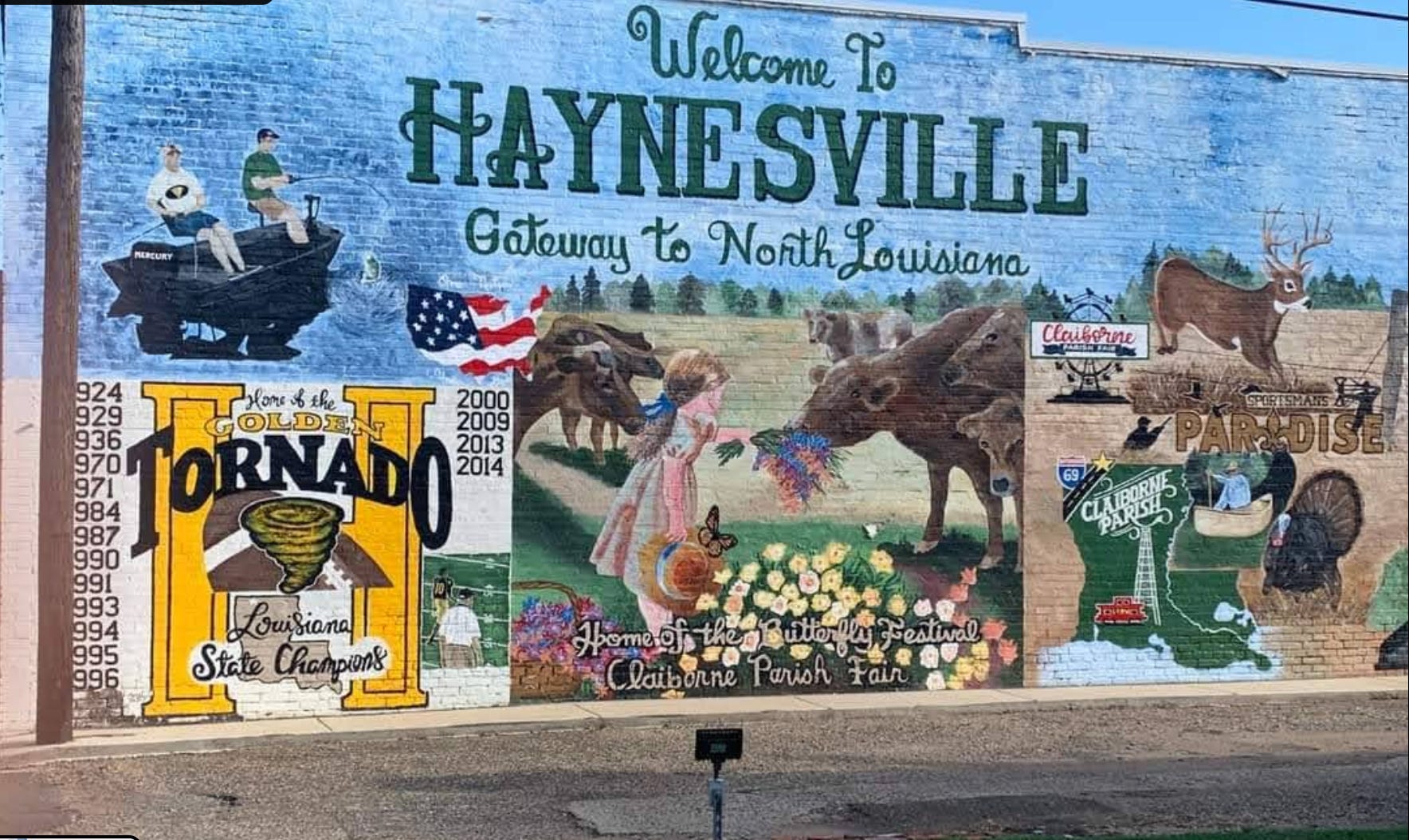
There is a small town in northern Louisiana called Haynesville. It is known for two things: an annual butterfly festival, and the fact that it sits on top of one of the largest natural gas fields on earth. There are dozens of drilling rigs scattered across the region. And according to the Financial Times, the single biggest owner and operator of those rigs is not an oil company.
It is a hedge fund.
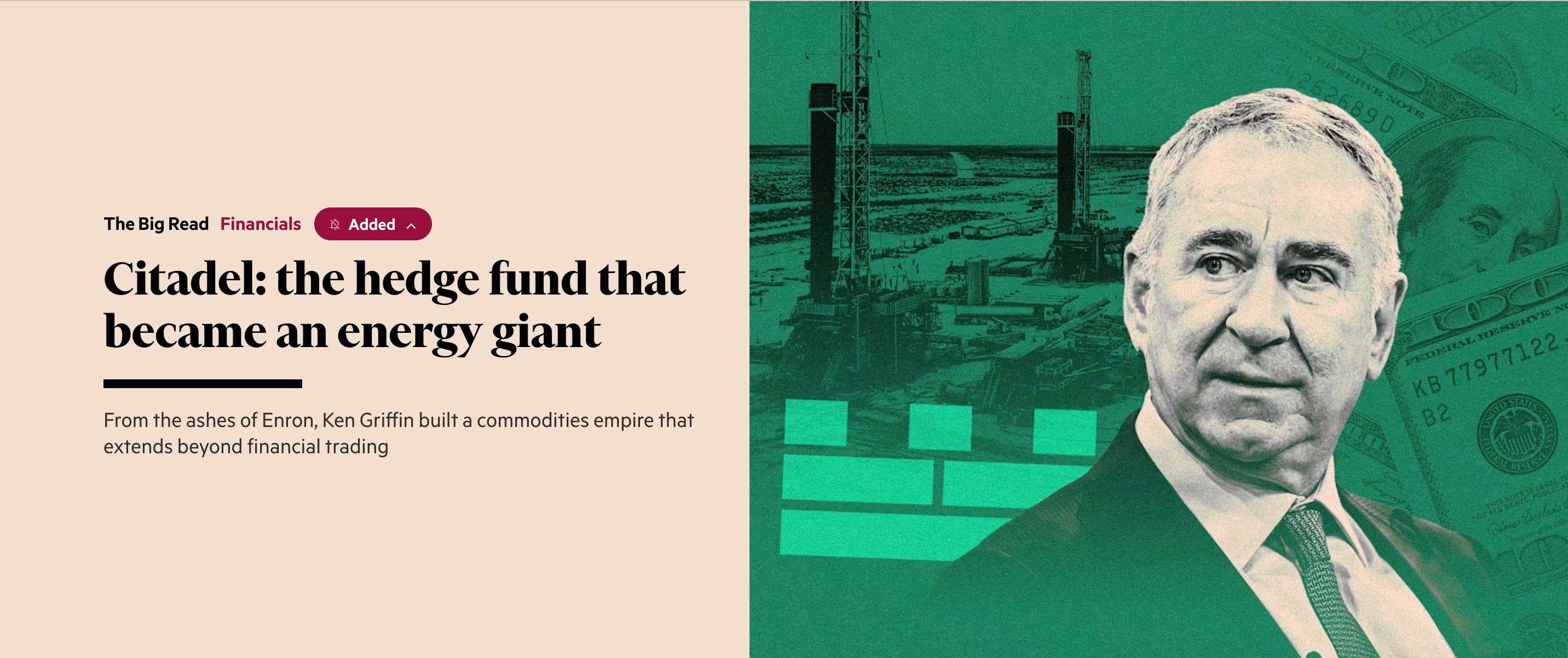
Ken Griffin’s Citadel, the firm most people associate with bond trades and quants in Miami, is now one of the largest physical energy players in the United States. The Financial Times recently traced how it got there, and if you flick a light switch in California, there is a decent chance the electrons passed through something Citadel touched.
I have read that article more times than is healthy, because I keep getting asked a version of the same question.
What would the African renewables version of that look like?
Now, let me get something out of the way, because I can already hear it.
The last thing this continent needs is someone reading one FT article and deciding they are now the Ken Griffin of Kwara. We have enough of those. The man with the 1 GW pipeline that has been “at final stages” since the last AFCON does not need a hedge-fund cosplay phase on top of everything else.
So this is not a “copy Citadel” essay. Copying Citadel would actually be a fast way to lose money in Lagos.
This is a “study the architecture beneath Citadel” essay. Because underneath the mythology, Citadel is not really a story about trading. It is a story about how information advantage, patient capital, talent, and physical ownership compound into something that becomes very hard to dislodge. And that architecture, translated honestly and not copied blindly, is the most useful mental model I have found for what a billion-dollar African energy company could actually be.
Let me show you what I mean. Then let me show you the one place the whole analogy breaks, because that broken place is the most important part.
What Citadel actually did
Strip away the drama and Citadel’s energy empire rests on a handful of moves. None of them are “be good at trading.”
The first move was distress. When Enron filed for the biggest bankruptcy in American history in 2001, Griffin did not wait for the dust to settle. He chartered a jet, sent his people to Houston within days, and they interviewed what insiders describe as nearly everyone in Enron’s trading operation, at every level. Other firms set up a few polite meetings. Citadel reverse-engineered the entire business. They walked away with a research team and, more valuably, a working map of how US energy markets actually function. A few years later, when the energy fund Amaranth blew up on bad gas bets, Citadel teamed up with JPMorgan, bought the entire book, and made a fortune cleaning it up.
The pattern is the thing to notice. Citadel did not fight incumbents at their strongest. It waited for capital structures to break, then acquired the assets and the people at a discount, and built the capabilities the previous owners never realised.
The second move was data, long before data was fashionable. By the mid-2000s Citadel was bragging about a “meteorology room.” Over the following decade it hired atmospheric scientists, built high-performance computing, and turned weather, shipping, satellite, and production data into something it could actually trade on. The claim the firm makes today is that it is the most sophisticated user of this kind of alternative data in the business. Whether or not that is literally true, the posture is the point. They treated information as the edge and everything else as plumbing.
The third move, and this is the one that matters most for us, was the slow walk from financial to physical. For years Citadel was a financial actor: buying and selling contracts on gas and power. Then in 2014 it set up an energy marketing business that physically moves gas from the people who produce it to the people who need it. Last year that business moved volumes equal to roughly a tenth of all US natural gas consumption. It now owns gas fields and rigs. It bought a German renewable-power trading firm and a Japanese power company. It went from betting on the flow to owning the flow.
That sequence (financial exposure first, physical control later) is the spine of the Citadel story. Understand the market on paper, then go own the tanks and pipes and wires that the paper represents.
And here is the deeper logic, the part that turns a clever trade into a moat. Once you own the physical layer, every asset becomes a sensor. The gas field tells you about production. The power assets tell you about flow. That proprietary information makes the next decision sharper, which funds the next asset, which generates more information. Information becomes assets becomes better information. The loop is the empire.
So far, so transferable. Distress acquisition, an obsession with data, ownership of the physical layer, and the patience to let the loop compound. You could write that on a whiteboard in Nairobi and it would still be true.
Except for one thing.
The lesson that breaks in the heat
Citadel got rich in deep, liquid, electronified markets. The US gas and power markets it trades are some of the most transparent and tradable on the planet. You can see prices by the second. You can hedge almost anything. Griffin’s whole worldview, by his own description, is that everything can eventually be automated and electronified.
Now look at the African commercial and industrial power market.
It is the opposite of electronified. Origination happens over relationships and site visits and warm bottles of water. Tariffs are negotiated, often with one side knowing far more than the other. Payment behaviour is idiosyncratic. Currency risk hangs over every contract. Land, permitting, and FX intrude at every step. There is no second-by-second price for “reliable industrial power in Aba.” There is barely a price at all.
Which means the part of the Citadel playbook that made Citadel its billions, the trading, the market-making, the merchant layer, is exactly the part that does not yet exist here.
This is the single most important thing I can tell you, so let me say it plainly.
You cannot copy Citadel’s order of operations. Citadel went financial first, then physical. In Africa you have to go physical first, because the financial and trading markets that reward a pure trader are years away from being deep enough to pay you. The African Citadel is built backwards from the original.
And once you accept that, something interesting happens. The opacity stops being a bug.
In a transparent market, information is a commodity. Everyone subscribes to the same data feed and competes on cost of capital. In an opaque market, the firm that quietly builds the only map wins everything. It originates better, buys better, and prices risk that nobody else can see. The very thing that makes African power impossible to automate, the fog, is what makes a proprietary information layer so valuable. You are not trying to be Citadel in a liquid market. You are trying to be the firm that builds the missing market’s nervous system, and then owns the best assets inside it.
So what actually transfers? Distress acquisition transfers, and in Africa distress is not a once-a-decade event, it is the weather. The data obsession transfers, except you cannot buy the data, you have to manufacture it. The reliability premium transfers, and harder than anywhere: in a market defined by counterparty fragility, “we will still be standing in twenty years, and our power will still flow” is itself the product. And the patient-capital discipline transfers, with a twist I will come to.
What does not transfer is the dream of a quant trading desk arbitraging a liquid market. Not yet. Pretending otherwise is how you end up with a beautiful model and an empty bank account.
The real scarcity is not panels
Here is the part where I am supposed to overwhelm you with market-size statistics. I will keep it to the ones that actually matter, because the numbers are not the argument. The numbers just tell you the argument is large.
Start with the wall of diesel. Wood Mackenzie counts roughly 100 GW of generators across the continent, and calls its own number conservative. Nigeria alone runs something like 28 GW, Ghana around 10, Kenya around 8. Seventeen African countries have more backup generator capacity than actual grid capacity. The Central Bank of Nigeria has noted that fuel for power can eat up to 40% of a manufacturer’s operating costs. Across sub-Saharan Africa, most firms experience regular outages, and more than half of manufacturers own or share a generator. This is not a market that needs to be created. It exists, it is enormous, and it currently runs on the most expensive, dirtiest power available.
Then the arbitrage that pays for everything. All-in diesel power lands around forty cents a kilowatt-hour, and higher once you honestly price the downtime, the theft, and the maintenance. Solar paired with storage now delivers somewhere between ten and fourteen cents in the same markets, with paybacks for a diesel-dependent factory that can compress toward a couple of years. That is not a marginal efficiency. It is a collapse in the cost of one of an industrial firm’s three biggest line items, available today, with technology that works.
Now the part I find genuinely funny, in a dark way. Nobody agrees how much solar Africa installed last year. The Global Solar Council says it was a record, around 4.5 GW, up more than fifty percent. The Africa Solar Industry Association, using its own bottom-up project tracking, counts roughly 2.4 GW. And then AFSIA looks at how many Chinese solar panels actually landed on African ports, and concludes that the real installed base might be 63.9 GW against the 23.4 GW it can formally see. A gap of something like 40 GW.
Sit with that. The official numbers might be wrong by nearly a factor of three, and most of the missing capacity is behind-the-meter: factories, mines, and commercial parks quietly going solar where no statistician can find them.
A 40 GW blind spot in the data is a tragedy for analysts. For a builder, it is a 40 GW map that nobody else has drawn. The disagreement is the opportunity.
And underneath all of it sits the real constraint, the one that decides who wins. It is not solar resource. We have absurd amounts of sun. It is not technology. Anyone can import a container of modules. The constraint is capital, and specifically the price of it. The IEA estimates the cost of capital for African energy projects runs at least two to three times higher than in advanced economies. Meanwhile private clean-energy investment on the continent has tripled, from around 17 billion dollars in 2019 to almost 40 billion in 2024, which sounds great until you remember it is a fraction of what is needed, held back precisely because lenders price the risk so high.
So here is the whole thesis in one line. In African energy, the scarce resource is not panels or even capital. It is risk judgment. Whoever can price African energy risk better than the banks, the DFIs, the utilities, and the developers will win, because better risk judgment means lower losses, lower losses mean a lower cost of capital, and a lower cost of capital wins the projects. Everything else is choreography.
That is the citadel. Not the megawatts. The judgment.
What you actually build
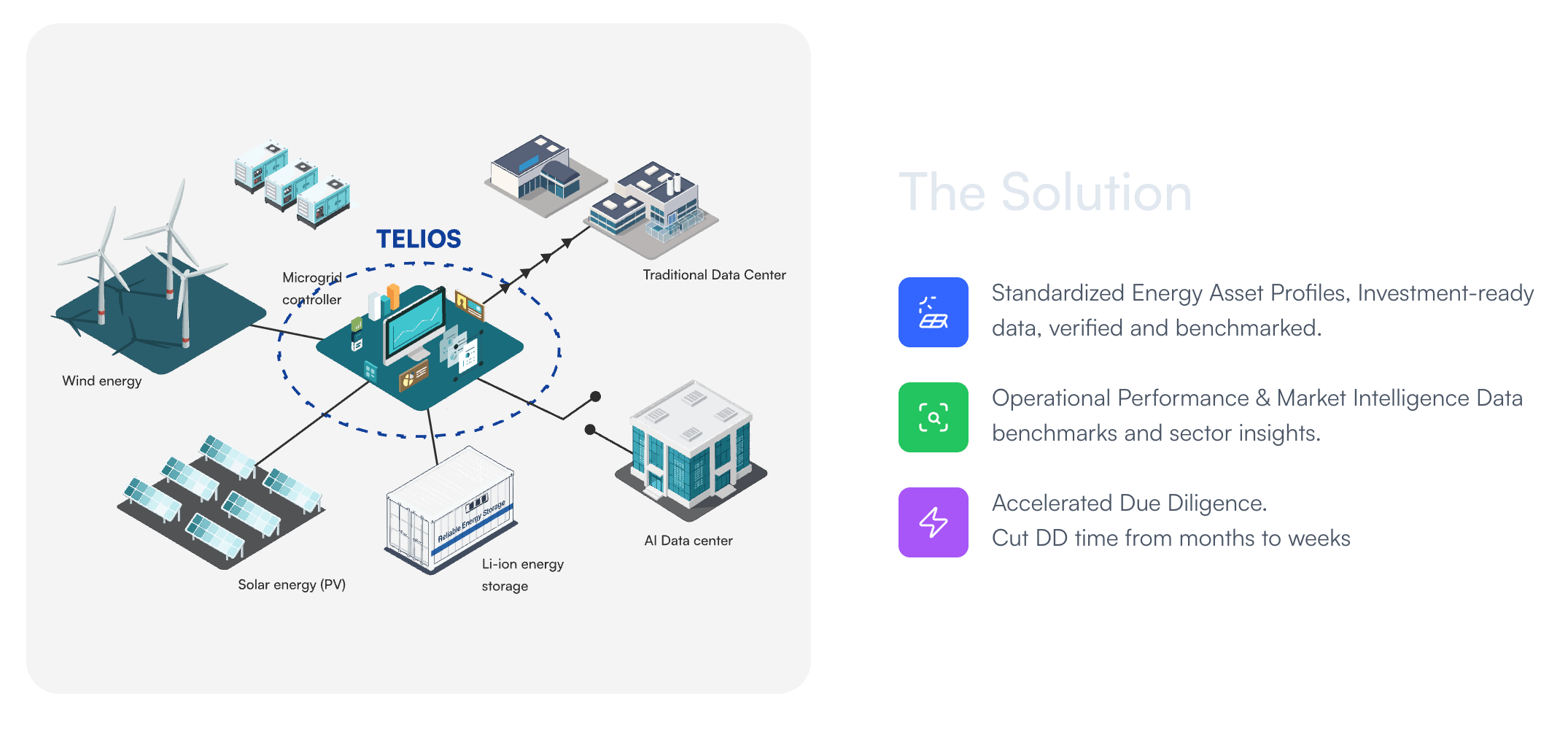
So you do not build another solar EPC. You do not build another IPP that prays at the altar of announced megawatts. You build the thing that prices risk better than anyone else, and you wrap physical assets around it. In practice that is three layers, and the order they go in is the entire game.
First, you build the map. Before you deploy serious capital, you build the best proprietary dataset in African energy. Not market reports. Real operating data. You meter the factories and the cold rooms and the agro-processors and the telecom sites. You learn their load profiles, their diesel runtime, their power-quality events, their payment history, their currency exposure, their roof and transformer constraints. You watch which feeders actually fail, as opposed to which ones the utility claims are fine. You track which inverter models die early in the heat and the dust, which battery chemistries degrade, which EPCs deliver and which ones vanish after commissioning.
Most developers underwrite a project from a stack of bills and a single site visit and a prayer. What you are building instead is a live underwriting engine, an African energy risk graph that knows which sectors pay, which geographies are real, which contract structures survive an FX shock. That graph is the thing the whole company is organised around, and it is the one asset that cannot be bought. It can only be accumulated, deal by deal, site by site, over years. A competitor with a fatter balance sheet can clone your app in a quarter. They cannot clone four years of verified knowledge of who burns what and who pays.
Second, you own what the map points to. This is where many platform founders flinch, and they are wrong to. The FT quotes a rival who studied Citadel and walked away, and his conclusion is the most useful sentence in the whole piece: unless you are willing to actually own assets, it is hard to build a real edge. Brokering and software alone leave you renting other people’s economics and, crucially, other people’s data.
Owning physical generation does three things nothing else can. It captures the full diesel-to-solar arbitrage instead of a thin fee on it. It turns you into the reliable, long-term counterparty that commands a premium, which is precisely why Shell wrote a cheque for Daystar in 2022 and why CrossBoundary can raise a half-billion-dollar-plus portfolio against blue-chip offtakers like Unilever, Diageo, Heineken, and a copper mine in the DRC, wrapped in a 495-million-dollar World Bank guarantee against the currency risk. And, most importantly for our purposes, every asset you own becomes a permanent sensor feeding the map: real yield, real degradation, real payment behaviour over a fifteen-year contract. The developer with assets but no data layer is wasting the telemetry. The software company with a data layer but no assets has no telemetry to waste. Only the firm that owns both keeps the map alive.
You do not buy randomly, though. You own selectively, where ownership produces information and optionality: C&I solar and storage portfolios, hybrid systems in weak-grid corridors, battery fleets where reliability is scarce, eventually wheeled positions where the rules allow. And you treat distress as the accelerant, because the consolidation wave is already releasing supply below replacement cost: underperforming portfolios with good sites and bad operators, sub-scale installers who cannot raise the next round, developers caught on the wrong side of a currency move, and the occasional fund-level governance break that strands an entire book. The Amaranth move, adapted. When a competitor’s capital structure cracks, the assets and the people are available to whoever did the work and kept capital ready.
Third, and last, you cash the asymmetry. This is the merchant layer, the part that made Citadel its fortune, and I am going to be honest about it in a way that most pitch decks are not: in African power, it barely exists yet. So you rank it by what is real today.
Biomass feedstock trading is real now. It does not wait on any power-market reform. It is physical, relationship-gated, and information-intensive, which is exactly the terrain where a proprietary supply-and-logistics map plus contracted tonnage is a genuine edge. Certificates are real, and growing: I-RECs from African projects still trade for less than a dollar a megawatt-hour, which is small, but if you own the generation you originate them at zero marginal cost, and the impact variant, the Peace REC, has sold to the likes of Microsoft and Google at around forty-five dollars a certificate. When you already own the asset, that is pure margin sitting on top of power you were selling anyway.
And then there is the tell, the single clearest signal that the merchant layer is coming and that the data company is positioned to own it. Look at South Africa. Eskom launched virtual wheeling commercially in 2025, Vodacom became the first to use it at scale, and the wholesale electricity market is being stood up as we speak. But traders and aggregators, the people who would actually make that market liquid, are still locked out, waiting on the rules. And the reason everyone keeps naming for why it cannot scale yet is automation. With many generators and thousands of meters, somebody has to track allocations, match them to consumption, and reconcile settlements at a scale that is impossible by hand. Eskom had to hire a firm to build the software platform to do it.
Read that again with a builder’s eyes. The continent’s most advanced power market is being throttled by precisely the settlement-and-aggregation capability you would be building anyway. That is not a coincidence to admire from a distance. It is the merchant opening, and it arrives the moment the rules catch up to the code.
So the discipline is this. Underwrite the data and the assets on their own economics, because those pay today. Treat the merchant layer beyond biomass and certificates as cheap optionality on a market that is visibly, if slowly, electronifying. Do not put a single naira of required return on a power-trading market that has not been built. But be the one company positioned to walk through the door the instant it opens.
Why this is hard to copy
Each of those three layers is a business on its own. Composed, they become a moat, and the reason is the loop.
The map points you at the best assets. The assets generate proprietary operating and payment data. That data sharpens both the next round of origination and the merchant decisions. Better decisions mean lower losses and higher utilisation, which lowers your cost of capital, which wins you the next assets, which feed the map. Around it goes, and it widens with every turn.
Now watch why a single-layer competitor cannot catch up. The pure software company sees only the deals that cross its own platform, earns a thin fee, owns nothing, generates no operating data, and is one well-funded copycat away from irrelevance. It is also worth remembering that horizontal software in this space already exists and is genuinely good: there are platforms moving billions in financing for distributed energy across the continent. Which is exactly the point. Software alone is contestable. The pure developer owns assets and the telemetry they throw off, which is real, but it only ever sees its own deal flow. It selects from what walks in the door rather than from a map of the whole field, and it has no structural trading edge beyond its own generation. The pure trader has no proprietary supply or demand signal and no assets to generate one, so in a foggy market it is trading half-blind.
Only the integrated entity closes the loop. And it is defended by all the boring, durable things at once: network effects, because the benchmarking gets better with every site you add; switching costs, because offtakers are embedded in multi-year metered contracts; scale economies, because you finance portfolios instead of projects; and a proprietary-data advantage that a balance sheet cannot buy because it can only be lived.
The replicable layers are the ones founders love to talk about: the slick app, the clever lease product, the brand. The defensible layers are the quiet ones: the accumulated data, the calibrated asset telemetry, the earned trust of a guarantor like the World Bank. The strategy is not to build the best software. It is to use the software to accumulate the one asset capital cannot buy, and bolt it to a balance sheet a software company could never raise.
The ways this kills you
I have spent enough years in this market to know that the graveyard is full of beautiful models. So in the spirit of scar tissue, here are the ways this particular ambition gets you killed, and roughly how you survive each one.
It kills you through reputation and politics. The FT puts it perfectly: if half of California loses power and it traces back to you, that is bad. In Africa the charge is doubly live, because electricity is welfare and governments intervene, sometimes retroactively. The moment you are simultaneously the firm that sees the most, owns the assets, and profits from the spread, you attract scrutiny a humble installer never would. Eskom is already in court trying to slow the very traders the market was meant to unlock. You survive this by being additive rather than extractive, by never being the single point of failure for a critical load, and by treating regulators as people you help build investable markets, not people you outsmart.
It kills you through currency. This is the structural killer, the one that has buried more African energy projects than any inverter fault. Your revenue is in naira and cedi and CFA. Your capital and your panels are priced in dollars. A single currency move can add a fifth to your costs overnight, and several have. You survive this the way the serious players do: local-currency debt where it exists, guarantee wraps against inconvertibility, tariffs structured to breathe with the shocks, and a geographic spread across currency regimes so no single devaluation sinks the book.
It kills you through the wrong capital. The FT lands on this quietly: once you start owning assets, you are really a private equity firm wearing a hedge fund’s clothes, and you need locked-up capital. An asset-owning platform run on hot, redeemable money is a contradiction that ends in a fire sale. This is the twist on the patience lesson. Citadel returns capital to stay nimble. You need the opposite: committed, long-duration capital that can sit through an eighteen-month development cycle without flinching. The cleanest answer is to split the house. Let a capital-light data and software company carry the venture money and the high margins and the proprietary datasets. Let a separate, patient asset vehicle carry the infrastructure capital and the long-tenor debt and the guarantees. Wire them together with one nervous system: the data company feeds origination and risk intelligence to the asset vehicle and is paid for it, the asset vehicle feeds operating data back. Investors can back either risk appetite. The value accrues to whoever owns the layer running between them.
And it kills you through the smaller, dumber things, the ones that do not make it into thesis essays but do make it onto gravestones. Selling solar when the customer is buying reliability, and watching them churn the moment a cheaper quote appears. Chasing announced megawatts instead of collected kilowatt-hours, because announced megawatts are vanity and collected kilowatt-hours are sanity. Financing customers you do not actually understand, the ones who serve you cold water, nod gravely through the meeting, show you three generators, and then treat your invoice as a philosophical suggestion. Customising every single project until you are not a scalable business at all, just a very tired consultancy with some panels attached. Ignoring operations and maintenance until dust and heat and a dead inverter quietly destroy an IRR that looked beautiful in the model. And making carbon credits the base case, when carbon should improve a return, never be the thing standing between your project and financial sadness. If a project only works because of carbon, it is not a project yet. It is a prayer request with an emissions factor.
None of these are clever. All of them are fatal. The companies that scale are not the ones with the best slides. They are the ones that internalised the boring discipline early.
The endgame
Here is what I actually believe, underneath all the jokes.
The African renewable-energy unicorn will not be a solar company. It will be an energy intelligence company. A credit-underwriting company. An asset-management company. A reliability company. A financing company. A data company. And yes, somewhere in there, also a renewable-energy company.
The endgame was never panels on rooftops. It is control of the reliability layer of African industrialisation. The next phase of this continent’s growth needs power for factories and cold chains and data centres and ports and irrigation and the processing of the minerals the world is suddenly desperate for. The company that wins is the one that knows, before anyone else, which factories will grow, which feeders will fail, which customers will pay, which states will regulate well, which batteries will die early, which portfolios are mispriced, and which markets are about to open. That is not a solar installer. That is an energy institution.
And it gets there backwards from Citadel, on purpose. Build the map first, because in the fog the map is everything. Own the assets the map points to, because ownership captures the economics and keeps the map alive. Let the merchant layer pay out last, as the markets electronify, fastest in South Africa, where the bottleneck is already the exact capability you are building. Do that, and the thing that makes you hard to dislodge is not any single layer. It is that no competitor can assemble all three in the order the market actually rewards.
A hedge fund became the biggest rig operator in a Louisiana town famous for butterflies. It did not happen because they were the best traders. It happened because they understood the flow before anyone else, and then went and owned it.
The African version is sitting there waiting to be built. Not by the loudest installer. By the best risk-underwriter, data owner, operator, financier, and eventually market-maker in African power.
That is the template. The market is open. The window is not permanent.
Next in the series, we leave the hedge funds and go somewhere stranger.
A few honest disclosures, because this is the internet and someone always asks.
P.S. - None of this is investment advice. I model power projects for a living, and I have watched genuinely beautiful ones die, in spreadsheets and in the field. That has left me allergic to confident predictions, my own included. Read everything above as a way of thinking, not a tip sheet.
P.P.S. - The views here are mine alone. Not my employer’s, not any board’s, not the committee that has to sign off on my actual day job.
P.P.P.S. - And yes, I am aware that I have just spent four thousand words describing, in some detail, a company that looks a great deal like the one I have been building on nights and weekends for years. We will get to that another day. Or we will not, and you can simply wonder.
P.P.P.P.S. - If this was useful, the kind thing is to subscribe. The useful thing is to forward it to the one person you know who is about to raise money to install panels and call it a strategy. And if you think I have this wrong, I would honestly like to hear why. I have been wrong about enough things to find the exercise interesting.
P.P.P.P.P.S. - Template 2 is already taking shape. It is stranger than a hedge fund, which is a high bar.
Read this as research. Read it as strategy. Read it as vibes. Read it as me, once again, thinking too loudly on the internet.
Sources and further reading
The Citadel source
Robin Wigglesworth, “Citadel: the hedge fund that became an energy giant,” Financial Times. https://www.ft.com/content/3d0842dd-a8f4-435d-b888-5587b4b9eeda
The scale of the problem: market size and economics
“Africa’s hidden solar boom: how C&I platforms are quietly consolidating a 40 GW market,” African Exponent (the ~100 GW of African gensets per Wood Mackenzie; Nigeria ~28 GW, Ghana ~10 GW, Kenya ~8 GW; all-in diesel above $0.40/kWh versus solar-plus-storage at $0.10 to $0.14/kWh). https://www.africanexponent.com/africas-hidden-solar-boom-how-c-i-platforms-are-quietly-consolidating-a-40-gw-market/
Adewale A. Adesanya and Joshua M. Pearce, “Economic viability of captive off-grid solar photovoltaic and diesel hybrid energy systems for the Nigerian private sector,” ScienceDirect (diesel captive generation at roughly $0.28 to $0.33/kWh). https://www.sciencedirect.com/science/article/abs/pii/S1364032119305568
“Solar PV powering the C&I sector in Africa,” Synergy Consulting (financed captive solar at $0.08 to $0.12/kWh, 60 to 70% below backup diesel at $0.35 to $0.40/kWh). https://www.synergyconsultingifa.com/noteworthy/industry-knowledge/solar-pv-powering-commercial-industrial-sector-in-africa/
“Africa Diesel Genset Market,” Market Data Forecast (Central Bank of Nigeria estimate that businesses spend up to 40% of operating costs on fuel for power). https://www.marketdataforecast.com/market-reports/africa-diesel-genset-market
Nigeria electricity prices, GlobalPetrolPrices.com (business grid tariff around $0.048/kWh, September 2025). https://www.globalpetrolprices.com/Nigeria/electricity_prices/
“Tipping point for African C&I solar,” pv magazine (Nigeria’s C&I solar opportunity put at “at least $15bn per year”). https://www.pv-magazine.com/2022/11/01/tipping-point-for-african-ci-solar/
The data, and the disagreement about it
“GSC: Africa adds record 4.5GW of new solar PV capacity in 2025,” PV Tech (Global Solar Council figure, a 54% year-on-year increase). https://www.pv-tech.org/gsc-africa-adds-record-4-5gw-new-solar-pv-capacity-2025/
“AFSIA: 2.4GW of new solar deployment in Africa in 2025,” PV Tech (the African Solar Industry Association’s lower, bottom-up tracked figure). https://www.pv-tech.org/chinese-solar-imports-batteries-2-4gw-new-solar-deployment-africa-2025/
“Africa’s installed PV capacity estimated above 63 GW,” pv magazine (23.4 GW tracked versus 63.9 GW estimated once Chinese export data is reconciled). https://www.pv-magazine.com/2026/01/22/africas-installed-pv-capacity-estimated-above-63-gw/
“Solar PV in Africa: conflicting data confuse the messaging,” Empower New Energy (a direct read on the AFSIA versus GSC disagreement). https://www.empowernewenergy.com/post/solar-pv-in-africa-conflicting-data-confuse-the-messaging
The developers and the deals
“CrossBoundary Energy C&I Africa Portfolio,” MIGA / World Bank Group (the $495m guarantee framework against currency inconvertibility and transfer restriction). https://www.miga.org/project/crossboundary-energy-ci-africa-portfolio
“CrossBoundary Energy secures US$200M senior debt...,” CrossBoundary Energy, November 2025 (Standard Bank-led facility with Absa, MCB, FEI, DEG, FMO; blue-chip offtakers; the Kamoa Copper baseload deal). https://crossboundaryenergy.com/crossboundary-energy-secures-us200m-senior-debt-to-further-renewable-energy-portfolio-in-africa/
“Shell acquires African C&I solar provider Daystar Power,” PV Tech, December 2022 (a supermajor’s first power acquisition in Africa). https://www.pv-tech.org/shell-acquires-african-ci-solar-provider-daystar-power/
“Merger activity heats up in African commercial solar market,” pv magazine (the Starsight and SolarAfrica merger, backed by Helios and AIIM). https://www.pv-magazine.com/2022/09/28/merger-activity-heats-up-in-african-commercial-solar-market/
The merchant layer: wheeling, certificates, biomass
“Eskom moves to automate virtual wheeling,” Energize (the Enerweb platform; automation as “a prerequisite, not a nice-to-have”). https://www.energize.co.za/article/eskom-moves-to-automate-virtual-wheeling
“Virtual Wheeling,” Eskom Distribution (the mechanics of the product). https://www.eskom.co.za/distribution/virtual-wheeling/
“South Africa: why Eskom’s virtual wheeling is a breakthrough moment for SMEs,” Zawya (Vodacom as first at scale via a Sola Group PPA, September 2025; the wholesale market arriving in 2026). https://www.zawya.com/en/economy/africa/south-africa-why-eskoms-virtual-wheeling-is-a-breakthrough-moment-for-smes-x1ejwt8q
“The trader’s legal landscape,” Cliffe Dekker Hofmeyr (traders and aggregators excluded from virtual wheeling pending NERSA’s trading rules, anticipated around mid-2026). https://www.cliffedekkerhofmeyr.com/en/news/publications/2025/Sectors/Projects-Energy/projects-and-energy-alert-20-august-The-traders-legal-landscape
“A guide to renewable energy certificates and global attribute markets,” Innovo Markets (I-RECs, and the Peace REC variant for fragile and conflict-affected regions). https://www.innovomarkets.com/blog/renewable-energy-certificates-and-global-attribute-markets
“The market outlook for International Renewable Energy Certificates,” Ecohz (I-REC issuance, redemption, and cross-border trade). https://www.ecohz.com/news/irec-market-outlook
Energy Peace Partners, Peace REC FAQs (average prior transactions around $45 per Peace REC; corporate buyers including Microsoft and Google).
Odyssey Energy Solutions / Transforming Energy Access (horizontal distributed-energy platform; billions in financing enabled across thousands of company users).
Investment and capital
“Africa, World Energy Investment 2025,” IEA (private clean-energy investment tripling from around $17bn in 2019 to almost $40bn in 2024; roughly 600 million Africans still without electricity access; cost of capital for African energy projects at least two to three times higher than in advanced economies). https://www.iea.org/reports/world-energy-investment-2025/africa