

I have a strange job.
I sit in meeting rooms across Africa and tell business executives three things: that they can decarbonise almost everything they do, that it will cost them nothing upfront because someone else will finance it and carry the risk, and that in most cases it will be cheaper than whatever they are using today.
Then I watch them not believe me.
Fair enough. If a stranger told me the same thing, I would also assume he was selling timeshares.
So consider this the receipts.
One more thing before we start. This is not theoretical analysis. It is a menu, and every item on it is something I arrange for companies in Africa today, either delivered by my own team or through the platforms I work with daily. Keep that in mind; we will come back to it.
The Numbers Work
Most decarbonisation presentations still begin with a familiar assumption: the green option is environmentally responsible but financially painful.
That assumption is increasingly out of date.
Renewables did become cheaper. IRENA says more than 90% of utility-scale renewable projects commissioned globally in 2025 produced electricity below the cost of the cheapest new fossil-fuel plant available in their respective markets. Solar averaged $44 per megawatt-hour and onshore wind $33.[8]
The other half of the story is that the incumbent became more expensive.
The green option did not suddenly become cheap. The incumbent became expensive, twice over: once at the fuel pump and once at the bank.
At the pump: in April 2024, Nigeria’s electricity regulator raised the Band A grid tariff from ₦66/kWh to ₦225/kWh, a 3.4x increase for the roughly 15% of customers who consume about 40% of the country’s power[1], which is to say: factories. Diesel went from around ₦260 per litre in 2021 to ₦1,600 to ₦1,950 in 2026[2]. Domestic gas is priced in dollars ($2.18/MMBtu base from April 2026)[3], so every leg of naira depreciation, over 60% against the dollar between 2022 and 2025[4], lands directly on the boiler bill. Your energy cost is not just an operating expense, It is equally an FX position you did not choose to take.
At the bank: Nigeria’s monetary policy rate sat at a record 27.5% for most of 2025 before a token cut to 27.0% in September[5], with commercial banks lending to ordinary corporates at 30% and beyond[6]. Ghanaian bank lending has historically averaged near 30%[7]. So if you decide to fund your own solar plant, boiler or fleet, you are building it with some of the most expensive money on Earth.
Which is why the sentence that actually matters in this article is this one: you no longer have to pay the capex.
A whole industry now exists to finance, build, own and operate the asset with cheap, patient, mostly DFI-backed dollars, sell you the output at a fixed tariff, and take the performance risk. Your only job is to sign an offtake agreement and pay for what you consume.
Let me walk the stack.
Layer 1: Electricity. Solar, batteries, and now the grid itself
Commercial and industrial solar in West Africa stopped being a pilot programme years ago.
The basic arrangement is now familiar. A developer finances, designs, installs, owns and maintains the solar plant. The customer signs a long-term power-purchase agreement and pays for the electricity produced. There is no upfront customer expenditure on the plant and no solar maintenance team to manage.[23]
CrossBoundary Energy was already running a $188 million portfolio for 30 corporate customers across 14 African countries by 2022 (Unilever, Diageo, Heineken, AB InBev, Rio Tinto), on 10 to 25 year agreements where the client pays only for the power produced[9]. By mid-2025 its awarded portfolio had reached roughly $707 million across 560MW of generation and 695MWh of storage in 20 countries[10].
Daystar Power, bought by Shell in 2022[11], sells the same promise in four words: no upfront capital expenditure[12]. Empower New Energy is rolling out a portfolio of commercial-scale solar-plus-storage plants for Justrite Superstores across Nigeria[13] under the same structure, a programme I worked on personally in a previous role.
And the bench keeps getting deeper: ManoCap Energy replaces diesel generators with solar-and-battery hybrids for C&I clients across Ghana and Sierra Leone, now expanding into Nigeria, Côte d’Ivoire, Guinea, Liberia and Togo with $20 million of Mirova debt behind it[14], while Germany’s GRIPS Energy runs solar-as-a-service into markets as unfashionable as Senegal’s farming belt[15].
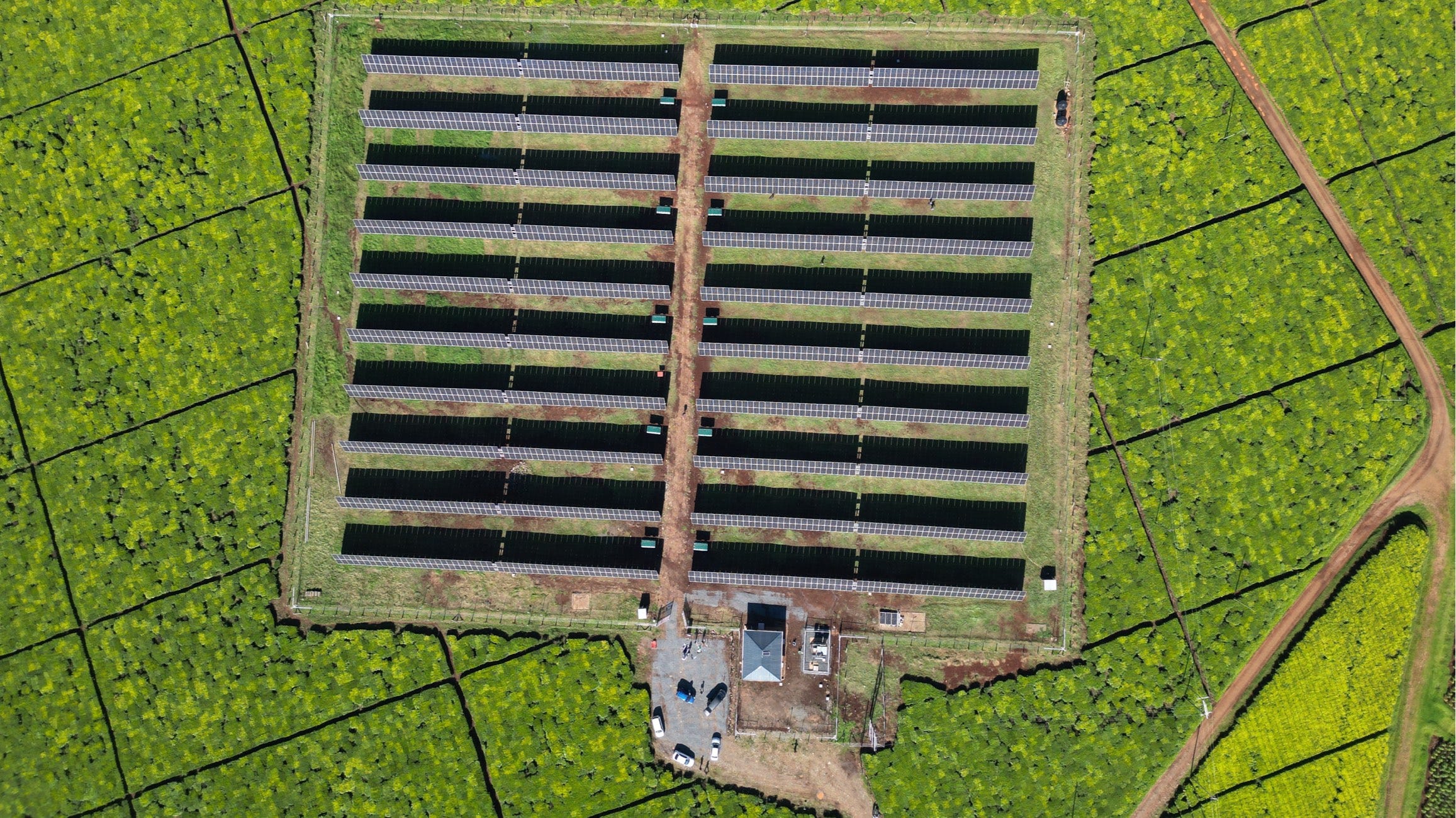
Onsite solar under a PPA is now the boring, settled, default first move, and my own team writes these contracts too. A two-plant 2.0MW solar array now supplies about 17% of James Finlay’s tea operations in Kericho and saves roughly 2,000 tonnes of CO2 a year, sitting alongside the estate’s own micro-hydro, biogas and wood-fired steam in one of the quietest full-stack energy systems in East Africa.[25][26][27] Del Monte’s pineapple operation in Thika commissioned an 807kWp plant this February, designed, financed, built and operated by us, next to its new frozen-pineapple line.[24] Even the shoppers at Nairobi’s Junction Mall are browsing under our rooftop panels.[28][29] I should know the layer well: I have done more than fifty C&I clean energy projects across the region in the last five years, and this is where most of them started.
The newer story is batteries. BloombergNEF’s December 2025 survey put average lithium-ion pack prices at a record $108/kWh, and, more interestingly, stationary storage packs at $70/kWh, down 45% in a single year[16], making stationary storage the cheapest battery segment for the first time. That collapse is what lets us size storage not just to smooth solar but to push the backup generator towards retirement. Wood Mackenzie counted 17 African countries with more diesel generator capacity than grid capacity, Nigeria alone sitting on roughly 28GW of gensets[17]. Every megawatt-hour a battery shifts is a megawatt-hour a genset does not burn at 30-plus US cents[17]. The flagship proof at scale is CrossBoundary’s Kamoa Copper project in the DRC: 222MWp of solar with a 526MWh battery, contracted to deliver 30MW of round-the-clock baseload to a mine[18]. If a battery can baseload a copper mine, it can carry your factory through the evening shift.
And then there is the grid itself. Konexa holds one of Nigeria’s first private energy trading licences and wheels renewable power across the national network to Nigerian Breweries: a roughly 40MWp solar plant with a battery in Niger State delivering about 70GWh a year to breweries in Lagos and Enugu, plus 20.5GWh a year from the 30MW Gurara hydro plant, with a MIGA guarantee wrapped around it[19]. South Africa shows where this goes: licensed traders like Etana Energy are now wheeling at real scale, including a February 2026 deal to supply Sibanye-Stillwater with 600GWh a year of wheeled wind and solar[20] at a stated 20 to 30% saving against utility rates[21]. West Africa is years behind that curve, but the model has arrived, and wheeled renewable supply is now part of my own working portfolio here too, not just something I admire from a distance.
At many facilities, we can now replace most routine generator operation with onsite solar and batteries. Where the grid is reasonably available, it supplies the remaining energy. Where it is not, a smaller generator, a biomass CHP plant or remotely supplied renewable power can provide firmness.
That last option matters because not every factory has enough roof or land.
Upfront cost to the corporate in every case above: nothing.
Layer 2: Thermal heat. Steam, and now the whole powerhouse
Electricity is maybe a third of a food factory’s energy problem. The rest is steam[30], and steam is the hardest line in my order book. Not the only line, as we will get to, but the hardest, which is why it gets its own section. So read this knowing I am talking my book, and then read the receipts anyway.
Steam is invisible, extremely hot and financially consequential.
The proper thermal sequence is usually to eliminate waste first, recover usable heat second, electrify appropriate loads where the power economics permit it, and then replace the remaining fossil fuel with the most suitable renewable heat source.[30]
For many African food and beverage plants, sustainable biomass is commercially attractive because agricultural residues exist locally while the displaced gas, diesel, LPG or heavy fuel oil is expensive, volatile or imported.[40]
Thermal is also the part of this stack where I am not merely studying other people’s case studies.
It is my day job.
The proposition: my team finances, builds, owns and operates a biomass boiler at your site, burning palm kernel shells, cashew shells, cocoa husks or rice husk briquettes, and sells you steam at a fixed tariff under a steam purchase agreement with an availability guarantee. Fuel sourcing risk, the thing that actually kills these projects, sits with us, not you, managed through multi-feedstock, multi-supplier contracts with moisture and calorific value specs written in, and every kilogram sourced sustainably under ISCC or equivalent certification[31].
That last clause matters more than it looks: the three objections every corporate raises about biomass (deforestation, competition with food, supply security) are exactly what a certified, provider-managed, audited supply chain answers. The reputational risk dies in due diligence instead of in your annual report. You buy steam by the tonne, the way you buy electricity by the kilowatt-hour, and your capex contribution is zero.
This is not theoretical, and I no longer need other people’s case studies to prove it. At Berkeley Energy Corporate Solutions, where I lead the business for West and Central Africa, we have signed a steam purchase agreement with Kasapreko PLC[32], the Ghanaian beverage manufacturer behind Alomo Bitters, to build and operate a biomass-to-steam plant at its Tema facility with a capacity of 15.3 tonnes of steam per hour[32]: the first project of its kind in the region, delivering clean industrial steam at lower cost and lower emissions than the fossil alternative.
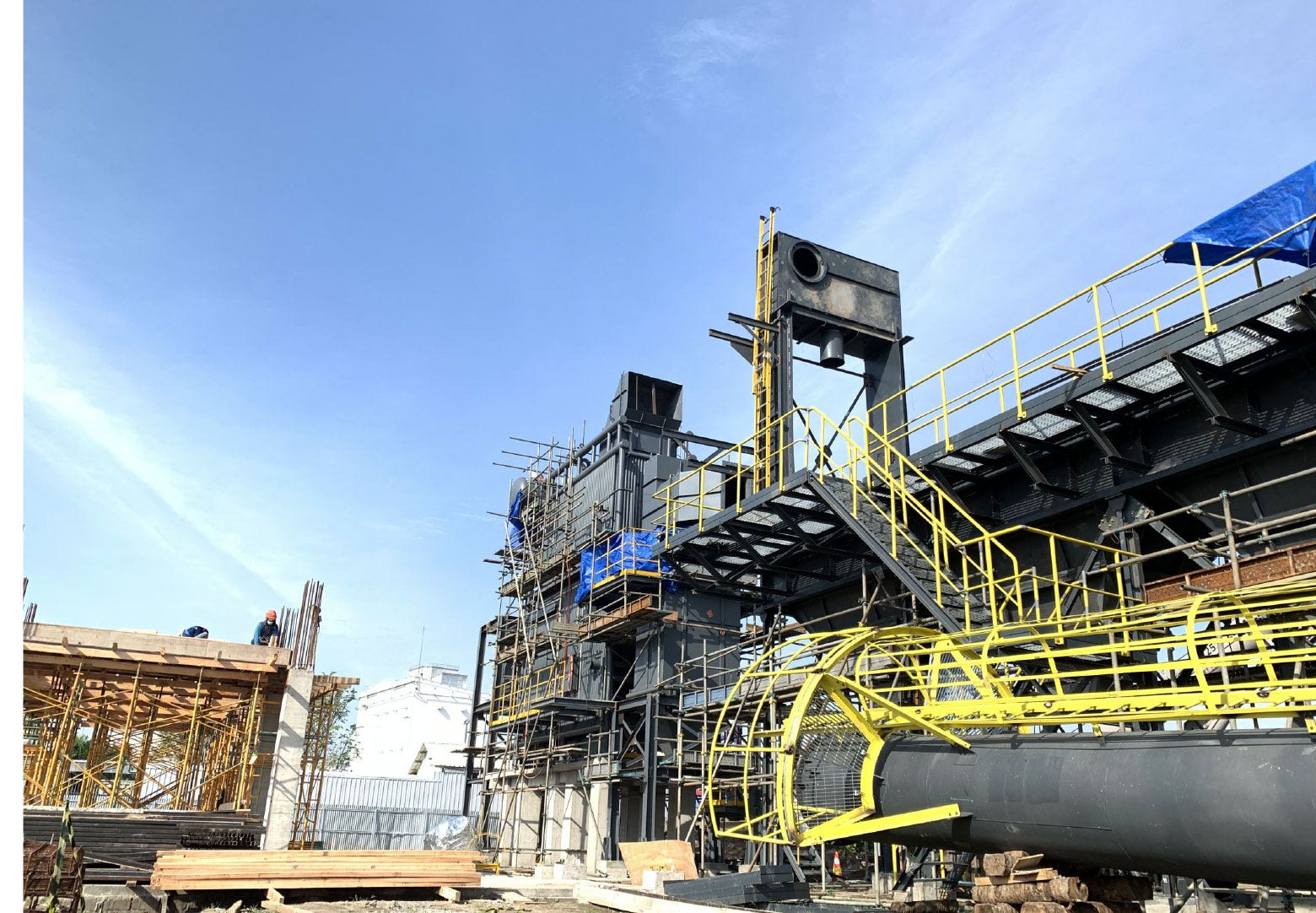
Several further West African projects are well advanced; they will appear here when they are signed and public, because I dislike counting deals before they close.
What is already public: over 150 tonnes per hour of bioenergy projects in development across the continent[40], and a partnership with John Thompson, the ACTOM boiler house, to roll the same funded steam-as-a-service model through South Africa, Zambia, Mozambique etc. The client, as John Thompson’s chief executive put it, does not need to become an energy expert or an infrastructure owner.[41] That is rather the point.
A small aside about Kasapreko, because it deserves it. This is also the company behind Ghana’s first PPA-financed commercial solar plant, a CrossBoundary installation since expanded to 1.3MWp covering roughly 19% of the plant’s electricity[22]. One Ghanaian beverage company, quietly stacking zero-capex decarbonisation layers while larger multinationals are still holding workshops about it.
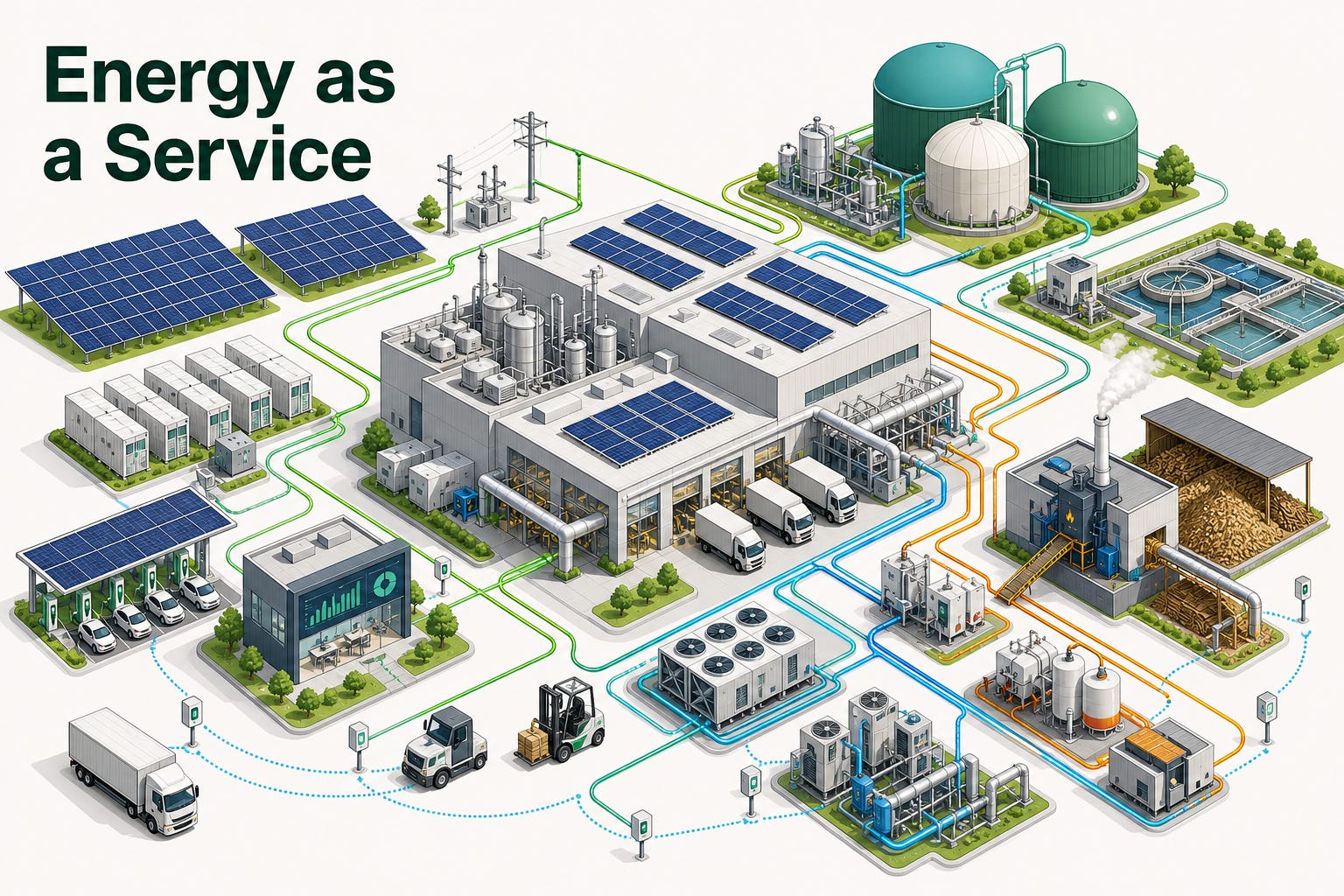
A correction to a lazy shorthand, including my own: none of this makes us a boiler company. My team sells energy as a service across the whole utility room: electricity, steam, heat, cooling and compressed air, delivered through onsite solar, battery storage, biomass boilers, electric boilers, solar thermal, heat pumps, chillers and absorption chillers, waste heat recovery, anaerobic digestion and compressed air systems[39], all under one long-term energy purchase agreement in which we fund the full project cost, you pay only for performance, and you can buy the plant outright when the contract ends.[39] In a typical bioenergy project we demonstrate an 85 to 95% cut in greenhouse gas emissions, and the sourcing is exactly as described above: certified, audited, ours to manage.[40] The boiler is the flagship. The fleet behind it covers the whole energy bill.
The model has years of operating history behind it, because our sister platform in Asia was doing this before it was fashionable. Heineken’s brewery outside Phnom Penh runs on Cambodia’s largest biomass plant, which eats 45 tonnes of rice husks a day and saves around 17,000 tonnes of CO2 a year[42][43]; another Heineken plant in Indonesia has taken 100% of its steam from agricultural waste since 2018.[44] Danone’s Prambanan factory cut its site footprint by up to a third burning rice husk, with the ash going back to local farmers as fertiliser.[45]
Nestlé’s Cabuyao plant in the Philippines inaugurated an 18 tonne-per-hour biomass boiler this April to run the spray dryers that make its milk powder.[49][46][47][48] Thirteen bioenergy projects across six Asian countries, boilers from 6 to 25 tonnes per hour, and typical steam costs of $22 to $45 per tonne presented at Boiler World SEA 2025, falling below $20 where the feedstock sits on site.[33] Behind them, a solar book past 300MWp, and lenders like Clifford Capital, Pentagreen, BII and FMO writing eight-figure cheques against the portfolio.[79][80][81][82][83] At some point ‘unproven’ stops being an available objection.
And steam is no longer the ceiling. The same structure now extends to biomass combined heat and power: a plant at your site producing both process steam and electricity, sold under a combined steam and power purchase agreement, with the explicit aim of replacing your generators completely rather than merely supplementing them. This is old technology wearing a new contract. Mauritius has been running sugar-mill cogeneration since 1957, and its sugar-industry power producers grew to supply a large share of the island’s electricity from bagasse[34].
In Kenya, Tropical Power’s Gorge Farm plant turns about 50,000 tonnes a year of farm residue into 2 MW-plus of engine power and heat, selling electricity at $0.10/kWh against the $0.38/kWh it costs to make the same kilowatt-hour on diesel, displacing roughly five million litres of diesel a year[35]. A CHP that eats your own husks and shells, powers your plant and steams your process, financed by someone else, is about as close to a free lunch as this industry offers. I now arrange these too.
The template holds beyond my shop, in case you would rather trust the competition: Barry Callebaut’s cocoa processing plant in Itabuna, Brazil runs on a cocoa-husk boiler built and operated by EDP under a service contract[36]. Nestlé’s Kabirwala plant in Pakistan runs a 20 tonne-per-hour biomass boiler covering 85% of its thermal needs[37]. Diageo’s East African breweries burn macadamia shells and bagasse[38]. The fossil side, meanwhile, is a dollar-priced gas bill in a depreciating currency. That is not a baseline worth defending.
Layer 3: Electric Vehicles. Forklifts to 220-tonne mining trucks
Africa’s electric-mobility story is too often reduced to motorcycles.
Motorcycles matter. But inside and around an industrial site, the more immediate commercial opportunity may be machines with jobs, and the as-a-service wrapper now covers essentially all of them: forklifts, reach trucks, tow tractors, distribution trucks, buses, payloaders, excavators, even mining haul trucks, on long-term contracts that bundle the machine, batteries, charging, maintenance, telematics and often the trained operator into one monthly or per-kilometre fee.
You never own the asset. You never carry the battery risk. I can put any of these on a term sheet today.
Start inside the factory gate, because that is where the arithmetic is silliest. Electric forklifts cost 20 to 40% more to buy and roughly half or less to run[50]; a peer-reviewed field study of a 3.5-tonne electric unit against a Euro V diesel found a nearly tenfold reduction in energy cost per cycle and payback within a year under intensive use[50].
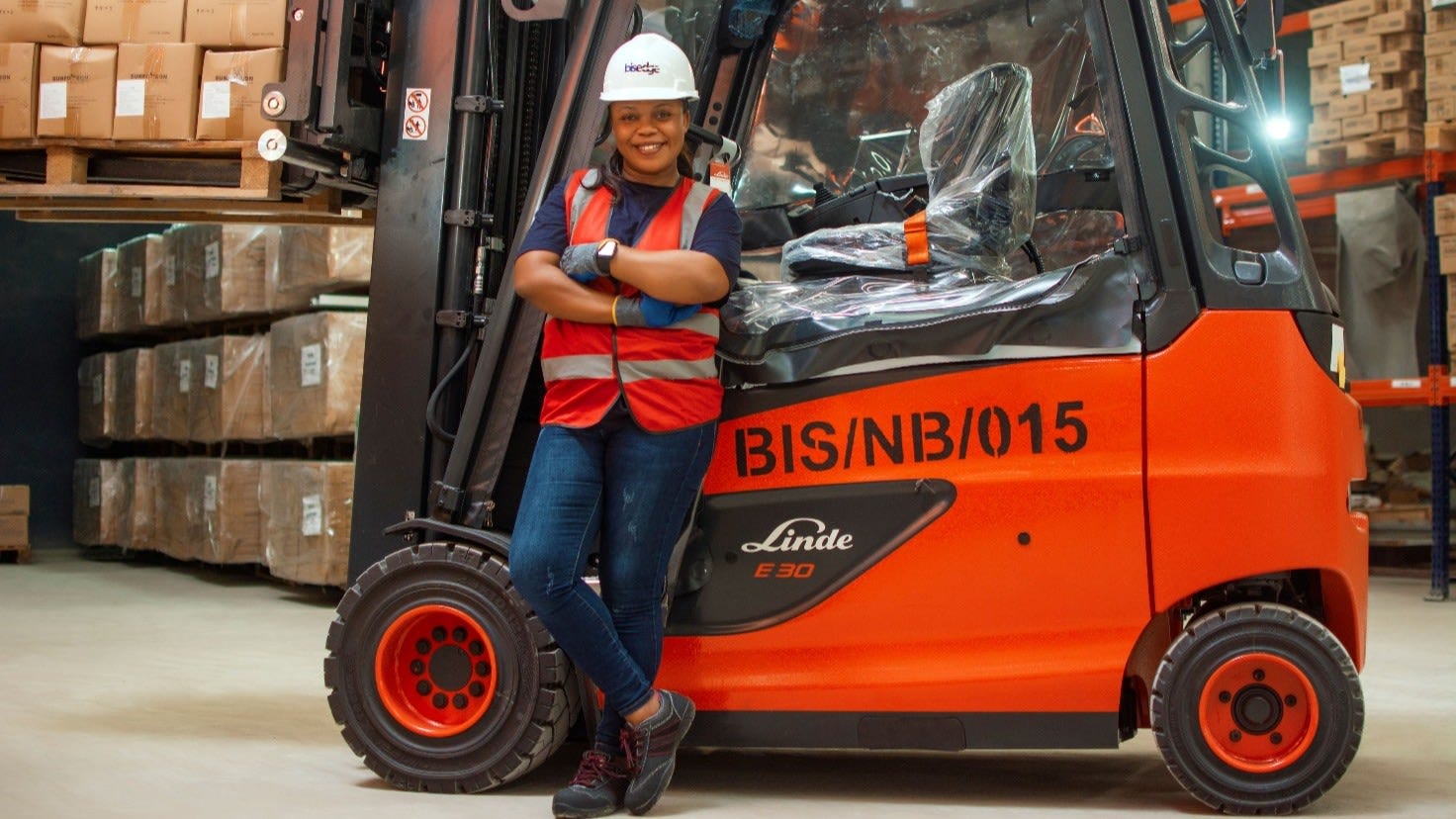
Which is why the most quietly impressive EV company in West Africa is not a car company at all: Bisedge, founded in Lagos in 2020 by the same people who built Daystar Power before selling it to Shell[51], runs a zero-capex machine-as-a-service fleet as Linde Material Handling’s partner across Nigeria, South Africa, Kenya and Tanzania, with 250-plus electric forklifts deployed[52] for clients like Coca-Cola and Heineken[53], and a fresh $20 million from Metier Private Equity (May 2026) to scale[54]. Each forklift converted saves around 55,000 litres of diesel and roughly 124 tonnes of CO2 a year[55]. Nobody puts forklifts in a sustainability report. They should; the payback is boring and fast, and someone else will finance the whole fleet.
On the road, Kenya’s BasiGo sells electric buses on a pay-as-you-drive model[56] (near-diesel upfront price, then a per-kilometre fee covering battery, charging and maintenance, with up to 90% bank financing and a 90% uptime guarantee[57]), with 114 buses in service by November 2025 and operators reporting up to 70% operating cost savings[58], helped by Kenya Power’s e-mobility tariff dropping to KES 8/kWh off peak[59]. Ampersand and Spiro run tens of thousands of motorcycles on battery-swap subscriptions[60].
Globally, the IEA counted electric heavy-truck sales nearly tripling from about 84,000 in 2024 to 230,000 in 2025[61], and truck-as-a-service operators like WattEV in California already price battery-electric haulage per mile at parity with diesel[62], while Germany’s Hylane leases DHL its electric Mercedes trucks strictly pay-per-kilometre, breakdown risk included[63].
Heavy iron is arriving in Africa on the same terms. Exxaro signed with XCMG in February 2026 for seven 220-tonne electric mining trucks at its Grootegeluk mine[64]; Zambia hosts a copper mine running what its contractor calls the first large-scale electric mining truck deployment on the continent[65]; DHL, Unilever and Volvo launched Africa’s first electric Superlink truck in South Africa in August 2025[66]; DSV followed with electric Volvos in December[67]. Volvo’s electric excavator cut hourly operating costs 74% in a 90-day pilot with Skanska[68].
The honest caveat: electric machines win on high utilisation and lose on idle assets and absent charging, so the multi-shift forklift fleet and the fixed-route distribution run pencil today, while the long-haul intercity truck mostly does not, yet.
Layer 4: Cooling. Buy the Cold, not the Chiller
Here is a number that surprises people: for a brewery, a dairy, a pharma plant or a data hall, cooling and refrigeration can be the largest single electricity load on site, and badly maintained systems quietly drift to using 30 to 40% more power than they should[30].
Cooling-as-a-service fixes this by removing the client from the equation entirely: the provider designs, finances, builds, owns and operates the whole cold stack (chillers, cooling towers, air handling, cold rooms, process refrigeration) and bills per unit of cooling delivered, the way Kaer in Singapore has done since 2013, charging per refrigerant-ton-hour and famously cutting one campus’s cooling energy 70% within six months[69].
Africa’s proof point is Energy Partners in South Africa. In February 2025 it committed R300 million to build, own and operate a centralised ammonia cooling plant at Aspen Pharmacare’s Gqeberha site over 20 years, a 17MWR system expected to cut energy consumption by more than 40%, the largest ammonia cooling plant in the country[70]. Its book includes a R360 million servitisation deal with dairy group Clover projecting R792 million of savings over the contract life[71]. The refrigerant transition mandated by the Kigali Amendment[72] (out with high-GWP HFC gases, in with natural refrigerants like ammonia) comes bundled in, which converts a looming compliance headache into somebody else’s engineering problem.
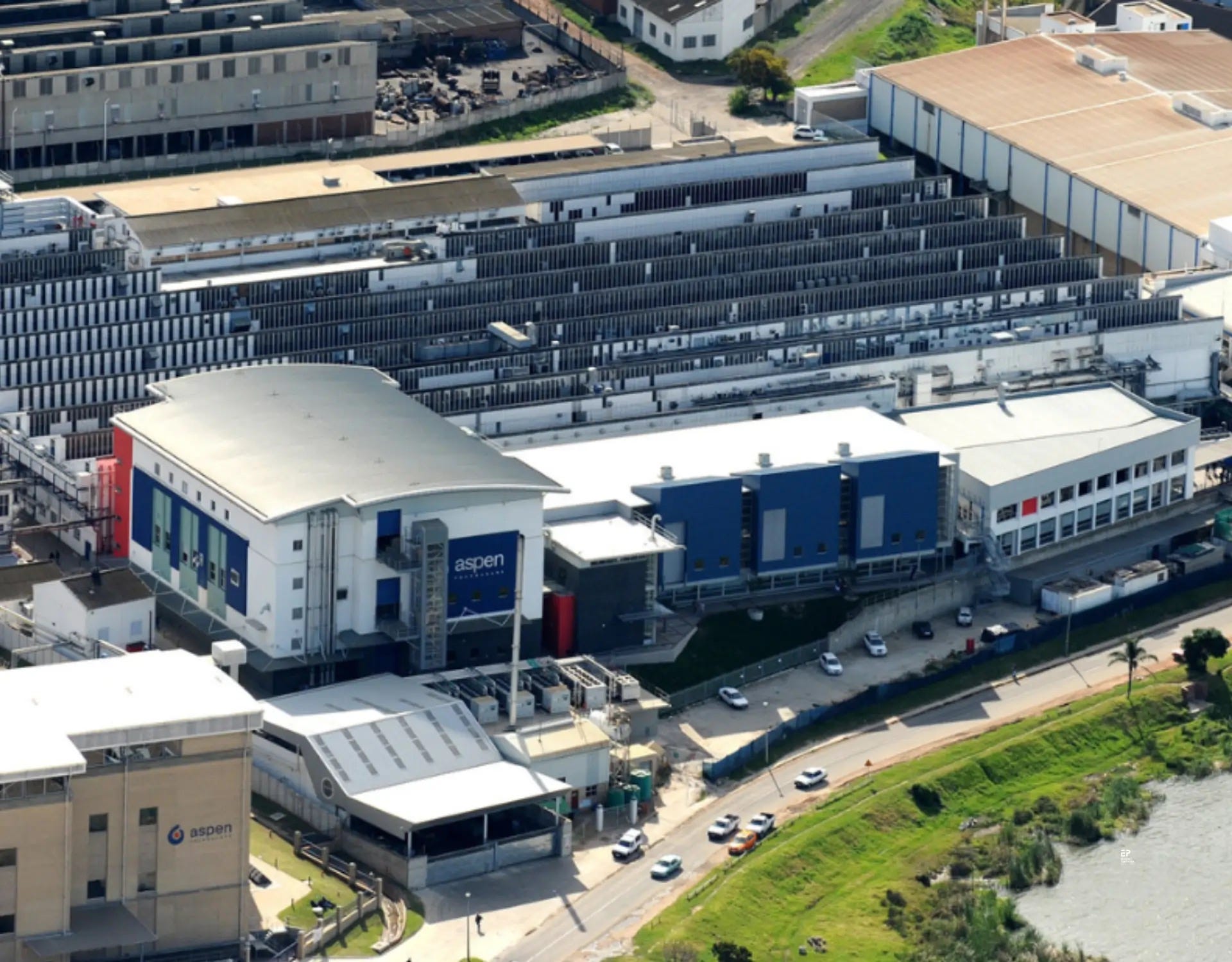
Nor is any of this exotic. In Asia, BECIS designs, installs and operates entire HVAC systems for a fixed rate per ton of refrigeration delivered, bundling cooling into the same energy-as-a-service book as its steam and solar[73][79], and August Energy, a Singapore platform built by veterans of that same scene, launched a $30 million joint venture with PIDG in December 2025 to roll out solar, storage and cooling-as-a-service across the Philippines, Vietnam and Thailand[74], with modelled energy cost savings of around 34% on combined cooling and power.[74] And the grandfather of the whole idea, Veolia, has been selling outsourced industrial utilities, cooling included, to corporates for decades.[75]
The concept is not the risk. The only question is who operates it well in your geography, and mine sells it directly: chillers, absorption chillers and full cold-stack contracts under the same energy purchase agreement as the steam and the solar, billed per unit of cooling delivered the way our Asian sister platform already prices it per ton of refrigeration-hour, fully outsourced and fully financed, now available in West Africa.[39][73]
And while we are in the utility room, the same wrapper covers the most forgotten machine in the factory: compressed air as a service, metered and guaranteed[77], because compressed air is famously the most expensive utility per unit of useful work in most plants[76], and almost nobody owns the problem.
The entire factory can become a service contract
Put the layers together and the shape of the opportunity becomes clearer.
The factory’s structure can use lower-carbon materials.[78]
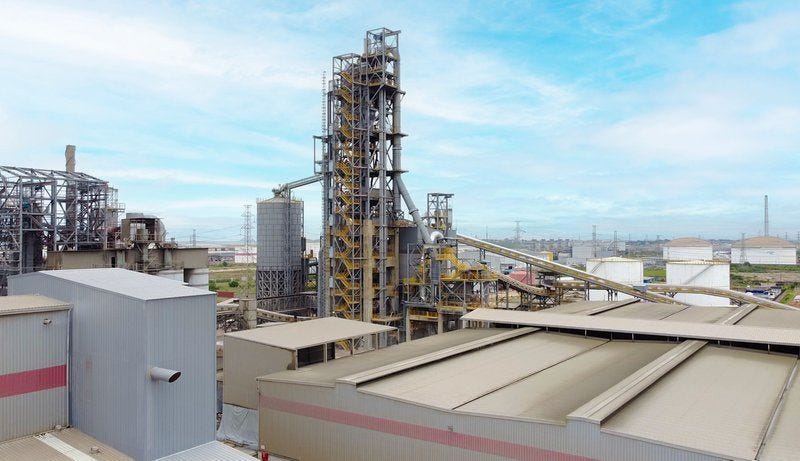
Its daytime electricity can come from onsite solar.
Additional renewable electricity can be wheeled from a remote project.
Batteries can manage power quality, peaks and outages while reducing generator runtime.
Sustainable biomass can provide process steam.
Biomass CHP can produce both heat and electricity where the load supports it.
Cooling can be procured as a guaranteed temperature service.
Forklifts, trucks and heavy equipment can be electrified under long-term fleet-service contracts.
Waste heat can be recovered. Organic waste and wastewater can become biogas. The biomass supply chain can be managed and certified by the service provider rather than pushed back onto the factory.
The company no longer has to appoint nine contractors and then discover that nobody is responsible for the total result.
It could instead have one decarbonisation programme, one technical baseline and one commercial architecture.
The units would differ—kilowatt-hours, tonnes of steam, refrigeration-ton-hours, kilometres, machine-hours or tonnes moved—but the underlying contract would be the same:
We finance the infrastructure.
We deliver the output.
We guarantee the performance.
You pay for what your factory uses.
This is what “everything on someone else’s balance sheet” means in practice: provider-funded infrastructure and transferred operating responsibility, rather than a corporate cheque for every asset.
One accounting footnote, because accountants can smell an overstatement from another continent: a provider-funded service is not automatically off-balance-sheet under IFRS. Control rights and contract terms matter, and your auditor gets the final word.[84]
The claim here is about upfront cash, ownership burden and risk allocation (not an unsolicited accounting opinion, I am definitely not an accountant).
Why someone else may finance your factory more cheaply than you can
There is no magic pool of philanthropic money paying for all this. The service provider still needs a return. It can nevertheless produce a lower customer tariff for four reasons.
First, the replacement technology may consume cheaper energy. Solar displaces diesel. An electric forklift replaces fuel and engine maintenance. Waste heat replaces purchased steam. Agricultural residues may replace imported boiler fuel.
Second, the new system may use energy more efficiently. Centralised cooling, professional plant operation, modern controls and properly sized equipment reduce the energy required for each unit of output.
Third, the provider absorbs and manages risks that the customer currently pays for badly: performance, maintenance, spare parts, fuel aggregation, battery degradation and residual value.
Fourth, a specialist platform can finance assets differently. It can combine projects, obtain long-tenor institutional capital and use portfolio structures that are unavailable to an individual factory.
The $30 million BECIS bioenergy facility is one example.[80] MIGA’s guarantees for Konexa are another.[19] They demonstrate how contracted corporate demand can be turned into financeable infrastructure cash flows.
The multinational’s creditworthiness effectively becomes infrastructure.
But cheaper must be a test, not a slogan.
The relevant baseline is not merely the price of diesel or the grid tariff. It is the customer’s all-in cost: fuel, maintenance, labour, consumables, downtime, inventory, capital, FX exposure, future replacement and the value of reliability.
The proposed service price must beat that number on an agreed set of assumptions.
Currency matters too. Financing a project in dollars and then charging a naira-earning customer an aggressively dollar-indexed tariff can simply move the FX risk from the fuel invoice into the PPA.
A good contract allocates currency and indexation according to the actual cost base, financing structure and customer revenues. A bad one takes a cheaper technology and finances it into an expensive problem.
My commercial rule is simple: I will not ask the sustainability department to justify a project that the operating economics cannot support.
If the financed tariff does not beat the properly calculated incumbent cost (or offer a reliability improvement valuable enough to justify the difference) the project is not ready.
The honest ledger
Now the part a marketing department would usually remove.
I cannot point to a publicly documented West African factory that has placed every layer in this article under one master contract.
There are facilities that have combined several of them. Kasapreko has both financed solar and a signed biomass-steam project.[22][32] Clover has outsourced power, steam and refrigeration.[71] Nigerian Breweries is using site-side systems and wheeled renewable power.[19] Bisedge is electrifying industrial material handling.[52] CBI Ghana is lowering the carbon content of construction materials.[78]
The pieces exist.
The integrated category is still forming.
Nor does “end to end” mean a multinational has reached literal net zero across every Scope 1, 2 and 3 emission.
A food company may decarbonise its factory while emissions remain in fertiliser, agriculture, packaging and third-party logistics.
A data centre can address electricity, cooling, backup power and construction materials while server racks, semiconductors and networking equipment remain deeply carbon-intensive.
A mine can electrify light vehicles, loaders and some processing loads while its heaviest haul routes remain difficult.
A cement plant can reduce clinker, substitute fuels and improve efficiency, but conventional cement chemistry still releases process emissions.
Batteries are excellent at seconds, minutes and hours. They are not automatically the cheapest answer to several consecutive days without grid power or sunlight.
Biomass is useful only where the feedstock is genuinely sustainable, traceable, locally available and contractually secure.
Electric heavy trucks work best on the routes that suit them. Low-utilisation, long-distance vehicles with no charging infrastructure remain a weak starting point.
And not every “green” product is cheaper. Some lower-carbon materials still carry a premium, particularly where supply is immature.
So the defensible claim is not:
“Every African industry can become absolutely zero-carbon tomorrow at a lower cost.”
It is:
A very large share of the controllable emissions from African industrial facilities can already be removed using commercial technologies, long-term finance and service contracts—and many of the first reductions can lower the customer’s total operating cost.
That is still a very big claim.
It is also one I am prepared to put into a model.
The actual pitch
Here is the disclosure I have delayed less than most people would.
I sell this for a living.
Thermal decarbonisation is the most publicly visible part of my current work. The Kasapreko agreement carries my name and quote because I helped originate and progress it. The Asian operating portfolio gives us evidence that the model works beyond a presentation.
But my work in Africa today is wider than boilers.
I can structure onsite solar, battery storage, wheeled electricity, Cooling-as-a-Service, electric commercial fleets and heavy equipment, biomass steam, biomass CHP and the sustainable feedstock supply chain required to support them.
The assets can be financed over long periods. The operations, maintenance, technology and performance obligations can be bundled into the service. The customer can buy electricity, steam, cooling, kilometres or machine availability instead of becoming the owner of a collection of unfamiliar infrastructure.
I am not claiming that I have already closed every layer under one agreement.
I am saying that I can sit with an industrial customer, examine the entire facility from foundation to loading bay, determine which parts can be decarbonised commercially today, assemble the appropriate technology and operating partners, and put financed offers behind the options that work.
A technical baseline. A risk allocation. A tariff. A performance guarantee. And a counterparty prepared to write the cheque.
Bring twelve months of electricity and fuel bills, interval load data, steam and cooling profiles, fleet routes, equipment duty cycles, site drawings and planned capital projects.
I will bring the engineering options and the term sheets. Your signature on an offtake agreement is the entire ask.
This is what I do for a living, some of it delivered by my own team, the rest arranged through the platforms I work with every day, across Africa, for exactly the kind of companies reading this.
If any layer of this stack is sitting on your to-do list behind “get through this quarter,” reply to this email or find me on LinkedIn.
Bring your last twelve months of energy bills, your fleet list, or your next build’s bill of quantities. I will bring the term sheets.
Worst case, you get a free benchmark of what you are overpaying. Best case, you get cheaper, cleaner everything, paid for by someone else’s balance sheet.
P.S. Full disclosure, because this newsletter is called what it is called: I sell several of these services for a living and arrange the rest, and one of the press releases cited below carries my own quote in it. I am talking my book from the first paragraph to this one. That is also precisely why I know these term sheets exist rather than merely believing in them, so weigh the bias against the access and make your own call.
A confession: I still cannot find an independently audited, third-party cost-per-tonne-of-steam benchmark for biomass versus HFO in West Africa. Every number I have is from a vendor, a conference presentation (yes, including my employer’s) or my own models. If you have real operating data from a real plant, I will trade you a very good dinner for it.
P.P.S. If you think I am wrong about any of this, especially the “cheaper” claims, say so in the comments or by reply. Being corrected in public is the cheapest consulting I ever receive.
P.P.P.S. If this was useful, subscribe, and forward it to the one person at your company who owns the energy budget and the one who owns the sustainability slide. They are rarely the same person, which is roughly 40% of the problem.
Next up: I am building an open, live map of every software company in African energy, and the launch piece explains why the boring plumbing matters more than the apps. Stay tuned.
References
Repeated citation numbers point to the same source.
Energy economics
NERC — April 2024 Supplementary MYTO Order (Band A)
Nigeria National Bureau of Statistics — Automotive Gas Oil (Diesel) Price Watch
NMDPRA pricing analysis — 2026 domestic base price for natural gas
IMF — Nigeria: 2026 Article IV Consultation
Central Bank of Nigeria — 2025 Monetary Policy Committee decisions
Nairametrics — Nigerian commercial lending rates
Bank of Ghana — Interest-rate data
IRENA — Renewable power generation costs in 2025
Electricity, solar and storage
CrossBoundary Energy — $188m C&I renewable-energy portfolio
MIGA — $495m framework supporting CrossBoundary Energy projects
Shell — Acquisition of Daystar Power
Daystar Power — No-upfront-capex service model
Empower New Energy and AFRIGREEN — Justrite solar-plus-storage financing
Mirova — $20m ManoCap Energy debt financing
GRIPS Energy — SCL solar project in Senegal
BloombergNEF — 2025 Lithium-Ion Battery Price Survey
Wood Mackenzie — Africa’s distributed diesel-generation landscape
Kamoa Copper and CrossBoundary Energy — Solar-plus-storage baseload project
MIGA — Konexa renewable supply for Nigerian Breweries
Etana Energy and Sibanye-Stillwater — Wheeling PPA
Sibanye-Stillwater — 2025 results and energy-cost savings
CrossBoundary Energy — Kasapreko solar project
Daystar Power — Corporate service model
BECS — Del Monte Kenya 807kWp solar commissioning
BECS — James Finlay Kenya 2.0MW solar commissioning
The Star — James Finlay solar-project coverage
Standard Media — James Finlay solar-project coverage
LinkedIn — Junction Mall Nairobi rooftop-solar site visit
LinkedIn — Junction Mall Nairobi rooftop-solar project post
Industrial heat and bioenergy
Review — Energy use and decarbonisation in food and beverage manufacturing
ISCC — Sustainability certification system
BECS — Kasapreko biomass steam-purchase agreement
Boiler World Update — BECIS biomass Steam-as-a-Service
Study — Bagasse cogeneration in Mauritius
Tropical Power — Gorge Farm Energy Park
EDP and Barry Callebaut — Itabuna cocoa-husk biomass project
Nestlé Pakistan — Kabirwala biomass boiler
Diageo — Biomass energy at East African Breweries
BECS — Energy-as-a-Service solutions
BECS — Sustainable biomass, 150 t/h pipeline and 85 to 95% GHG reduction
Engineering News — John Thompson and BECS biomass-steam partnership
BECIS — Heineken Cambodia biomass plant
Khmer Times — Heineken opens Cambodia’s largest biomass plant
BECIS — Heineken Indonesia bioenergy case study
BECIS — Danone Prambanan bioenergy and circularity case study
Nestlé Philippines — Cabuyao biomass-boiler inauguration
Philstar — Nestlé Cabuyao biomass facility
BusinessWorld — Nestlé Philippines Cabuyao biomass facility
Enertech — Nestlé Cabuyao 18 TPH biomass-boiler project
Electric mobility and machinery
Research Square — Comparative field study of electric and diesel forklifts
Endeavor Nigeria — The founders behind Bisedge and Daystar Power
GCPF and responsAbility — Investment in Bisedge’s electric logistics fleet
Bisedge — Electric logistics clients and service model
Metier Private Equity — $20m investment in Bisedge
Energise Africa — Bisedge forklift fuel and emissions savings
BasiGo — Pay-As-You-Drive model
BasiGo — Financing and uptime support
Africa Signal — BasiGo fleet deployment and operating savings
Kenya Power — E-mobility off-peak tariff
Associated Press — African electric motorcycles and battery swapping
IEA — Global EV Outlook 2026: heavy-truck sales
WattEV — Battery-electric trucking economics
Hylane and DHL — Pay-per-kilometre electric trucks
International Mining — Exxaro and XCMG mining trucks
Africanews — Electric mining trucks deployed in Zambia
DHL, Unilever and Volvo — Africa’s first electric Superlink
DSV — Electric Volvo truck deployment in South Africa
Volvo CE — EC230 Electric pilot results
Cooling and industrial utilities
Ellen MacArthur Foundation — Kaer Cooling-as-a-Service case study
Energy Partners — Aspen Pharmacare cooling-as-a-service project
Business Report — Energy Partners and Clover servitisation agreement
UNEP Ozone Secretariat — Kigali Amendment overview
BECIS — Cooling-as-a-Service
PIDG and August Energy — $30m Energy-as-a-Service platform
Veolia — Integrated industrial utilities management
U.S. Department of Energy — Cost of compressed air in industrial plants
Kaeser — Compressed air supplied as a metered utility
Cement and buildings
World Cement — CBI Ghana’s calcined-clay plant
Finance, standards and integrity checks
BECIS — 300MWp-plus solar portfolio presentation
BECIS, Clifford Capital and Pentagreen — $30m green-loan facility
BECIS, BII and FMO — $50m financing facility
BECIS — New equity financing
BECIS — $45m in new equity
IFRS Foundation — IFRS 16 lease definition and control rights