

It is 2:03am Lagos time when I start writing this.
I woke up for a scheduled call (US time zones are undefeated at ruining sleep patterns) and couldn’t fall back asleep. So I did what any highly intelligent and resourceful person would do. I doomscrolled on Twitter. (Sorry Elon, it’s still Twitter).
And then I saw it.
Jack Dorsey just cut Block’s workforce nearly in half. Over 10,000 people down to just under 6,000. More than 4,000 human beings, gone. Not because the company is struggling. No. Block reported $10.36 billion in gross profit in 2025, up 17% year-over-year. Revenue is growing. They’re serving more customers than ever. Profitability is improving.
He did it because of AI.
His words: “Intelligence tools we’re creating and using, paired with smaller and flatter teams, are enabling a new way of working which fundamentally changes what it means to build and run a company.”
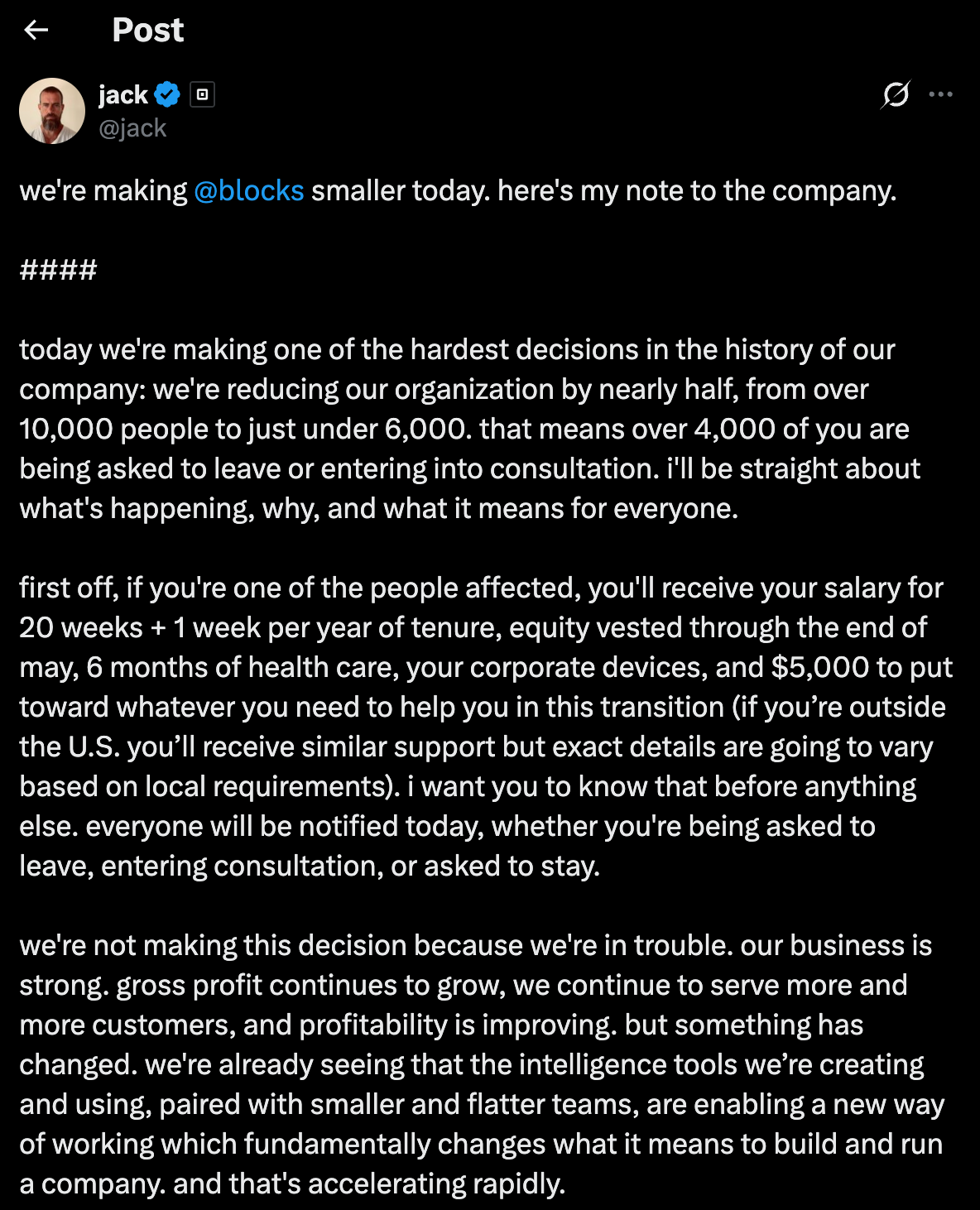
The stock jumped over 20% after hours. The market cheered. Four thousand people are updating their LinkedIn profiles at 2am and the market is cheering.
Someone in the quote tweets compared this to the first reports of coronavirus breaking out as a “pneumonia-like symptom” that many people didn’t pay attention to. I don’t know if that comparison is right. But something froze inside me when I read it, and I think it is fear.
And here’s the part that actually made me sit up in bed:
“I don’t think we’re early to this realization. I think most companies are late. Within the next year, I believe the majority of companies will reach the same conclusion and make similar structural changes.”
Within the next year. The majority of companies.
Block isn’t an anomaly. Amazon laid off 16,000 employees at the end of January, having already cut 14,000 roles a few months earlier (while simultaneously ramping AI spending, naturally). Zuckerberg said he expects 2026 to be “the year that AI dramatically changes the way we work,” adding that projects that used to take big teams are now being accomplished by a single person. HP announced plans to cut up to 6,000 employees by 2028, explicitly citing AI.
This isn’t a blip. This is the pattern.
I’m not going to pretend I have answers. I’m going to tell you upfront: I don’t. I’m writing this because I can’t sleep and because the questions won’t stop looping in my head and because I think people in my industry, the energy sector, specifically renewable energy, need to be having this conversation right now instead of pretending it’s not coming for us.
Because it is coming for us.
But also (and this is the thing that’s breaking my brain at 2am) it literally cannot exist without us.
The Loop I Can’t Escape
Here’s what’s been circling in my head since I saw that tweet:
If AI accelerates and removes all tasks, what exactly does humanity do? What will drive GDP? Who even pays for the AI? If there are no jobs in the market, how does any of this stay sustainable? What does it all mean?
I keep coming back to this: the entire economic model we’ve built assumes people work, earn money, spend money, and that cycle creates demand. AI is threatening to break that cycle. Not in 20 years. Not in 10 years. Right now. Today. 4,000 people at a time.
And look, I’ll confess something. I am not some distant observer wringing my hands about the ethics of automation from a philosophical ivory tower. I am a user. A heavy user. Claude (yes, the AI I’m literally using to help research this piece, make of that what you will) is shipping new products virtually every single day. I rely on Sunclaw (sunclaw.kiisha.io) AI tools now for things I didn’t think were possible two years ago. I text an AI on Telegram and it gets things done. When I say everything, I mean everything. You don’t fully grasp what I mean by everything but I’ll leave that for another post.
Every single day, startups that launched on low friction and high speed are being killed by the same AI that birthed them, faster than they can spell ASI. The iteration speed is insane.
Many people thought AI was going to make them rich. And it did, briefly. Then the same tool made them irrelevant.
So yeah, I’m scared. I’m also complicit. We all are. The irony isn’t lost on me. Let’s keep going.
But I’m an Energy Guy, So Let Me Talk About Energy
I don’t know enough about fintech or SaaS or whatever Block’s 4,000 employees were building to tell you what their future looks like. I’m not going to pretend. (If you’ve read anything I’ve ever written, you know pretending isn’t really my thing. I literally named my blog “The Impostor’s Guide to Clean Energy.” The self-awareness is load-bearing at this point.)
What I do know is energy. Specifically, renewable energy in Africa. I spend my days structuring solar PV deals, biomass projects, battery storage solutions for industrial clients across Nigeria, Ghana, and Côte d’Ivoire. I’ve worked on 40+ renewable energy transactions. I’m doing a PhD on hybrid solar-biomass-hydrogen systems. I co-founded an AI-native platform for African energy infrastructure. I still confuse harmonic distortion with power factor correction sometimes. Twelve years in. We’ve established this.
So when I ask “what does AI mean for energy jobs?” I’m not asking from the sidelines. I’m asking from inside the house. And the house might be on fire. Or it might be fireproof. I genuinely cannot tell.
The Paradox That Should Keep Every Energy Person Up at Night (It’s Keeping Me Up, Clearly)
Here is the thing nobody in the AI discourse is talking about enough:
AI has three Achilles heels. Three things without which it simply cannot exist. Chips. Energy. Water. Take away any one of these three and AI dies. It’s a trifecta, a delicate balance upon which the entire future of artificial general intelligence rests.
This is not metaphorical. This is physics. Every large language model, every inference call, every AI agent writing code or cutting jobs or helping me research this blog post at 2am runs on electricity. And the numbers are absolutely wild.
Data centres globally consumed about 415 terawatt-hours of electricity in 2024, according to the IEA. That’s about 1.5% of global electricity consumption. By 2030, that number is projected to more than double to around 945 TWh. That is roughly equivalent to Japan’s entire electricity consumption. Japan. An entire industrialised nation’s worth of power. Just for data centres.
(I’m going to throw more numbers at you because I’m an energy guy and numbers are how I cope with existential dread.)
AI-specific servers alone consumed an estimated 53 to 76 TWh in the US in 2024. By 2028, that could climb to 165 to 326 TWh. Training a single large model like GPT-4 consumed roughly 50 GWh of energy and generated over 550 tons of CO2, equivalent to the annual carbon footprint of 121 US households. And here’s the bit that really gets me: training is actually the smaller piece. Inference, the process of actually using these models after they’re trained (every ChatGPT query, every Claude response, every AI-generated email), accounts for up to 90% of a model’s total lifecycle energy consumption.
Goldman Sachs estimates current global data centre power usage at around 55 GW, projecting that to reach 122 GW by 2030. S&P Global puts total global power demand from data centres at 860 TWh in 2025, rising to 1,587 TWh by 2030. These aren’t incremental numbers. This is a structural shift in global electricity demand of a kind we haven’t seen since, I don’t know, industrialisation?
And how fragile is all of this? Hilariously fragile. In 2024, a minor grid disturbance in Virginia’s Fairfax County caused 60 data centres to switch to backup generation simultaneously. The sudden loss was around 1,500 megawatts. That’s roughly equivalent to the entire power demand of Boston. One hiccup. One county. Nearly cascaded into widespread failure. And Virginia’s data centres already consume 26% of the state’s total electricity supply.
So here’s your paradox: the technology that is eliminating jobs across every sector is simultaneously creating the single largest surge in electricity demand in human history. And somebody has to build, finance, operate, and maintain the infrastructure to meet that demand.
That somebody is us. The energy people.
The tech companies know it too. They’re scrambling. Google opened its first UK data centre powered by a renewable portfolio managed by Shell. Amazon invested $700 million in small modular reactor technology through X-energy (SMRs! For data centres!). Plans are underway to revive retired nuclear plants, including Three Mile Island (yes, that Three Mile Island), specifically to power AI. Several US states are now weighing legislation requiring data centres to draw power from renewable sources.
The AI revolution runs on electricity. And it is desperately short of the clean kind.
What AI Is Already Doing to Energy Jobs
Let me be honest about both sides of this, because one thing I’ve learned from years of writing about energy is that people can smell BS from three continents away. So here’s the full picture.
The stuff that’s being automated or compressed (a.k.a. the part that should make you uncomfortable):
The modelling work I do? Financial models for solar projects, IRR calculations, sensitivity analyses, tariff structures? AI can already do 80% of that in minutes. Work that used to take a junior analyst a week, Claude or GPT can draft in an afternoon. The iteration speed means one person with AI tools can now do what three or four people did two years ago. I know this because I am that one person. I used to need a team for things I now do with a prompt and a coffee.
AI-driven predictive maintenance is already cutting wind turbine downtime by up to 20% and extending asset life by 15%. Fewer emergency repair crews. Fewer unplanned maintenance dispatches. More uptime. Less humans.
Site assessment? Satellite imagery analysis that used to require teams of engineers walking sites with GPS equipment can now be done with AI-powered geospatial tools in hours.
Energy forecasting? AI predicts solar irradiance and wind speeds with over 95% accuracy now. The old models, the ones that employed teams of meteorologists and data scientists to build and maintain, are being replaced by systems that learn and improve on their own.
Procurement and supply chain optimization? Automated. Contract review and due diligence? Getting there. Regulatory compliance monitoring? AI is eating that too.
If your primary value as an energy professional is sitting at a desk running spreadsheets and generating reports, you should be paying very close attention. I say this as someone whose primary value was, for a long time, sitting at a desk running spreadsheets and generating reports.
The stuff that can’t be replaced yet (a.k.a. the part that lets me sleep at night, on the nights I can actually sleep):
Nobody is sending an AI agent to negotiate a power purchase agreement with a Nigerian industrial offtaker. Trust me on this. The cultural nuance, the relationship building, the ability to read a room when a CFO is nervous about committing to a 15-year contract, that is deeply, irreducibly human. I’ve been in those rooms. The AI would get eaten alive. Politely, with kola nut and small talk, but eaten alive nonetheless.
Nobody is sending an AI to navigate the politics of getting grid connection approvals in Ghana. Or to manage the on-the-ground realities of constructing a biomass facility in a West African industrial zone where the logistics alone require a level of improvisation that no training dataset can capture. (Last month I had to solve a transport bottleneck that involved, among other things, a road that didn’t exist on any map. Good luck prompting your way through that one.)
The physical infrastructure has to be built by human hands. Solar panels don’t install themselves. Transmission lines don’t appear from the cloud. Substations need engineers who can work in 40-degree heat with unreliable supply chains.
And the deal-making. The deal-making is where I exhale a little. Structuring the first FX-hedged commercial bioenergy agreement in Ghana wasn’t something you could prompt your way through. It required understanding regulatory frameworks across multiple jurisdictions, building trust with counterparties over months, and creative problem-solving that emerged from years of pattern recognition in markets that don’t have standardized playbooks.
You want to know what energy deal-making in Africa is like? It’s jazz. It’s improvisation on top of theory. The theory is the financial model. The improvisation is everything else. And “everything else” is about 85% of the job.
The Africa-Specific Reality (Or: Why Silicon Valley’s AI Discourse Misses the Plot)
Here’s something the AI conversation completely ignores: the world is not uniform.
In markets like Nigeria, Ghana, and across West Africa, the energy transition is not a luxury. It is not a nice-to-have sustainability initiative for the ESG section of an annual report. It is an infrastructure imperative. These are markets where grid reliability is a daily challenge, where industrial clients are running on diesel generators and paying three to five times what they should for power, where the economics of solar and biomass aren’t just “green,” they’re survival.
AI might be collapsing headcount at Block’s offices in San Francisco, but across Africa, we don’t have enough energy professionals to begin with. The International Renewable Energy Agency reported that global RE employment hit 16.2 million in 2023 and is projected to more than double to over 30 million by 2030. And a massive chunk of that growth needs to happen in emerging markets where the talent pipeline is already running on fumes.
The IEA’s own data shows Africa has less than 1 kWh of data centre electricity consumption per capita. The US? Hundreds. Even by 2030, that gap barely narrows. The energy access challenge in Africa is not being solved by Silicon Valley’s language models. It’s being solved by people on the ground doing hard, complex, deeply human work. People who navigate regulatory chaos, build relationships with communities and governments and industrial clients simultaneously, and get creative when the standard playbook doesn’t apply.
In Africa, the standard playbook never applies. That’s not a bug. That’s the whole market.
The Talent Gap Nobody’s Talking About (Or: The Irony That Might Save Us)
While AI is handing out pink slips in tech, the energy industry literally cannot find enough people.
BCG found that 46% of energy companies cite talent skill gaps as the primary barrier to AI adoption. Not budget constraints. Not technology limitations. Talent. Roles requiring both energy domain expertise and AI/data science capabilities are staying open for 90 days or longer. Some go unfilled for six months. Companies are paying 30 to 40% premiums above standard market rates for these hybrid skill sets. And even at those levels, they’re struggling to compete.
The WEF’s Future of Jobs Report 2025 lists renewable energy engineers and environmental engineers among the 15 fastest-growing job categories globally. The clean energy workforce is expected to expand faster than nearly any other sector.
Let me say that again because I need you to actually absorb it: the sector is expanding faster than nearly any other. While Block cuts 40% of its workforce because AI made them redundant, the energy industry is desperately trying to hire people it cannot find.
The bottleneck isn’t demand. The bottleneck is supply. The energy sector is hiring for people who can operate at the intersection of physical energy systems and digital intelligence. That intersection is tiny. And it’s where the next generation of careers lives.
If you’re reading this at 2am like I’m writing it, this is the part you should screenshot.
So Where Does This Leave Us? (Somewhere Between Terror and Defiance, Apparently)
I keep going back and forth between two feelings:
Terror. Because the speed of AI improvement is genuinely exponential, not linear. What can’t be automated today might be trivially automated in 18 months. The junior analyst roles, the entry-level modelling positions, the support functions that are the pipeline for future energy leaders: those are getting compressed right now. Where do the next generation of energy professionals come from if the entry-level jobs disappear? This question haunts me. I don’t have a good answer.
Cautious defiance. Because energy is one of the few sectors where atoms matter as much as bits. You can’t AI your way out of needing a physical solar panel on a physical roof connected to a physical grid. The world needs more energy, not less. Dramatically more. And the harder, messier, more human work of deploying that energy, especially in frontier markets, is not something a language model can do from a data centre in Virginia.
The honest answer is probably both. The energy sector will lose jobs to AI. Some of them will be jobs held by people reading this right now. Some of them might be parts of my own job. (The spreadsheet parts. Definitely the spreadsheet parts.) But the sector will also create jobs that don’t exist yet, demand skills that blend technical energy knowledge with AI literacy, and disproportionately reward the people who can operate at the intersection of technology and the messy physical world.
What I Think Energy Professionals Should Do Right Now (My 3AM Instincts, Worth Exactly What You Paid For Them)
I said I didn’t have answers and I still don’t. But I have instincts, and they’ve gotten me through 40+ deals without a formal certification in anything, so take that for whatever it’s worth.
Learn the tools. Not because you want to. Because you have to. If you’re in energy and you’re not using AI tools to accelerate your work, you’re not being noble or principled. You’re being left behind. The person who will replace you isn’t AI. It’s a person using AI who is now doing your job and three other people’s jobs before lunch.
Go deeper on what can’t be automated. Relationships. Negotiations. On-the-ground project execution. Regulatory navigation. Cross-cultural deal-making. The ability to sit across from a counterparty and actually read the room. These skills are becoming more valuable, not less, precisely because everything else is being compressed.
Understand the energy-AI nexus. The biggest opportunity in energy right now might be serving the AI industry itself. Data centres need power. They need it clean, they need it reliable, and they need obscene amounts of it. If you’re in RE, you should be thinking about how to position yourself for that demand curve. Every new hyperscale facility is a potential customer. Every tech company’s net-zero commitment is a contract waiting to be structured. The companies building AI are your future offtakers. Let that sink in.
Build for frontier markets. The markets where AI deployment is hardest (complex regulatory environments, infrastructure gaps, cultural complexity) are paradoxically the markets where human expertise retains the most value for the longest. Africa. Southeast Asia. South America. These are not fallback positions. These are not the places you go when you can’t get hired in London. These are strategic advantages. The messier the market, the harder it is to automate, the longer your expertise stays relevant.
Become the polymath. The energy professional of 2026 can’t just know how a solar inverter works or how to model a PPA. You need to understand how machine learning optimizes those systems, how to work alongside AI tools, and critically, how to make the judgment calls that AI gets wrong. Because it does get things wrong. Frequently. The engineer who can supervise and validate AI-generated outputs while catching the errors that models inevitably make (and they always make them, I check) will be worth more, not less.
Don’t stop asking the uncomfortable questions. What happens to GDP when jobs collapse? Who pays for AI when consumers can’t earn? Is any of this sustainable? I don’t know. Nobody knows. But the people who engage with these questions early, rather than burying their heads in another feasibility study, will be better positioned when the answers start to emerge.
The Part Where I Don’t Wrap This Up Neatly
It’s now past 5am. I still don’t have answers. Jack Dorsey’s stock is still up. 4,000 people are still out of work. AI is still accelerating. And somewhere in Lagos, a diesel generator is humming outside someone’s factory because the grid failed again tonight.
That generator needs to be replaced by clean, reliable power. That work needs to happen. And right now, today, it still needs humans to make it happen.
I don’t know how long “right now” lasts.
But I know that the people who will navigate this transition (both the energy transition and the AI transition) are the ones who refuse to look away. Who sit with the discomfort. Who ask the questions even when the answers aren’t there yet. Who learn the tools even when the tools are the thing they’re afraid of.
It’s 2am somewhere. Don’t go back to sleep.
I’m Kay. Business Development in renewable energy across Africa. PhD candidate. Co-founder. Professional impostor. These are my honest, middle-of-the-night thoughts from someone who doesn’t know enough but refuses to stop asking. I’d love to hear yours.
Wrong about energy so you don’t have to be.