

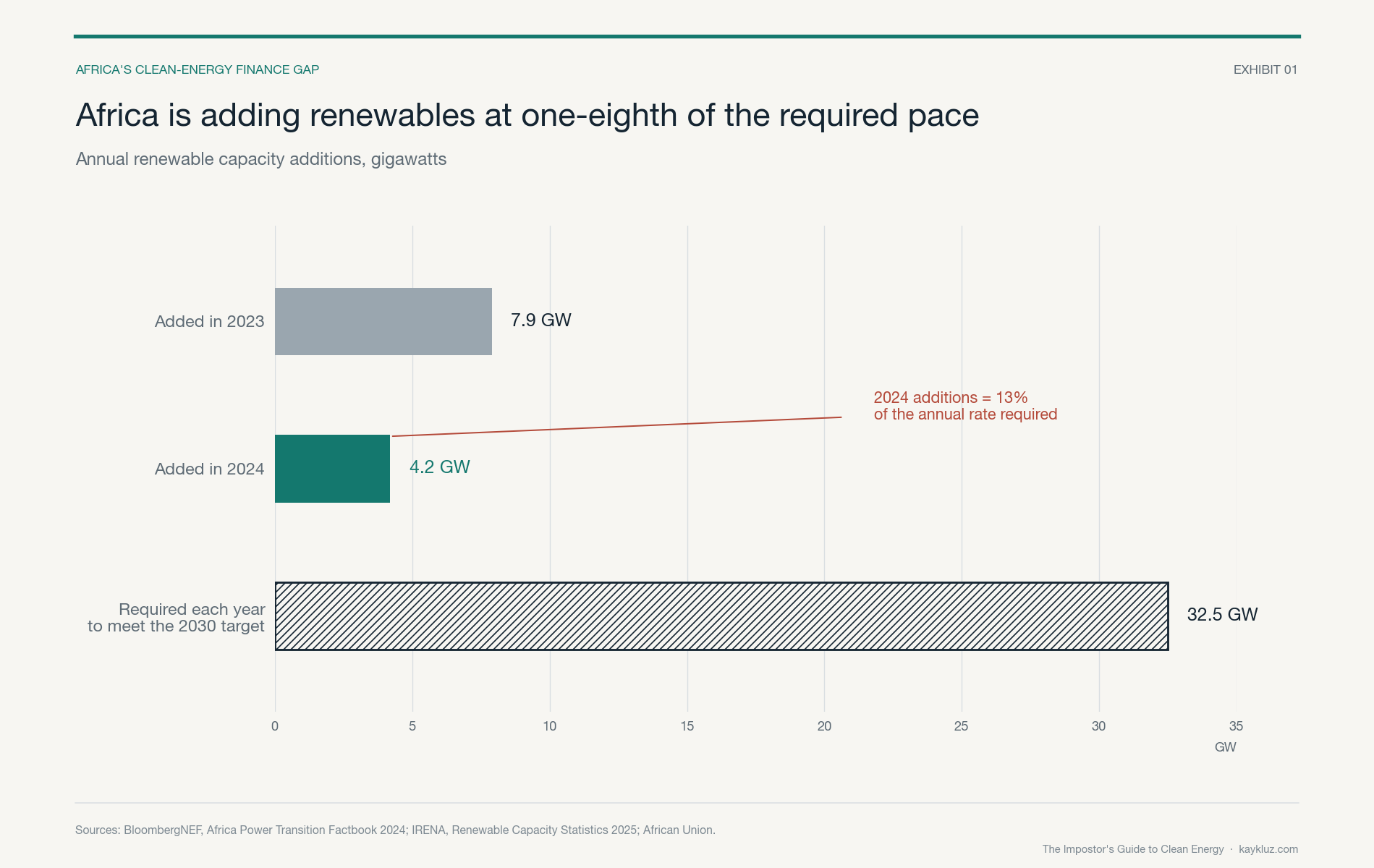
Africa needs to add 32.5 GW of renewable capacity every year until 2030 to hit its own targets. Last year it managed 4.2 GW.
Let me show my working, which regular readers will recognise as the part where I usually get into trouble.
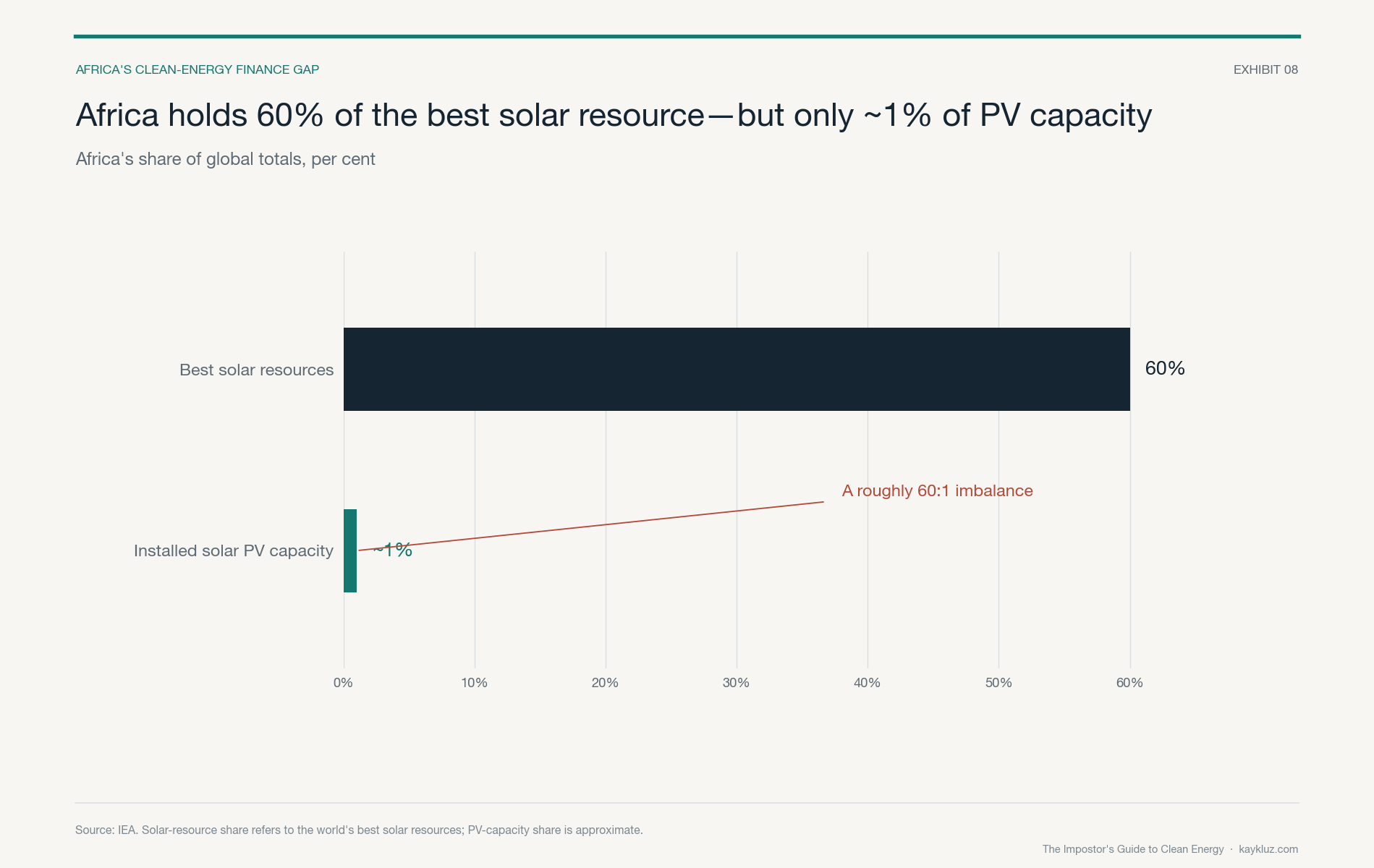
The 32.5 GW figure comes from BloombergNEF’s Africa Power Transition Factbook 2024, which worked out what the African Union’s 300 GW renewables-by-2030 target actually requires: quadrupling the 7.9 GW added in 2023, every year, for the rest of the decade. The 4.2 GW comes from IRENA’s Renewable Capacity Statistics 2025, and it was not a fluke of a bad year. It was 0.7% of the 585 GW the world added in 2024, a record year globally in which Africa, home to 60% of the planet’s best solar resources by the IEA’s own assessment, went backwards in relative terms.
I structure energy deals in West Africa for a living, which means I am partly responsible for these numbers. Keep that in mind as I explain why the next four years decide the next thirty.
The money numbers come from three different reports, and the difference matters
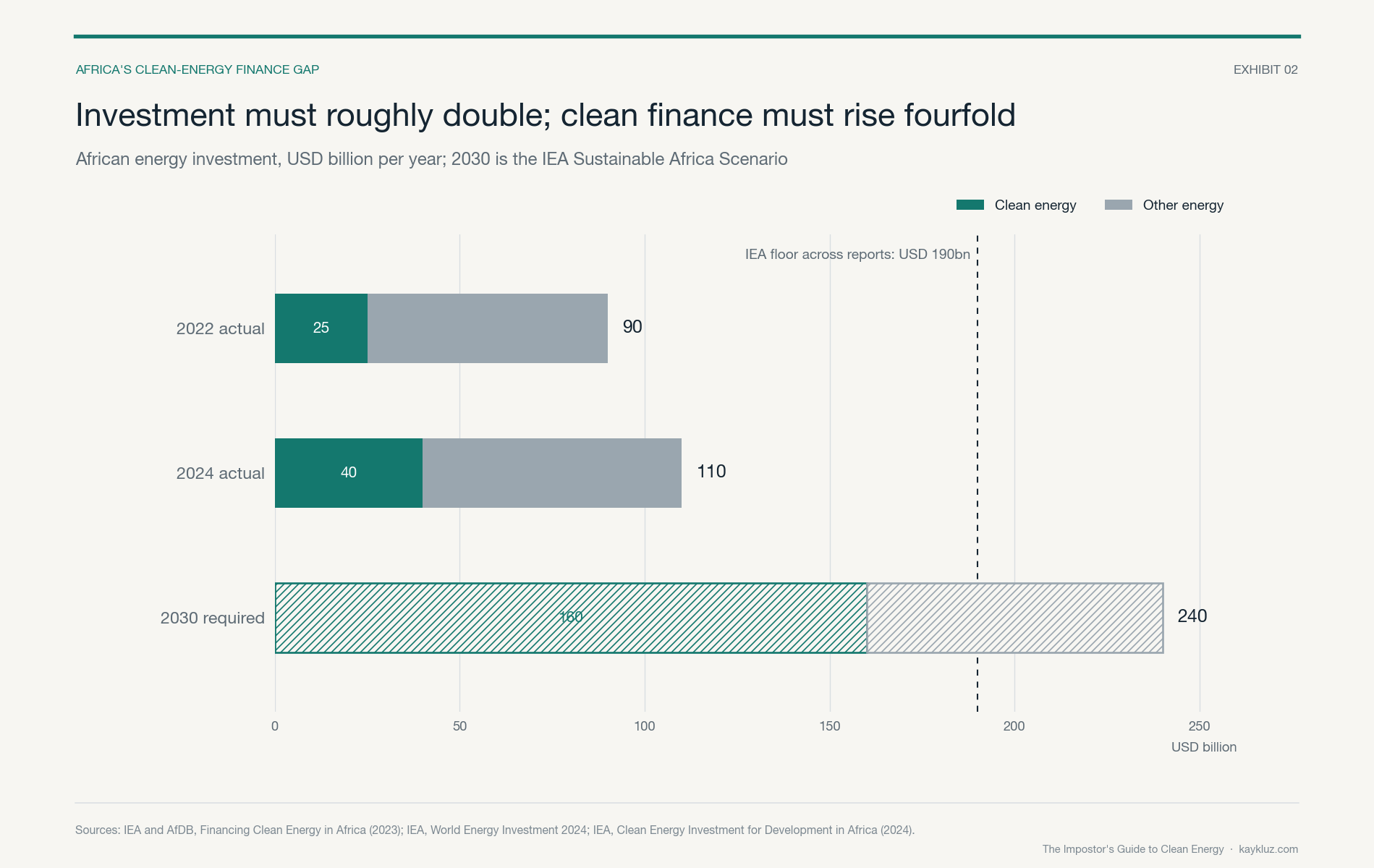
If you have read anything about African energy investment, you have seen a version of this sentence: investment must more than double, from around USD 100 billion a year to somewhere between USD 190 billion and USD 240 billion.
The sentence is true. The actual numbers to believe depend on what reference reports is used.
The IEA’s Africa Energy Outlook 2022 built the Sustainable Africa Scenario and set the original bar: over USD 190 billion each year from 2026 to 2030, with two-thirds going to clean energy.
It also produced my favourite underused statistic: in that scenario, energy investment rises to 6.1% of Africa’s GDP over 2026 to 2030. Pretty much a macroeconomic reorganisation.
The IEA and African Development Bank’s Financing Clean Energy in Africa (2023) restated the requirement as over USD 200 billion annually by 2030, against actual 2022 investment of under USD 90 billion, of which clean energy was roughly USD 25 billion. Do the arithmetic: two-thirds of USD 200 to 240 billion is about USD 130 to 160 billion of clean spending. From a USD 25 billion base, that is a five-to-sixfold increase. When you see “clean energy investment must rise sixfold” in a conference deck, this is where it comes from, usually without the working shown.
The IEA’s Clean Energy Investment for Development in Africa (2024) supplied the granular targets: total investment reaching almost USD 240 billion annually by 2030; electricity sector investment growing from just under USD 30 billion in 2022 to more than USD 120 billion in 2030; private capital growing 2.5 times, from around USD 75 billion to USD 190 billion.
And what actually happened?
The IEA’s World Energy Investment 2024 put actual African energy investment at roughly USD 110 billion, about USD 70 billion of it fossil and about USD 40 billion clean. So against a clean energy requirement of USD 130 to 160 billion a year by 2030, the continent is running at roughly a quarter of the destination, with four years left and the ramp not visibly ramping.
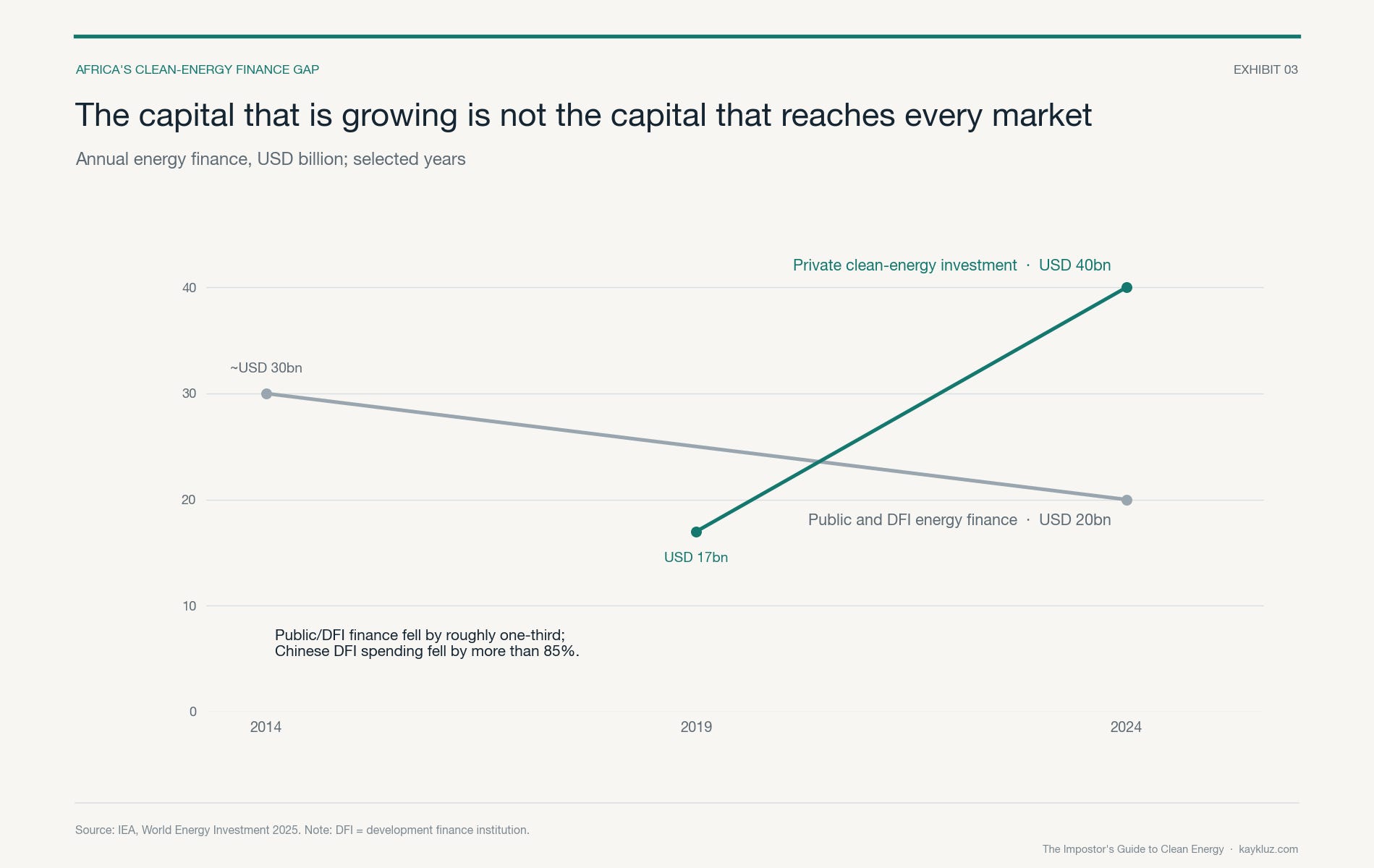
One genuinely encouraging line hides in the World Energy Investment 2025: private clean energy investment in Africa tripled from about USD 17 billion in 2019 to almost USD 40 billion in 2024. Private money is showing up. The problem is where the rest went. Public and development finance institution funding for African energy fell by roughly a third over the decade, to USD 20 billion in 2024, driven largely by a reduction of more than 85% in spending by Chinese DFIs. The capital that is growing chases the most bankable markets. The capital that reaches the hardest places is the capital in retreat.
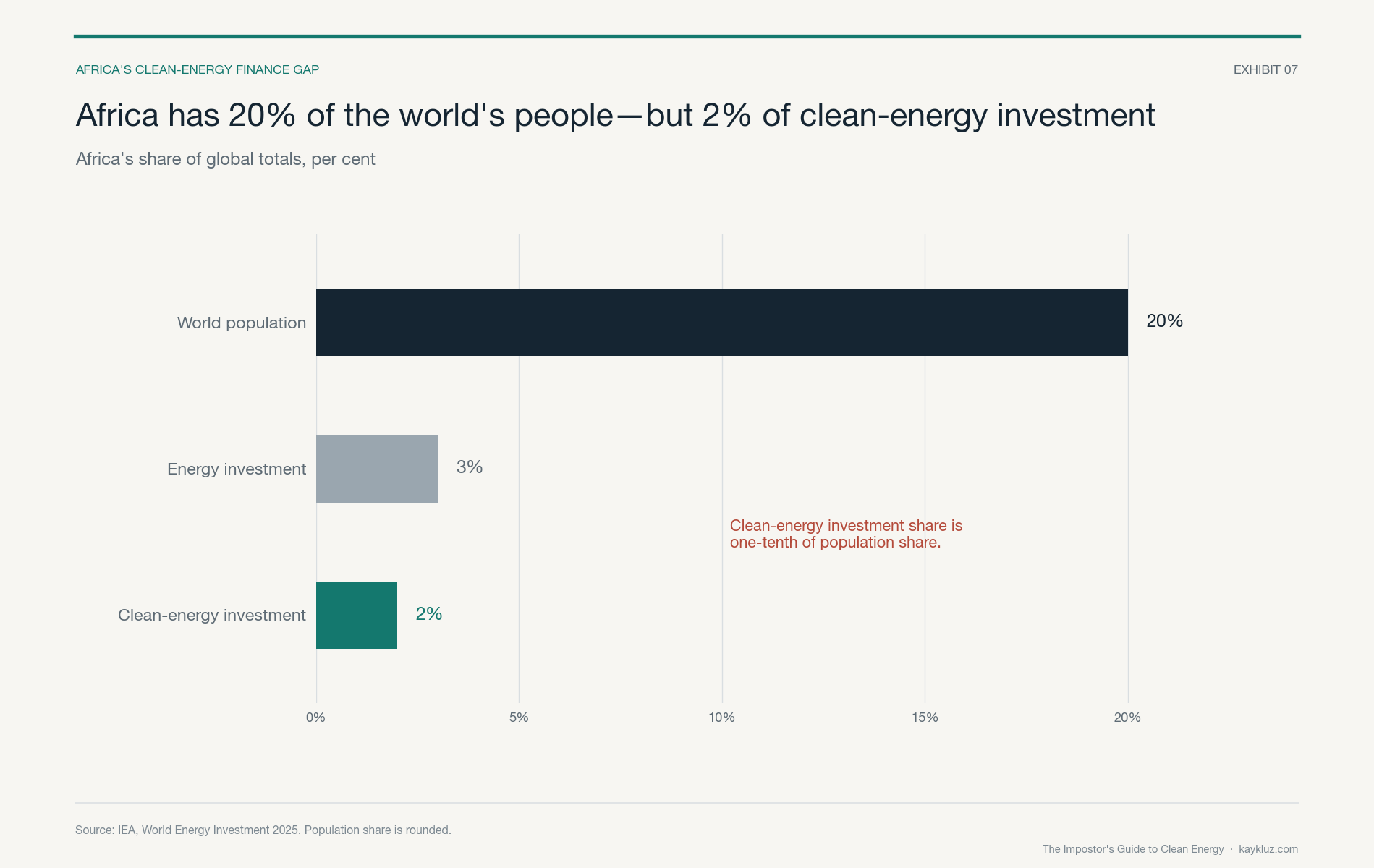
Africa, with about 20% of the world’s population, receives about 2% of global clean energy investment and about 3% of total energy investment. Two different denominators, routinely blurred in op-eds, kept separate here because I would like to still be quotable in five years.
Projects are slow, and the calendar knows it
The mechanism that turns “2030 target” into “2026 decision”, is a Gantt chart.
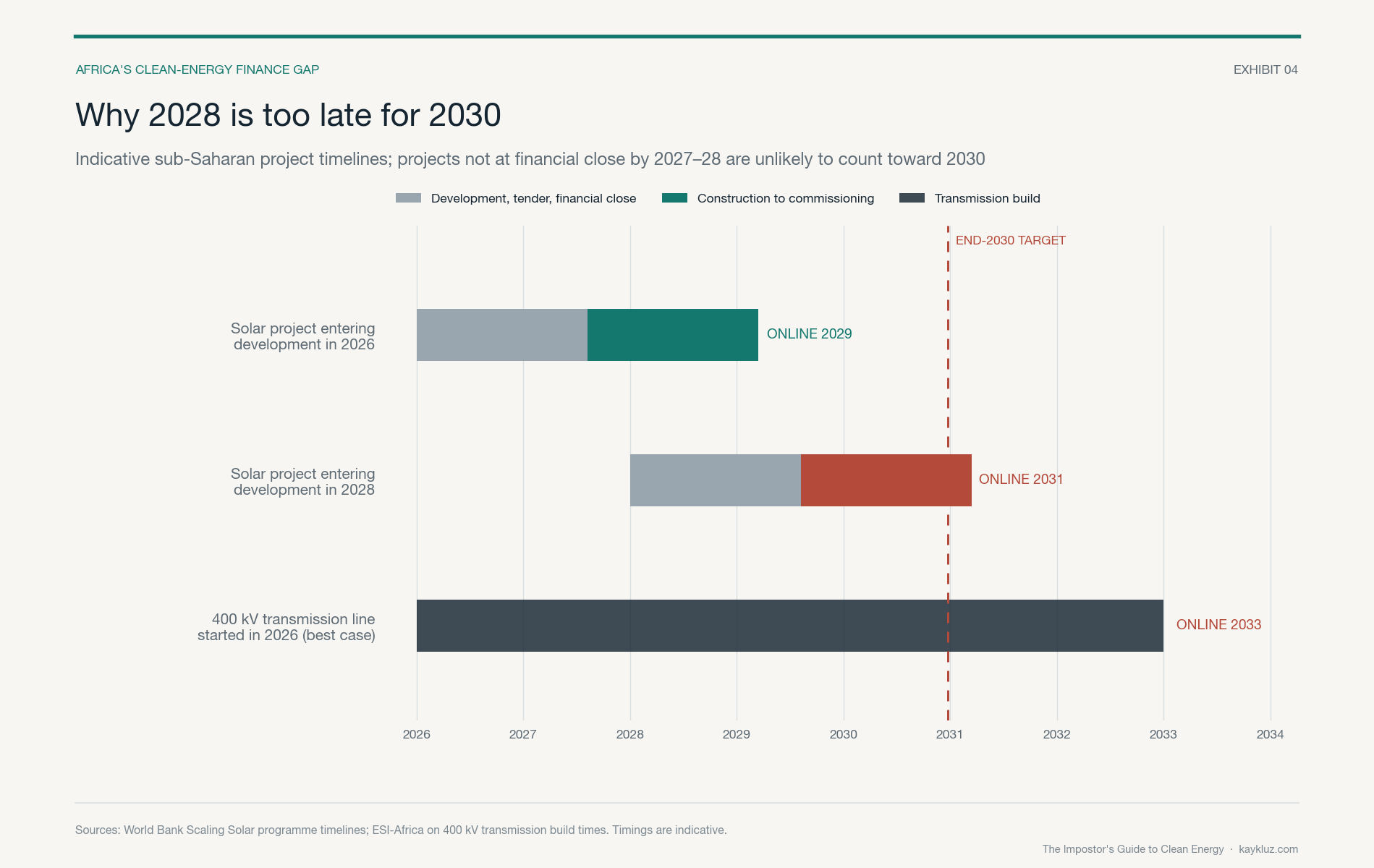
A utility-scale solar project in sub-Saharan Africa routinely takes well over a year from tender to financial close, and that is under the World Bank’s streamlined Scaling Solar programme, which exists specifically to make this faster. Ordinary projects take longer. I have watched projects take longer. I have, on at least two occasions, been the reason projects took longer, which I mention so you know I am critiquing the mirror as well as the market.
After financial close comes construction and commissioning, another one to two years for solar if everything goes well, which it will not, because something involving a customs official and a shipping container never goes well.
Transmission is worse. A 400 kV line takes up to seven years in a best case, and South Africa, the continent’s most sophisticated power market, is estimated to be roughly two decades behind on its transmission build. Kenya’s 310 MW Lake Turkana wind farm remains the canonical cautionary tale: the turbines stood finished while the 428 km Loiyangalani to Suswa line ran years late, and Kenyans paid for electricity that physically could not reach them.
Chain it together. A project that has not reached financial close by 2027, or generously 2028, will not be generating by December 2030. Which means every megawatt that counts toward the 2030 targets is being originated, negotiated, financed or abandoned right now, by identifiable people, in identifiable meeting rooms, some of which I am sitting in while writing this instead of paying attention.
That is why 2026 to 2030 is not just another five-year planning cycle. The 2030 scoreboard is being written in the present tense.
Let us concede 2030 now and get it over with
Having spent two sections building the window, I am now going to say the quiet part: the 2030 targets are almost certainly gone.
Tracking SDG7: The Energy Progress Report 2025 counted 666 million people without electricity in 2023, 85% of them in sub-Saharan Africa, and projects that on current trajectory 645 million will still lack power in 2030, with 1.8 billion people worldwide still without clean cooking. BloombergNEF’s own 2030 forecast for African wind and solar additions falls 43% short of the required build, and even the upper range of countries’ own targets misses by 35%. When the optimistic case misses by a third, the target is not in danger. The target is in the past tense.
So why write 3,000 words about a window onto a landscape that has already burned down?
Because the window was never really about the date. Missing 2030 while adding 4 GW a year and missing 2030 while adding 20 GW a year are entirely different civilisational outcomes. The first means entering the 2030s stalled: same access deficit, same institutional muscle memory, same pitch decks with the year find-and-replaced. The second means entering the 2030s compounding: auction programmes that work, offtakers that pay, transmission that exists, local banks that have seen a solar loan perform. Institutions and pipelines compound the way interest does, and 2026 to 2030 sets the base of the exponent.
I honestly think that this window does not decide whether Africa hits 2030. It decides the slope of everything after it.
The real constraint is the price of money
The strongest objection to this entire essay goes: the calendar is not the binding constraint, the cost of capital is, and no amount of window rhetoric changes a discount rate. I know this objection intimately because it is what I mutter in financial models at 1 a.m.
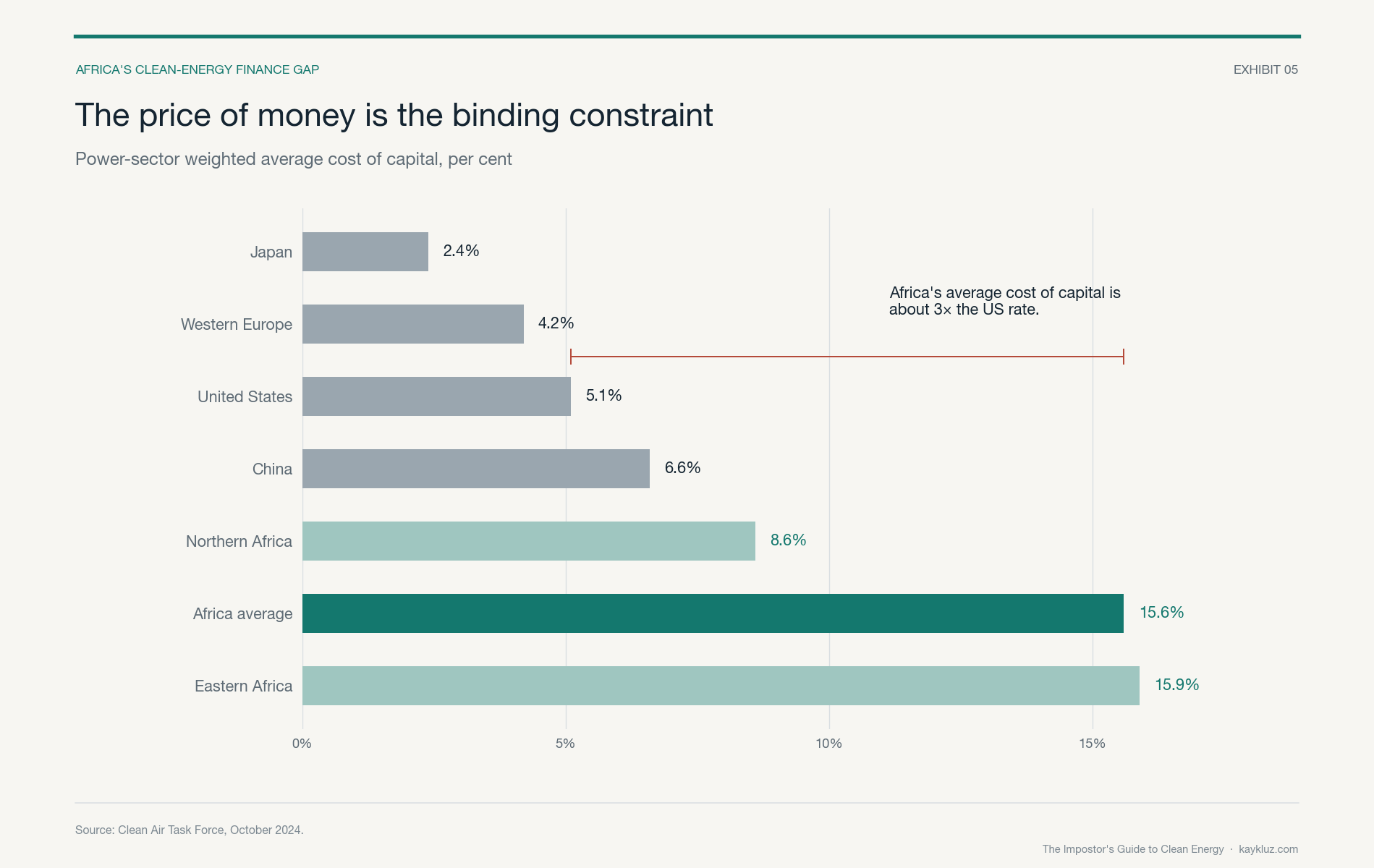
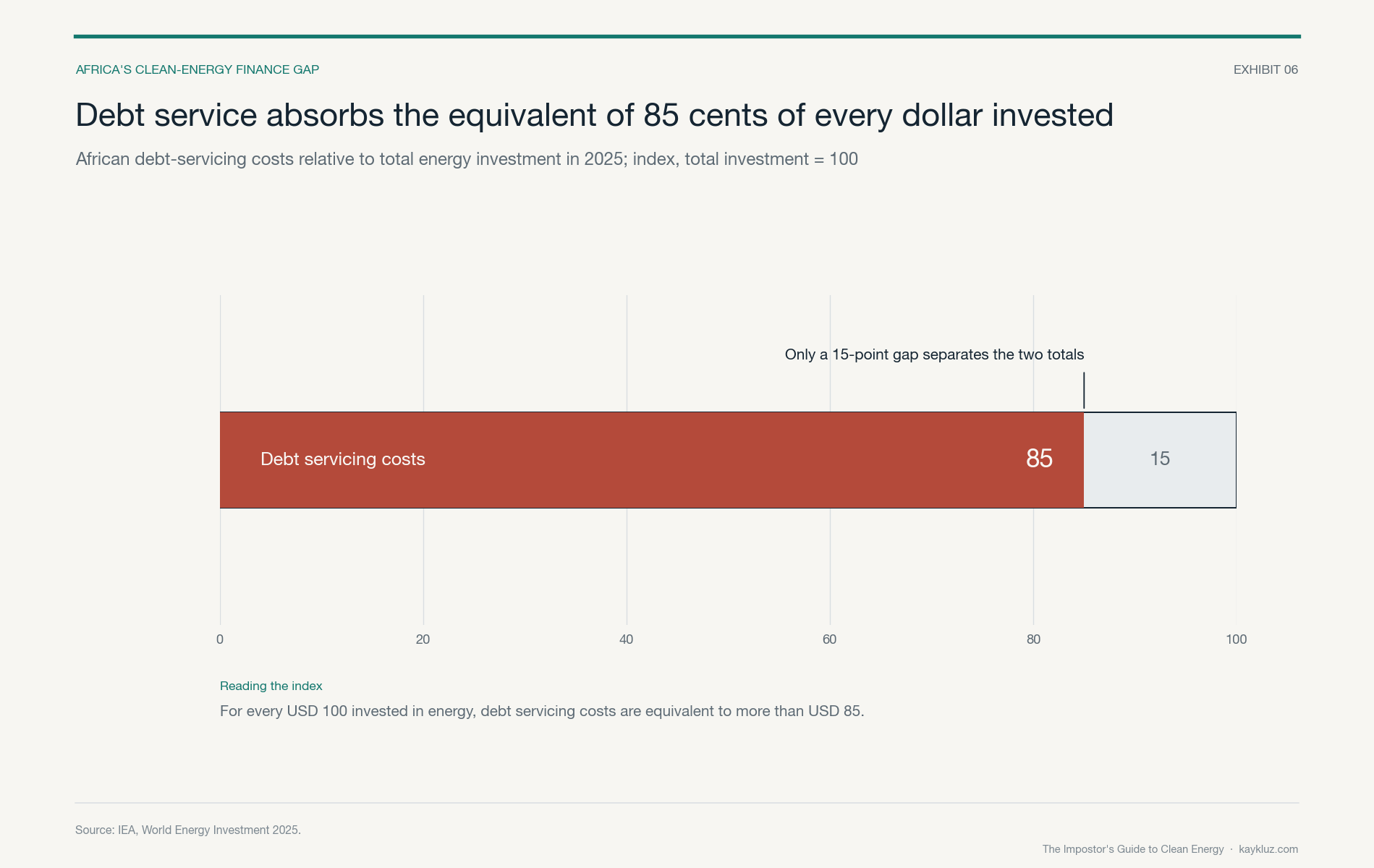
The numbers behind it are brutal. The Clean Air Task Force’s October 2024 analysis puts Africa’s average power sector weighted average cost of capital at 15.6%, more than three times the 2 to 5% typical of Western Europe and the United States (their breakdown: 2.4% in Japan, 4.2% in Western Europe, 5.1% in the US, 6.6% in China). The IEA has separately estimated African power WACC above 18% in 2023. And the IEA’s World Energy Investment 2025 contains the single most quietly devastating sentence in the whole literature: in Africa, overall debt servicing costs are equivalent to over 85% of total energy investment in 2025.
Read that again. For every dollar the continent invests in energy, it pays roughly 85 cents servicing existing debt. The panels are cheap. The money is not.
Cost of capital is not weather. It is the output of decisions: sovereign guarantees, currency frameworks, concessional blending, offtaker reform, DFI risk appetite. Financing Clean Energy in Africa (2023) estimated that about USD 28 billion a year of concessional capital could mobilise USD 90 billion of private clean energy investment by 2030, a more than tenfold increase on current concessional flows. Whether that concessional capital materialises is being decided in exactly this window: in Mission 300 country compacts, in the direction of EU Global Gateway, in whatever replaces the American development finance apparatus, of which more shortly.
The calendar and the cost of capital are not competing explanations. The window is when the cost of capital gets decided.
Waiting will not get cheaper
The second objection is the patient one: solar keeps getting cheaper, so a project built in 2032 beats one built in 2027, and the window is just impatience with a deadline attached.
This argument had a good decade. It just ended.
Solar modules bottomed at USD 0.07 to 0.09 per watt in 2024 and early 2025, an absurd, historic low. Then China withdrew its solar export VAT rebate and Wood Mackenzie tracked module prices rising roughly 9% in late 2025. SolarPower Europe’s Global Solar Market Outlook 2026 to 2030 forecasts global installations declining 8% in 2026 to 612 GW, after a record 664 GW in 2025: the first contraction in more than twenty years, led by a 24% drop in China.
The great deflation is over, or at least on pause. Meanwhile the thing that actually determines African project economics, the 15.6% cost of capital, does not fall while you wait. It compounds against you. A country that waits five years does not collect cheaper panels. It collects five more years of diesel imports, five more years of 85 cents on the dollar to creditors, and the same financing penalty at the end of it.
Waiting was never free. Now it is not even cheap.
The leapfrog has a weight limit
Every essay in this genre is legally required to mention mobile money, so let us do it properly and then put it down.
Yes, Africa skipped fixed-line telephony and built M-Pesa. Yes, there is a real energy version of this: Afrobarometer’s 34-country survey finds 23% of households using electricity from a source other than the national grid, 16% relying on off-grid sources alone, mostly solar. At the household level, the leapfrog is not a metaphor. It is happening in several hundred million living rooms.
But a 2024 paper in Science on technology leapfrogging in Africa states the limit plainly: off-grid solar can leapfrog the grid for lighting and phone charging, but it cannot leapfrog the massive generation and grid investment needed to power a growing economy. A phone call needs milliwatts. A cement kiln does not care how inspiring your fintech comparison is.
So the greenfield advantage is real but bounded. Africa can absolutely deploy AI-native grid management, smart metering and distributed architecture without ripping out legacy systems, because in much of the continent there is mercifully little legacy to rip out. What it cannot do is app-store its way past transmission lines and baseload. The leapfrog carries households. Industry still needs the boring, slow, seven-year infrastructure, which is precisely the infrastructure whose 2030s existence is being decided in this window.
The window is a decision interval
If the window were merely a countdown, this essay would be a eulogy. It is not, because the defining feature of 2026 to 2030 is how much of it is being actively, visibly decided by named actors, in both directions at once.
On the ledger’s good side: Mission 300, launched by the World Bank and AfDB, targets 300 million new connections by 2030. In January 2025, thirty African heads of state endorsed the Dar es Salaam Energy Declaration, with 48 countries eventually signing on and partners pledging more than USD 50 billion. By mid-2026 the AfDB reported over 50 million people connected across 40 countries. The World Bank has committed roughly USD 30 billion for African energy through 2030, nearly double its historic pace. These are the largest coordinated electrification commitments in the continent’s history, and they were made inside this window.
On the ledger’s other side: USAID, and with it Power Africa, was effectively terminated in early 2025. Power Africa had brought roughly 12,000 MW to financial close and mobilised about USD 22 billion since 2013. Germany, France and the UK have cut development budgets. Chinese DFI energy lending is down more than 85%. The concessional layer that the whole USD 28 billion mobilisation arithmetic depends on is being dismantled and rebuilt simultaneously, live, by people with calendars and elections.
That is what makes this a decision interval rather than a countdown clock. Countdown clocks run whether you watch them or not. This window is made entirely of choices: a regulator gazetting a tariff methodology, a DFI board approving a guarantee facility, a finance ministry choosing which compact to actually implement, a developer choosing to reach financial close in 2027 instead of writing a strategy document about 2035.
The next four years will not decide whether Africa hits its 2030 targets. That question has quietly answered itself.
They will decide whether the 2030s begin with momentum or with a rebrand of the same deficit. And unlike the targets, that outcome is still entirely for sale.
P.S. Honest disclosures, as always. The “quarter of the destination” and trajectory arithmetic in this piece are my own calculations from IEA figures, not IEA findings; the underlying numbers span report vintages from 2022 to 2026, and the IEA has an endearing habit of restating the same requirement as USD 190 billion, USD 200 billion and USD 240 billion depending on the framing, so I have cited each figure to its specific report and you should too. My maths might be wrong. It has been before. Check it.
P.P.S. A confession. I started researching this essay to prove the window thesis was airtight, and the evidence kept politely informing me that the thesis was right but the deadline was dead. I have chosen to publish the version the data supports rather than the version I pitched myself, which my MBA professors would call intellectual honesty and my inner impostor calls losing an argument to a spreadsheet.
P.P.P.S. If you think I am wrong, and in particular if you think 2035 is the honest deadline and this whole window framing is consultant theatre, I genuinely want to hear it. The comments are open and I respond to everything, usually at hours that concern my family.
P.P.P.P.S. If this was useful, subscribe, and forward it to the one person you know who still has “300 GW by 2030” in a live slide deck. They need this more than either of us.
P.P.P.P.P.S. Next up: the Africa Energy Software Map goes live, and possibly a new short-form section for those of you who have complained, with some justification, that my essays are too long. Still not your lawyer.